Blog
9 Panel Drug Test: What It Tests for and Why It Matters


TL;DR:
- A 9 panel drug test screens for nine drug classes, including THC, cocaine, opiates, PCP, and others, using urine specimens. Confirmation of positive results with mass spectrometry is essential for legal and employment decisions, as immunoassays can produce false positives. The ninth analyte varies by lab, so it is important to verify specific panel components before testing.
A standard 9 panel drug test screens for nine drug classes: cannabinoids (THC), cocaine, opiates, phencyclidine (PCP), amphetamines, MDMA, barbiturates, benzodiazepines, and methadone, with the ninth slot often occupied by propoxyphene or another analyte depending on the lab’s panel configuration. According to ARUP Laboratories, its Drug Panel 9 includes all of those classes with defined immunoassay cutoffs for each. The ninth analyte is not universal — Quest Diagnostics notes that vendors may substitute propoxyphene, methaqualone, or another compound, so always confirm the component list with your specific lab before ordering.
Here are the nine substances a 9 panel test typically covers:
- Cannabinoids (THC/marijuana)
- Cocaine
- Opiates (morphine, codeine, heroin metabolite 6-AM)
- Phencyclidine (PCP)
- Amphetamines (including methamphetamine)
- MDMA (ecstasy/molly)
- Barbiturates
- Benzodiazepines
- Methadone (with propoxyphene as the common ninth variant)
Table of Contents
- What each drug class on a 9 panel test actually means
- What specimen does a 9 panel test require?
- How a 9 panel drug test actually works
- Typical detection windows for each drug class
- Who uses a 9 panel test and why
- What can affect your 9 panel test results
- Specimen storage and stability for urine samples
- What your results mean and what happens next
- Key Takeaways
- The part most guides skip over
- Where to find accurate panel and cutoff information
- Rapidtestcup has the supplies your program needs
What each drug class on a 9 panel test actually means
Understanding the label on lab paperwork is half the battle. Here is what each drug class covers in plain terms.
- Cannabinoids (THC): The lab detects THC-COOH, the primary urinary metabolite of delta-9 THC. Standard immunoassays do not distinguish delta-8 from delta-9 THC, so delta-8 products can trigger a positive. CBD alone typically does not, but contaminated CBD products sometimes contain enough THC to cross the cutoff.
- Cocaine: The test targets benzoylecgonine, cocaine’s main metabolite. Cocaine itself clears blood quickly; the metabolite lingers in urine for days.
- Opiates: This class covers morphine, codeine, and the heroin-specific metabolite 6-monoacetylmorphine (6-AM). Hydrocodone and oxycodone are sometimes listed separately or may fall below the opiate cutoff — check whether your panel specifies them individually.
- Phencyclidine (PCP): Screens for PCP itself, sometimes called “angel dust.” Cross-reactivity with certain antihistamines and dextromethorphan (found in cough syrup) is a documented source of false positives.
- Amphetamines: Covers amphetamine and methamphetamine, including prescription drugs like Adderall and Vyvanse. Pseudoephedrine in decongestants can cross-react at high doses.
- MDMA: Listed separately on many panels, though some labs fold it under the amphetamine class. If MDMA detection matters for your program, confirm it has its own cutoff rather than relying on the amphetamine screen alone.
- Barbiturates: Includes phenobarbital, butalbital (found in some migraine medications), and secobarbital. These sedatives are less commonly prescribed today but still appear in clinical and forensic contexts.
- Benzodiazepines: Covers diazepam (Valium), alprazolam (Xanax), lorazepam (Ativan), clonazepam (Klonopin), and related compounds. Detection varies by specific benzodiazepine because immunoassays are optimized around oxazepam as the reference metabolite.
- Methadone / Propoxyphene: Methadone is always included; propoxyphene (brand name Darvocet, now withdrawn from the US market) is the most common ninth analyte, though some vendors substitute methaqualone or another opioid.
Pro Tip: Employers and clinicians often step up from a 5 panel to a 9 panel specifically to capture benzodiazepines and barbiturates. The DOT 5 panel does not include either class, which leaves a real gap for safety-sensitive roles where sedative misuse is a concern.
What specimen does a 9 panel test require?
Urine is the standard specimen for a 9 panel drug test. It balances cost, ease of collection, and reliable metabolite detection in a way no other matrix matches for routine workplace or clinical screening. Most collection sites require a minimum volume, with some labs preferring a higher volume for full 9 panel workflows that include reflex confirmation.
Alternative specimen types exist and serve specific purposes:
- Hair / fingernail: Detects drug use over a longer window (up to 90 days for hair), useful for historical exposure rather than recent use. More expensive and requires a certified lab; not standard for most workplace programs.
- Oral fluid (saliva): Shorter detection window (typically 24–48 hours), reflects very recent use, and is harder to adulterate. Increasingly used for post-accident and reasonable-suspicion testing where recency matters.
- Sweat patch: Worn for days to weeks, captures cumulative exposure. Used mainly in treatment monitoring and probation settings.
For most employers, clinicians, and treatment programs, urine remains the default because it offers the widest detection window at the lowest cost per test. Proper specimen collection practices — temperature checks, chain-of-custody documentation, and correct labeling — matter as much as the specimen type itself.
How a 9 panel drug test actually works
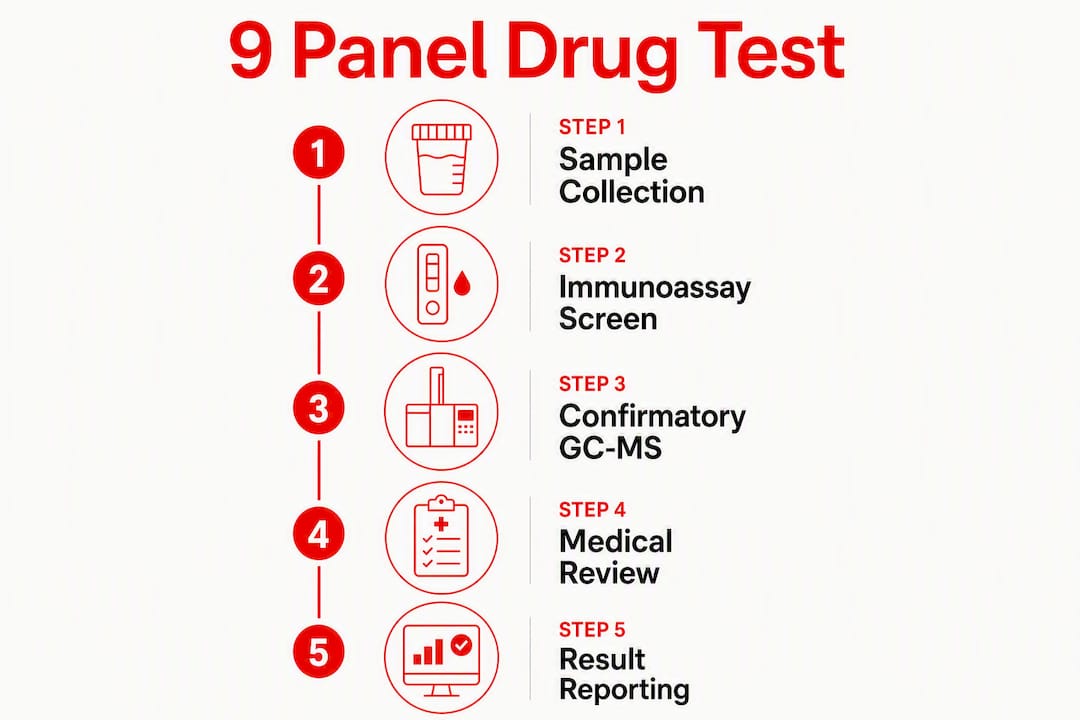
The lab runs two distinct steps, and understanding both matters if you ever need to challenge or interpret a result.
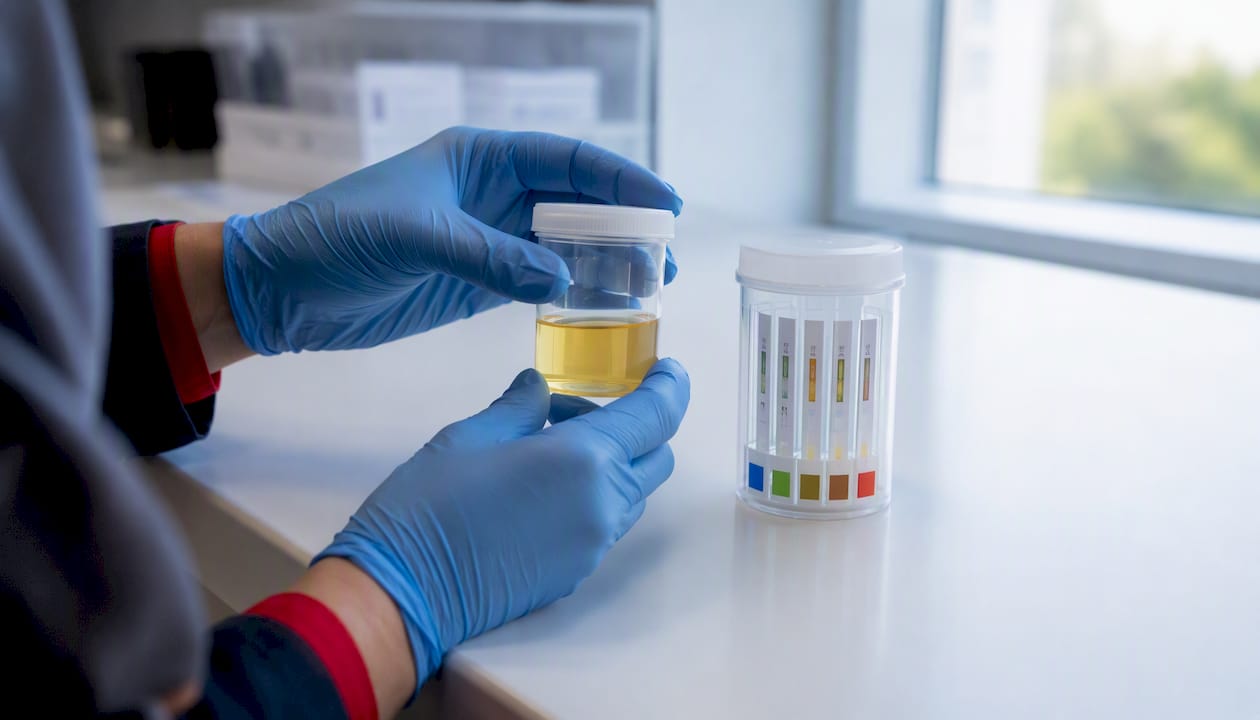
Step 1 — Immunoassay screen: The urine sample is first tested with an immunoassay, a rapid antibody-based method that produces a presumptive positive or negative for each drug class. This step is fast and inexpensive, which is why it is used for initial screening. A positive immunoassay result is not a confirmed finding; it is a flag that triggers the next step.
Step 2 — Confirmatory testing: ARUP Laboratories confirms that a positive immunoassay screen should be reflexed to mass spectrometry — either gas chromatography/mass spectrometry (GC-MS) or liquid chromatography-tandem mass spectrometry (LC-MS/MS) — before a final positive is reported. These methods identify and quantify the specific compound present, not just the drug class. Confirmation is required for any employment or legal action because immunoassays can cross-react with legal medications and supplements.
Why does urine detect metabolites rather than the parent drug? Because the body breaks drugs down before excreting them. Metabolite detection in urine extends the window of detectable exposure well beyond what a blood test would show — which is exactly why urine is preferred for most screening programs.
Key fact: Reflex confirmation by GC-MS or LC-MS/MS is the laboratory standard that converts a presumptive screen into a legally defensible result.
Typical detection windows for each drug class
Detection windows are estimates. Frequency of use, body mass, metabolic rate, hydration, and the lab’s specific cutoff all shift the window for any individual. The table below reflects typical urine detection ranges under standard cutoffs.
| Drug class | Typical urine detection window | Metabolite or parent detected | Notes on variability |
|---|---|---|---|
| Cannabinoids (THC) | 3 days | THC-COOH (metabolite) | 3–4 days for single use |
| Cocaine | 2–4 days | Benzoylecgonine (metabolite) | Shorter in casual users; crack cocaine clears similarly |
| Opiates | 2–4 days | Morphine/codeine/6-AM (metabolites) | 6-AM (heroin marker) clears in 6–24 hours |
| PCP | 7 days | PCP (parent and metabolites) | Longer in heavy users |
| Amphetamines | 2–4 days | Amphetamine/methamphetamine | Urinary pH affects excretion rate |
| MDMA | 2–4 days | MDMA and MDA (metabolites) | Similar window to amphetamines |
| Barbiturates | 2 days | Metabolites (drug-dependent) | Short-acting (secobarbital) clears faster than long-acting (phenobarbital) |
| Benzodiazepines | 2–7 days (short-acting) | Metabolites | Diazepam and clonazepam have long-acting metabolites |
| Methadone | 3–7 days | EDDP (metabolite) | Stable window; dose-dependent |
| Propoxyphene | 6–48 hours | Norpropoxyphene (metabolite) | Rapid clearance; timing of collection matters |
Disclaimer: These windows are approximate. Individual results can fall outside these ranges based on lab cutoffs, specimen dilution, and personal metabolism. For substance-specific detection guidance, consult the ordering lab’s test directory.
Who uses a 9 panel test and why
The 9 panel sits between the DOT-mandated 5 panel and larger 10 or 12 panel screens, which makes it a practical choice for organizations that need broader coverage without the cost of a full extended panel.
Employers choose the 9 panel as a middle-ground screen that captures commonly misused prescription sedatives and opioids the DOT 5 panel excludes. The DOT 5 panel covers THC, cocaine, opiates, PCP, and amphetamines only — no benzodiazepines, no barbiturates, no methadone. For industries outside DOT jurisdiction, that gap is significant.
Common use cases include:
- Pre-employment screening: Baseline testing before hiring, especially in safety-sensitive roles.
- Reasonable suspicion: When a supervisor observes behavior suggesting impairment.
- Post-accident: Required or recommended after a workplace incident.
- Return-to-duty: Confirming abstinence after a prior positive result.
- Treatment monitoring: Substance abuse treatment centers use 9 panel screens to track compliance and detect relapse.
- Court and probation: Drug courts and probation programs use it when the defendant’s substance history includes sedatives or opioids beyond what a 5 panel covers.
Panel choice is ultimately a risk-management decision. A construction company with OSHA obligations has different needs than a treatment center monitoring a patient on buprenorphine — and the 9 panel’s component list should match the program’s specific risk profile.
What can affect your 9 panel test results
Results are not always straightforward, and knowing what can alter them protects both the person being tested and the organization relying on the result.
Common causes of false positives:
- Ibuprofen and naproxen at high doses have historically cross-reacted with cannabinoid immunoassays (less common with modern assays but still possible).
- Dextromethorphan (cough syrup) can trigger a PCP false positive.
- Certain antihistamines and decongestants cross-react with amphetamine assays.
- Poppy seeds contain trace morphine and codeine and can produce opiate positives at low cutoffs.
- Quinolone antibiotics have been associated with opiate false positives.
Common causes of false negatives:
- Dilution: drinking large amounts of water before a test lowers creatinine and specific gravity, which labs check. Diluted samples are flagged and often require a retest or are treated as a policy-based fail.
- Adulteration: adding bleach, vinegar, or commercial adulterants to the sample. Labs test for pH, oxidants, and other markers to detect tampering.
- Timing: collecting a sample outside the detection window for a short-lived compound like 6-AM.
Before your test:
- Disclose all current prescriptions to the Medical Review Officer (MRO), not the collection site staff.
- Avoid extreme hydration in the hours before collection.
- Do not use unprescribed substances, including OTC products that contain cross-reactive compounds, in the days before testing.
Pro Tip: Bring your prescription bottle or a letter from your prescribing physician to the collection appointment. The MRO will need documentation to verify a legitimate medical explanation for a confirmed positive. Disclosing after the fact is harder and less credible.
Specimen storage and stability for urine samples
Proper handling between collection and analysis preserves the integrity of the result. Urine has a limited stability window that varies with storage temperature, lasting several days at room temperature and refrigerated, and longer when frozen, based on Quest Diagnostics’ test directory guidance for random urine specimens.
Key handling rules:
- Minimum volume: Most 9 panel urine tests require at least 25 mL as a minimum volume; some labs, including Quest Diagnostics, prefer 60 mL for workflows that include reflex confirmation.
- Reject criteria: Labs reject specimens that contain preservatives or fall below minimum volume. Never add anything to the collection cup.
- Temperature check at collection: The specimen temperature should read 90–100°F within four minutes of collection. Outside that range, the collector must note a possible substitution or adulteration.
- Chain of custody: Every transfer of the specimen must be documented. A broken chain of custody can invalidate a confirmed positive in a legal or employment proceeding.
- Prompt transport: Refrigerate specimens that cannot reach the lab within 24 hours. Freeze if transport will exceed the refrigerated stability window.
Stability reminder: Room-temperature stability is approximately 5 days; refrigerated is approximately 7 days. Specimens held longer than these windows without freezing risk degradation of labile metabolites like 6-AM.
What your results mean and what happens next
A result from a 9 panel screen falls into one of three categories, and each triggers a different process.
Negative: No drug class exceeded the cutoff. For employment purposes, this is a reportable negative and no further action is required. A negative screen does not confirm zero drug use — it means concentrations were below the detection threshold.
Screen positive (presumptive positive): The immunoassay flagged one or more drug classes above the cutoff. This is not a confirmed result. The lab reflexes the specimen to GC-MS or LC-MS/MS confirmation before reporting a final positive. No employment or legal action should be taken on a screen-positive alone.
Confirmed positive: Mass spectrometry identified and quantified the specific compound. This is the result that carries legal and employment weight.
Inconclusive / invalid: Specimen was diluted, adulterated, or substituted. The collector or lab flags it and typically requires a retest under direct observation.
Typical next steps after a confirmed positive:
- The lab reports the confirmed positive to the MRO.
- The MRO contacts the tested individual to ask about legitimate medical explanations (prescriptions, medical procedures).
- If a valid explanation exists and documentation supports it, the MRO may report the result as negative to the employer.
- If no valid explanation exists, the MRO reports a confirmed positive to the employer or program.
- The employer or program follows its written policy: suspension, termination, treatment referral, or retest after a waiting period.
- The individual may request a split-specimen retest at a certified lab if a split was collected.
The MRO is the critical checkpoint between a lab result and a consequential decision. Tested individuals should always respond to MRO contact promptly and provide documentation for any relevant prescriptions.
Key Takeaways
A 9 panel drug test screens for nine drug classes in urine using an immunoassay screen followed by GC-MS or LC-MS/MS confirmation for any presumptive positive, with the ninth analyte varying by vendor.
| Point | Details |
|---|---|
| Nine drug classes | THC, cocaine, opiates, PCP, amphetamines, MDMA, barbiturates, benzodiazepines, and methadone/propoxyphene. |
| Urine is standard | Minimum 25 mL required for most 9-panel urine tests, with some labs preferring up to 60 mL for full workflows; room temperature stability is approximately 5 days, refrigerated approximately 7 days. |
| Confirmation is required | Screen positives trigger GC-MS or LC-MS/MS reflex testing before any employment or legal action. |
| Ninth analyte varies | Always verify the lab’s component list — propoxyphene, methaqualone, or another analyte may occupy the ninth slot. |
| Rapidtestcup supplies the tools | Rapidtestcup offers multi-panel test cups and specimen collection supplies for labs, clinics, and employers running 9 panel programs. |
The part most guides skip over
Most explainers on 9 panel tests focus on listing the nine substances and leave it there. What they underplay is the gap between a screen result and a defensible result — and that gap is where real problems happen.
Organizations that act on a presumptive positive without waiting for GC-MS confirmation expose themselves to wrongful termination claims. Individuals who assume a positive screen is final sometimes fail to contact the MRO with legitimate prescription documentation, losing their only real avenue to reverse the result. Both mistakes are common, and both are avoidable.
The other thing worth saying plainly: the “9 panel” label does not guarantee a fixed set of substances. Procurement teams and HR managers who order a 9 panel from one vendor and assume it matches what another lab runs are taking a risk. If your program needs to detect a specific analyte — say, propoxyphene for a patient population, or methaqualone for a forensic case — verify the component list in writing before you order. The label is a shorthand, not a contract.
Where to find accurate panel and cutoff information
When you need to verify exact components, cutoffs, or specimen requirements for a specific lab’s 9 panel test, go directly to the source:
- Lab test directories: ARUP Laboratories’ test directory (ltd.aruplab.com) and Quest Diagnostics’ test directory (testdirectory.questdiagnostics.com) list exact analytes, cutoffs, specimen volumes, and reject criteria for their specific panels. Use these for procurement and policy decisions.
- SAMHSA certified lab list: The Substance Abuse and Mental Health Services Administration publishes a list of federally certified laboratories for workplace drug testing — useful for confirming a lab’s certification status.
- ARUP educational resources: ARUP’s clinical education materials (arup.utah.edu) cover interpretation guidance, metabolite science, and collection protocols for lab and clinical staff.
- Your MRO or lab account representative: For program-specific questions about cutoffs, reflex criteria, or panel customization, the MRO or lab rep is the fastest and most accurate source.
Never rely on a generic web explainer — including this one — as the definitive source for cutoffs or component lists. Lab-specific directories are the authoritative reference.
Rapidtestcup has the supplies your program needs
If you are running a 9 panel program — or considering stepping up to broader coverage — the cost and quality of your collection supplies matter more than most buyers realize. Rapidtestcup stocks CLIA waived, FDA-approved multi-panel test cups and urine specimen cups built for professional workflows, with bulk pricing that makes high-volume programs sustainable.
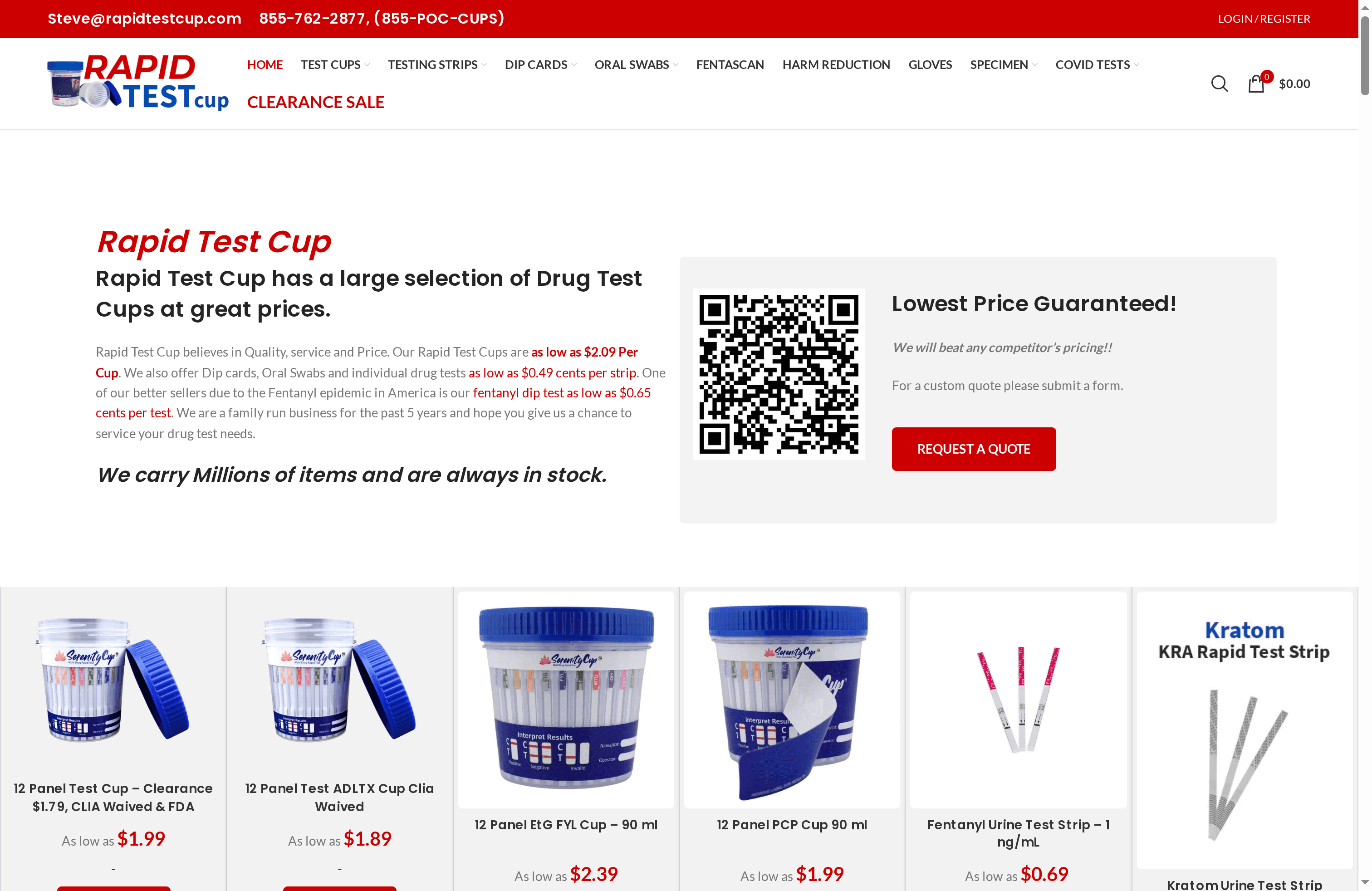
For organizations that need more than nine panels, Rapidtestcup carries expanded options including 12 panel test cups and higher-panel configurations with built-in adulterant detection. Every product ships fast, and bulk orders qualify for volume discounts. Whether you are equipping a treatment center, an HR department, or a forensic collection site, the catalog covers what you need at a price that holds up at scale. Browse the full product range at rapidtestcup.com and request a custom quote for large orders.