Blog
How Collection Methods Shape Drug Test Validity


The specimen collection method you choose determines three things that matter most in drug testing: the detection window, the legal defensibility of the result, and whether the specimen survives intact from donor to lab. Get the method wrong and even a perfectly analyzed sample can be thrown out in court, rejected by an MRO, or simply miss the substance you were looking for. The role of collection methods in drug testing is not a procedural formality — it is the foundation the entire program rests on.
Three points drive every decision:
- Detection window: Urine catches use from the past several days; oral fluid catches the past 24–72 hours; hair reaches back 90 days or more. Match the matrix to the investigative timeline.
- Chain-of-custody and legal defensibility: A specimen collected without a signed Federal CCF, proper sealing, or documented temperature check can be challenged and excluded regardless of what the lab finds.
- Anti-adulteration and operational feasibility: Some matrices are far harder to adulterate than others; some require private restrooms, others do not. Operational context shapes which method is realistic.
Where federal regulations apply — DOT safety-sensitive employees, federally mandated workplace programs — follow SAMHSA’s Mandatory Guidelines (OFMG/UrMG) and 49 CFR Part 40 without exception.
Key Takeaways
The collection method you choose determines whether a drug test result is usable, legally defensible, and capable of detecting the substance within the relevant timeframe — no downstream lab work can fix a compromised collection.
| Point | Details |
|---|---|
| Match matrix to goal | Use urine for standard screening, oral fluid for recent use, hair for 90-day history, blood for quantification. |
| Enforce collector training | Collectors must know Federal CCF requirements, temperature checks, and when direct observation is required. |
| Document every step | Signed CCF, temperature readings, seal initials, and courier handoff records are the legal record of the collection. |
| Layer anti-adulteration controls | Temperature strips, adulterant checks, tamper-evident seals, and split specimens together reduce successful tampering. |
| Rapidtestcup for compliant supplies | Multi-panel cups with adulterant detection and temperature strips are available with bulk pricing and fast shipping. |
Table of Contents
- What role do collection methods play across specimen matrices?
- Who is the collector, and what does U.S. law require of them?
- How do you run a compliant urine collection?
- When should you use oral fluid instead of urine?
- Hair, blood, sweat, and nails: when do they make sense?
- How do you protect specimens from adulteration and substitution?
- How do you choose the right collection method for your program?
- What supplies do you need for a compliant collection?
- What documentation survives an audit or legal challenge?
- The program mistakes that cost programs the most
- Rapidtestcup supplies built for compliant programs
- Sources
What role do collection methods play across specimen matrices?
Understanding the importance of collection techniques starts with knowing what each matrix can and cannot do. The six primary matrices used in U.S. drug testing programs each serve a distinct purpose.
Urine is the workhorse: high analyte concentrations, well-established cutoffs, and a detection window of roughly 1–7 days for most substances (longer for heavy cannabis use). It is the only matrix currently accepted for all federally regulated workplace programs. The tradeoff is vulnerability to adulteration and the need for a private collection space.
Oral fluid detects very recent use, typically within 24–72 hours, making it the preferred matrix for post-accident and reasonable-suspicion testing where impairment at the time of the incident matters. No restroom required, and direct observation is straightforward.
Hair offers a 90-day retrospective window and is difficult to adulterate, but it cannot detect very recent use (roughly the past 7 days), and cosmetic treatments can affect results.
Blood provides the most accurate quantification and is standard in clinical and forensic settings, but its detection window is short, collection is invasive, and it requires trained phlebotomy staff.
Sweat patches monitor continuous use over days to weeks and are used in probation and treatment monitoring programs. They require proper skin preparation and are susceptible to environmental contamination.
Nails (fingernail or toenail clippings) offer a very long retrospective window, up to 12 months, and are increasingly used in forensic and child welfare investigations. Collection is simple but lab turnaround is slow and reference ranges are still maturing.
| Matrix | Typical Detection Window | Best Use Case | Key Limitation |
|---|---|---|---|
| Urine | 1–7 days (substance-dependent) | Federal workplace, routine screening | Adulteration risk; privacy needed |
| Oral fluid | 24–72 hours | Post-accident, reasonable suspicion | Lower analyte concentrations |
| Hair | Up to 90 days | Long-term exposure, forensic history | Cannot detect very recent use |
| Blood | Hours to 1–2 days | Clinical, ER, forensic quantification | Invasive; short window |
| Sweat | Days to weeks (patch wear) | Probation, treatment monitoring | Environmental contamination risk |
| Nails | Months to ~12 months | Forensic, child welfare | Slow turnaround; maturing reference ranges |
Oral fluid analyte concentrations run significantly lower than those in urine for the same substance, which is why oral fluid requires HHS-certified lab confirmation and why onsite screening cutoffs differ from urine cutoffs.
Who is the collector, and what does U.S. law require of them?
The collector is the single most critical control point in any drug testing program. A flawless lab analysis means nothing if the specimen was collected without proper documentation, sealed incorrectly, or handed off without a complete chain-of-custody record.
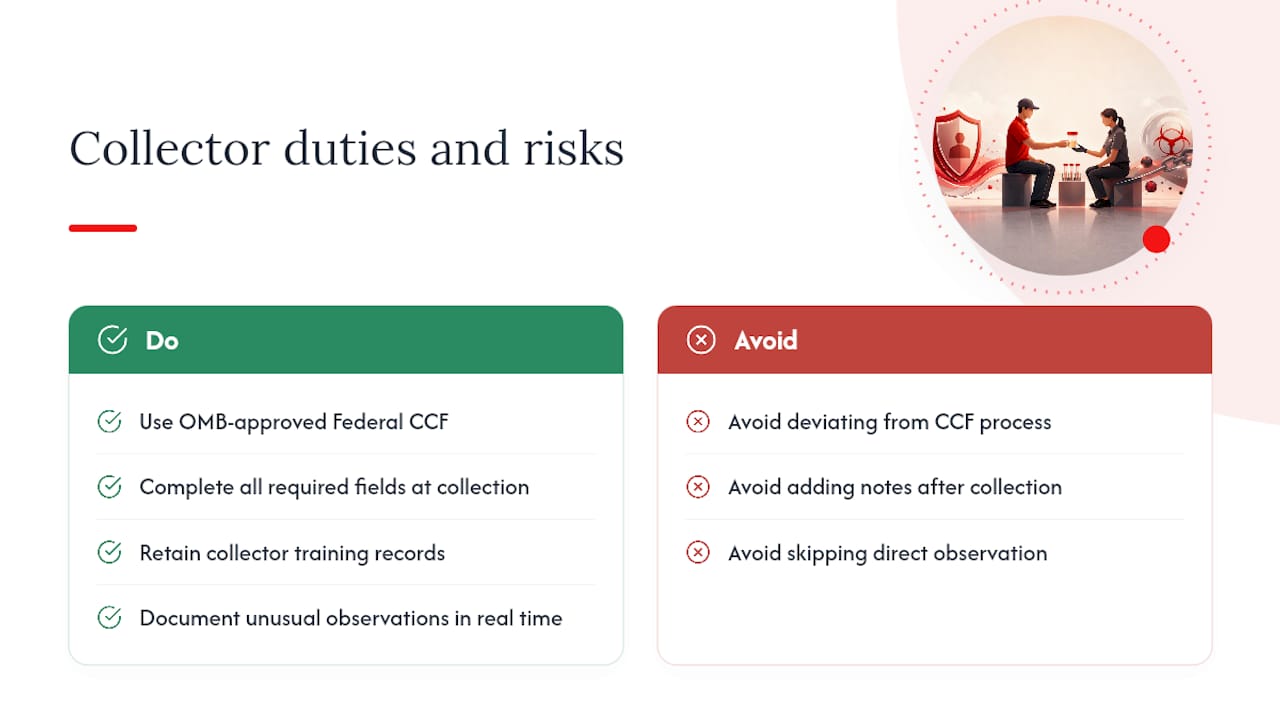
SAMHSA’s Urine Specimen Collection Handbook requires collectors to use the OMB-approved Federal CCF (paper or an SAMHSA-approved ECCF), complete all required fields at the time of collection, and retain training records. ECCF systems require separate collector training and must be approved for use by the HHS-certified lab receiving the specimens. Under 49 CFR Part 40, collectors for DOT-regulated employees must be specifically trained, must know when direct observation is required, and cannot deviate from the prescribed CCF process.
The collector’s signature on the Federal CCF is a legal attestation. Every annotation, correction, and escalation note made during collection becomes part of the evidentiary record reviewed by the MRO and, if challenged, by a court or arbitrator.
Collectors must escalate to monitored or directly observed collection when temperature is out of range, when physical characteristics suggest adulteration, or when the donor has a prior adulteration or substitution finding. The ODAPC frames the collector as the crucial link in chain of custody — strict procedural adherence protects test integrity regardless of downstream lab accuracy.
Pro Tip: Document every unusual observation in real time on the CCF remarks field, including exact timestamps. A note added after the fact carries far less weight during MRO review or an arbitration hearing than one written at the moment of collection.
How do you run a compliant urine collection?
Urine remains the most sensitive and widely accepted matrix, but it demands strict process controls at every step. A missed temperature check or an unsigned CCF copy can cancel a result that cost the program time and money to obtain.
Compliant routine urine collection steps:
- Verify the donor’s photo ID and complete the Federal CCF before collection begins.
- Instruct the donor to remove outer garments and leave personal items outside the collection area.
- Secure the restroom: blue the toilet water, remove or secure soap dispensers and other potential adulterants.
- Hand the donor a single-use collection container and explain the minimum volume required.
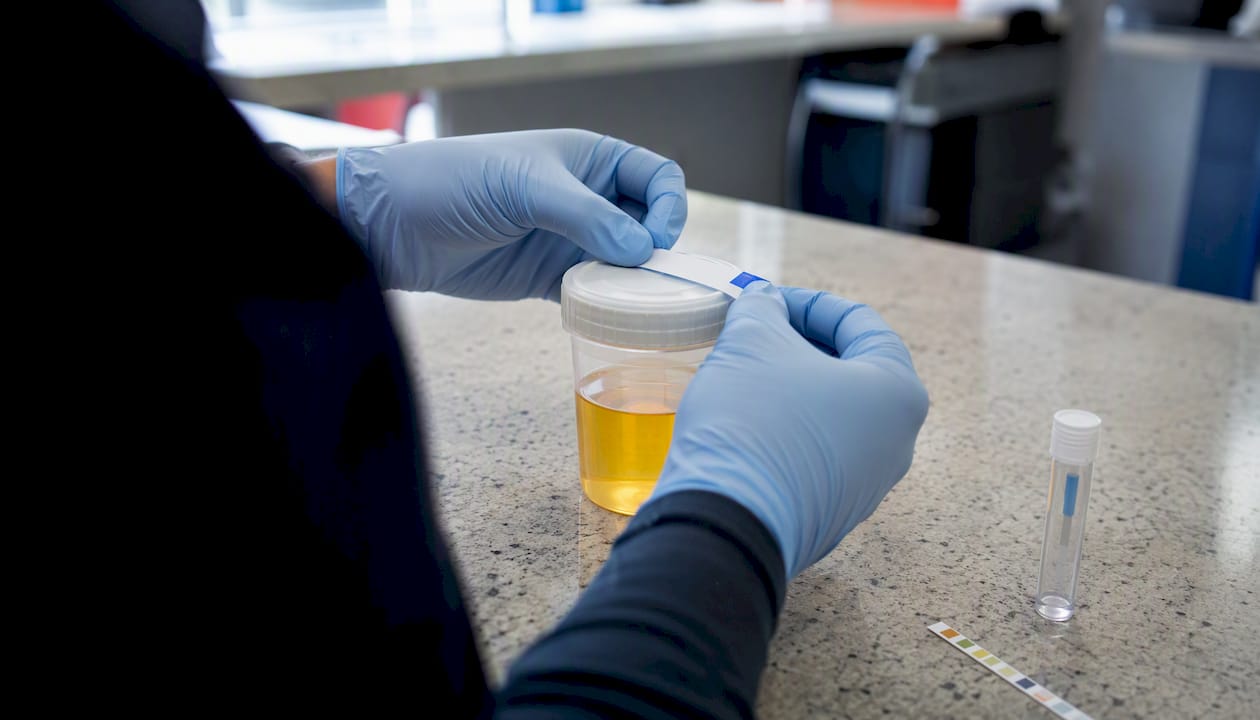
- Receive the specimen immediately after collection and check temperature within four minutes.
- Inspect for color, clarity, and any obvious signs of adulteration.
- Pour into primary and split specimen bottles, seal both with tamper-evident tape, and have the donor initial the seals.
- Complete all CCF copies, obtain donor signature, and package for transport.
Escalation triggers:
- Temperature outside 90°–100°F (32°–38°C): offer a second collection under direct observation; document on CCF.
- Specimen appears abnormal (unusual color, odor, or clarity): send to HHS-certified lab for validity testing.
- Prior adulteration finding on record: direct observation is required from the start.
For shy bladder situations, allow up to three hours with adequate fluid intake (no more than 40 oz), document each attempt on the CCF, and notify the MRO if the donor cannot provide a sufficient specimen.
When should you use oral fluid instead of urine?
Oral fluid is the right call when you need to detect use from the past day or two, when a private restroom is unavailable, or when direct observation of a urine collection would be logistically difficult. Under SAMHSA’s Oral Fluid Collection Site Manual, split-specimen collection is required: at least 1 mL of neat oral fluid for the primary specimen and at least 1 mL for the split, collected either simultaneously with two devices or serially with a single device that separates the specimen internally.
Device choice matters for lab acceptance. Confirm with your HHS-certified lab which collection devices they accept before purchasing in bulk. Document the device lot number and collection time on the CCF.
Pro Tip: Instruct donors to avoid eating, drinking, smoking, or using oral hygiene products for at least 10 minutes before collection. Residual food or drink can dilute the specimen and cause a failed volume check, requiring a recollection.
Hair, blood, sweat, and nails: when do they make sense?
UNODC guidance is clear: matrix selection must match the investigative goal. Minimally invasive methods reduce donor stress but trade detection window and sensitivity.
- Hair: Ideal for establishing a pattern of use over 90 days. Collect 100–120 mg (roughly 100–200 strands) cut close to the scalp. Bleaching, perming, or heavy dyeing can degrade drug metabolites and produce false negatives — document any visible cosmetic treatment.
- Blood: Use when quantification is the goal (DUI/DRE cases, clinical overdose, ER toxicology). Requires trained phlebotomy, proper preservative tubes (gray-top sodium fluoride/potassium oxalate for alcohol), and cold-chain transport. AAFS-ASB standards specify minimum volumes, container types, and storage temperatures for forensic blood specimens.
- Sweat patches: Applied by trained staff, worn for 7–14 days, and removed by the collector. Useful in probation and substance-abuse treatment monitoring but susceptible to passive contamination from environmental drug exposure.
- Nails: Clip at least 2–3 mm of free edge from all fingers or toes; wash with isopropyl alcohol before collection to remove surface contamination. Confirm lab acceptance and minimum weight before collecting.
Always contact your lab before collecting any non-urine specimen; refer to the Complete Guide to Immigration Medical Exam Lab Tests for detailed specimen collection requirements. Confirm accepted volumes, required preservatives, storage temperature, and turnaround time. A specimen collected in the wrong tube or insufficient quantity is a wasted collection.
A 2024 critical review recommends multi-matrix testing strategies combined with high-resolution mass spectrometry to detect new psychoactive substances (NPS) that standard immunoassay panels miss — a growing concern for programs that screen for synthetic cannabinoids, novel opioids, and designer stimulants.
How do you protect specimens from adulteration and substitution?
Urine is the matrix most vulnerable to tampering. Common methods include dilution with water, addition of chemical adulterants (bleach, nitrites, glutaraldehyde), and outright substitution with synthetic urine or another person’s specimen. Layered controls reduce risk substantially, though no single safeguard eliminates it.
Onsite physical controls checklist:
- Blue the toilet water and remove accessible water sources before collection.
- Use collection cups with integrated temperature strips for immediate read.
- Apply tamper-evident seals immediately after pouring; have the donor initial them in your presence.
- Place sealed specimens in leak-resistant bags with absorbent material before transport.
- Restrict restroom access to one donor at a time.
Use adulterant detection products that test for creatinine, pH, specific gravity, nitrites, glutaraldehyde, bleach, and oxidants. A specimen that fails validity checks goes to the lab flagged for confirmatory validity testing, not simply discarded.
For programs with a history of tampering or high-stakes legal consequences, a multi-matrix approach — pairing urine with oral fluid or hair — makes a substituted specimen far harder to execute successfully. See emerging drug trends for context on how NPS complicate standard panel detection.
How do you choose the right collection method for your program?
Start with the testing objective, then work backward to the matrix and controls.
- Define the goal: Recent impairment (oral fluid or blood), historical exposure (hair or nails), or standard workplace compliance screening (urine)?
- Identify the regulatory framework: DOT/SAMHSA-regulated program? Use urine or OFMG-compliant oral fluid only. Non-regulated? More matrix options are available.
- Assess the population: Federally regulated safety-sensitive employees, clinical patients, probationers, or law-enforcement suspects each carry different privacy, invasiveness, and documentation requirements. Review privacy rights in drug testing before finalizing your protocol.
- Confirm lab capabilities: Ask your lab which matrices and devices they accept, whether they are ECCF-approved, what their NPS panel coverage includes, and what turnaround times look like.
- Match controls to risk: High-stakes legal or safety programs need split specimens, direct observation protocols, and adulterant checks. Routine clinical monitoring may need less.
Audience-specific guidance:
- Employer random screening: Urine with temperature strip and adulterant check; Federal CCF required for DOT programs.
- Return-to-duty / follow-up: Urine or oral fluid depending on recency concern; direct observation often required.
- ER/clinical: Blood for quantification; urine for broad screening; confirm lab accepts clinical (non-CCF) specimens.
- Law enforcement/forensic: Blood or urine with full chain-of-custody documentation; consult forensic drug testing essentials for evidence-handling requirements.
What supplies do you need for a compliant collection?
Every compliant collection requires specific equipment. Missing one item — a tamper-evident seal, a temperature strip, a CCF copy — can invalidate the entire specimen.
Essential supplies for urine collections:
| Supply Item | Compliance Requirement |
|---|---|
| Single-use collection cup with temperature strip | Temperature read within 4 minutes; 90°–100°F range |
| Primary specimen bottle (30 mL minimum) | Tamper-evident cap; volume markings |
| Split specimen bottle (minimum volume) | Separate tamper-evident seal |
| Tamper-evident seals / labels | Donor initials required |
| Leak-resistant transport bag with absorbent | Required for shipping |
| Federal CCF (paper) or approved ECCF | OMB-approved form; all copies completed |
| Adulterant test strips | Creatinine, pH, nitrites, oxidants, specific gravity |
Buying tips for bulk procurement: Verify that temperature strips read accurately across the full 90°–100°F range, not just a subset. Check shelf life and storage requirements before ordering large quantities. Request certificates of analysis for lot traceability, especially for legally sensitive programs. Confirm that your lab accepts the specific collection device or cup model you plan to order.
Pro Tip: Order a small pilot quantity of any new cup or device model and run it past your HHS-certified lab before committing to a bulk purchase. Lab acceptance of specific device lots is not universal, and a rejected device discovered mid-program is expensive to fix.
What documentation survives an audit or legal challenge?
Documentation is as important as the specimen itself. A chain-of-custody record with gaps, missing signatures, or uncorrected errors gives attorneys and MROs grounds to question the entire result.
QA checklist for every collection:
- Confirm donor identity with photo ID before touching any supplies.
- Complete the Federal CCF header fields before the donor provides the specimen.
- Verify specimen temperature within four minutes; record the reading on the CCF.
- Check volume against minimum requirements; document any shortfall.
- Seal primary and split bottles in the donor’s presence; have the donor initial each seal.
- Complete all CCF copies; give the donor their copy before they leave.
- Package in leak-resistant bag; attach lab copy of CCF to the outside.
- Document courier handoff with date, time, and courier name.
Retention guidelines for federally regulated programs:
| Record Type | Suggested Retention |
|---|---|
| Federal CCF (negative results) | 1 year minimum |
| Federal CCF (positive, refusal, or invalid) | 5 years minimum |
| Collector training records | Duration of employment plus 2 years |
| Lab reports | 5 years for positive results |
When a chain-of-custody break occurs — a seal is found broken, a CCF copy is missing, or a temperature strip was not read — annotate the CCF immediately with the exact nature of the irregularity, preserve the original specimen, and notify the MRO and lab before any further processing. Do not attempt to reconstruct a CCF from memory after the fact.
The program mistakes that cost programs the most
The most common program design error is not a dramatic failure — it is a quiet mismatch between the testing goal and the matrix chosen. Programs that use urine for post-accident testing when oral fluid would better capture recent impairment, or that rely on a single matrix when NPS exposure is a real risk, are building on a shaky foundation.
Undertrained collectors are the second most consistent problem. A collector who does not know when direct observation is required, or who skips the temperature check because the donor seemed cooperative, creates a vulnerability that surfaces only when a result is challenged. Paper CCF backups matter too: programs that go fully electronic without confirming ECCF approval with their HHS-certified lab have had results rejected at the lab level.
Implementation red flags to watch for: inconsistent tamper-evident seal application across collectors, no lot-number tracking for collection devices, and failure to verify that the lab’s ECCF approval covers the specific electronic form your program uses. Run a mock collection audit annually — walk through a full collection from ID check to courier handoff and document every gap. That exercise surfaces procedural drift before a real challenge does.
Rapidtestcup supplies built for compliant programs
Compliant collections start with the right supplies, and Rapidtestcup stocks the specific products that match the protocols described in this guide: multi-panel cups with integrated temperature strips and adulterant detection, tamper-evident seals, and oral fluid collection devices suited for both routine and federally regulated programs.
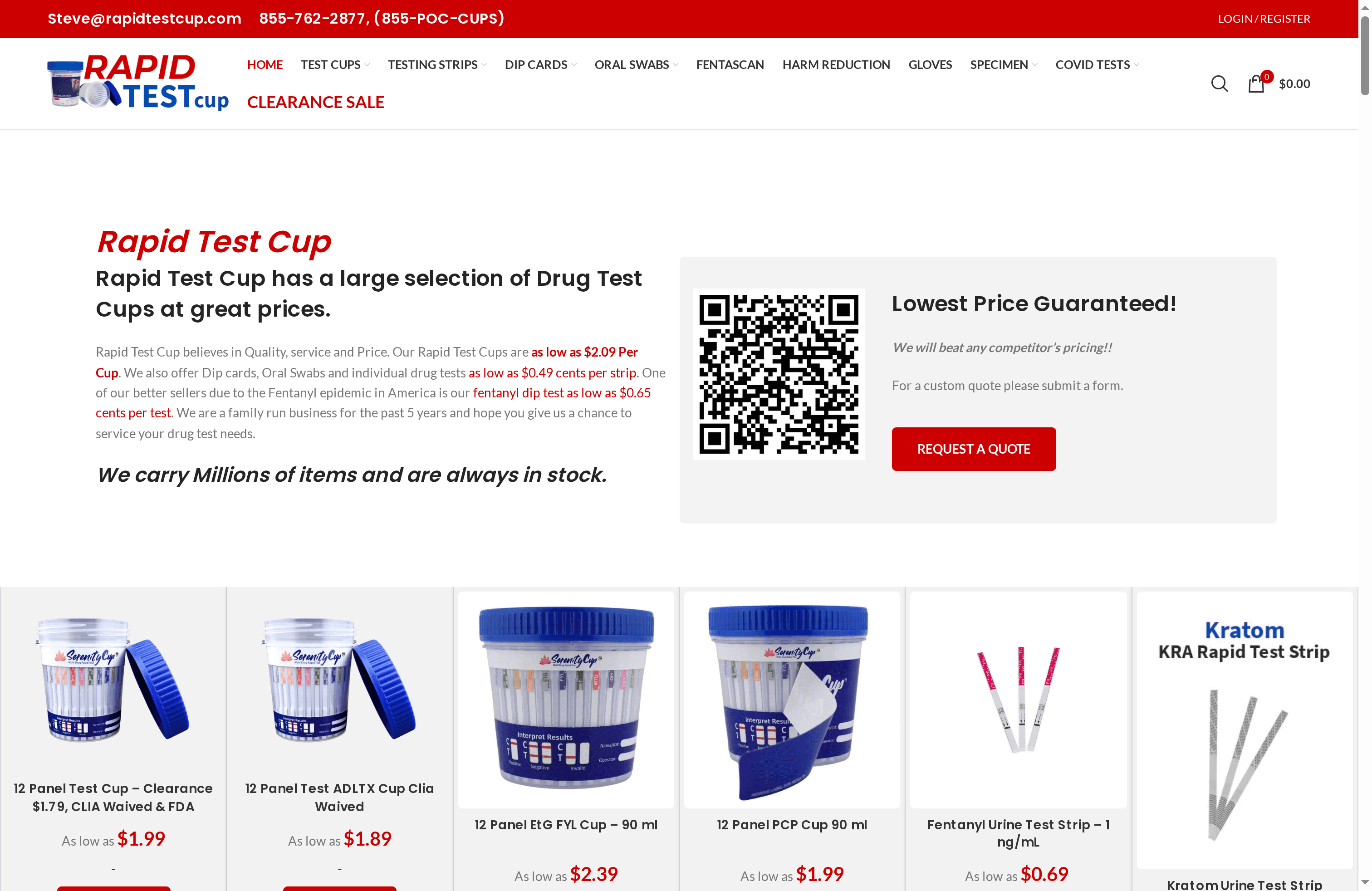
For employer random screening, the 12-Panel ADLTX Cup covers standard panels plus adulterant checks in a single cup. Programs needing broader NPS and fentanyl coverage can step up to the 22-panel cup with adulterants and Zaza. Forensic and clinical labs can browse the full drug testing products for labs catalog for CLIA-waived and FDA-cleared options with bulk pricing. All orders ship fast, and the team can provide custom quotes for high-volume programs. Browse the catalog and confirm device acceptance with your lab before your next procurement cycle.
Sources
- Urine Specimen Collection Handbook – 2024 (SAMHSA)
- 49 CFR Part 40 — Procedures for Transportation Workplace Drug Testing Programs (DOT)
- White Matrices Part 2 — ForensicRTI / NLCP DTM (May 28, 2019)
- AAFS-ASB Standard — Specimen collection and handling guidance (American Academy of Forensic Sciences Standards Board)
Confirm ECCF approval directly with your HHS-certified lab before switching from paper Federal CCFs — lab-level approval is required and is not automatic.
This article is general information, not a substitute for advice from a qualified doctor. Consult a qualified healthcare professional about your own circumstances before acting on anything here.