Blog
Harm Reduction: 2.5 µg/mL Limits Make Xylazine Drug Tests Unreliable


Yes, xylazine can be detected, but the right test depends entirely on what you’re checking. Purpose-made xylazine test strips catch the drug in a residue sample within minutes, while urine assays and laboratory mass spectrometry confirm exposure in the body. Each method has real limits, so a rapid strip is a screening tool, not a verdict. If a test comes back positive, or you’re at all unsure, keep naloxone within reach since xylazine so often travels with fentanyl.
TL;DR:
- Xylazine residue test strips detect the drug at around 2.5 micrograms per milliliter, but false negatives can occur at lower concentrations or with uneven samples.
- Urine tests detect recent metabolization at low thresholds like 10 nanograms per milliliter but may not reliably indicate recent exposure due to limited understanding of human pharmacokinetics.
- Laboratory methods such as LC-MS/MS are the definitive standard, especially for legal, clinical, or research purposes, but they take days to process.
- A positive result suggests xylazine is present in the sample or the body, but a negative does not rule out recent exposure, given the variability in detection windows.
- Testing is only one part of safety protocols; keep naloxone accessible, avoid solo use, and seek medical attention if overdose symptoms occur.
Table of Contents
- What a Xylazine Drug Test Actually Checks
- How to Test a Drug Sample for Xylazine Step by Step
- Urine Testing vs. Drug-Residue Testing: What’s the Difference?
- What the Studies Actually Show About Accuracy
- What to Do After You Get a Result
- How Long Xylazine Stays Detectable in Your System
- Xylazine Pharmacology, in Plain Terms
- Is It Legal to Test for Xylazine?
- Where Xylazine Shows Up and Why That Matters for Testing
- Why Testing Alone Isn’t the Full Picture
- Where to Buy Xylazine Test Strips and Related Supplies
- Get the Right Xylazine Testing Supplies for Your Situation
- Sources
- FAQ
What a Xylazine Drug Test Actually Checks
A “xylazine drug test” isn’t one product. It’s a category that splits into three distinct tools, each built for a different sample and a different question.
Drug-residue lateral-flow strips are the ones most harm-reduction programs and individuals reach for first. You dissolve a small amount of the substance you want to check in water, dip the strip, and read a line pattern after a few minutes. These strips work off an immunoassay reaction: antibodies on the strip bind to xylazine molecules if they’re present in high enough concentration, producing a visible test line.
Urine immunoassay tests work differently. They screen for xylazine metabolites in urine, meaning they answer “has this person’s body processed xylazine recently?” rather than “does this powder contain xylazine?” A 2026 validation study of one such assay reported a 5-minute test time, a 10 ng/mL cutoff, and impressive performance, 100% sensitivity and 98% specificity across 358 clinical urine samples confirmed by mass spectrometry. That said, the same study noted no rapid xylazine diagnostic had FDA clearance at the time of publication, so availability and regulatory status vary.
Laboratory confirmatory methods, primarily LC-MS/MS and DART-MS, are the gold standard for both matrices. Labs use these when a legal case, clinical diagnosis, or research study needs a definitive answer rather than a presumptive one.
A few things separate the categories at a glance:
- Residue strips are typically packaged with instructions referencing drug samples, water dilution, and short read windows.
- Urine test kits reference biological specimens, metabolite cutoffs (often in ng/mL), and clinical collection protocols.
- Lab-based methods require sending a sample to a facility and waiting days, not minutes, but they resolve ambiguous field results.
Detection limits vary by product and by strip generation. One NCBI report found detection down to about 0.5 µg/mL in solution, with consistent positive results at 2.5 µg/mL and above. Below that threshold, results get unreliable, which is exactly why concentration and sample prep matter as much as the strip itself.
How to Test a Drug Sample for Xylazine Step by Step
Testing a substance for xylazine residue follows a fairly standard protocol, but small details in how you prepare the sample change how reliable the result is.
What you’ll need:
- A xylazine-specific test strip (not a general-purpose color reagent test)
- A small, clean container for mixing
- Water (distilled if available)
- A way to measure a small, consistent amount of the sample
- Gloves and a disposable surface for handling
Pro Tip: Dissolving roughly 1 mg of residue in 1 to 5 mL of water, rather than a larger volume, raises the effective concentration and improves the strip’s odds of catching a real signal, according to pilot testing on strip performance. Oversized dilutions are one of the most common reasons a strip reads negative on a sample that actually contains xylazine.
- Collect a small residue sample. A pinch from the same batch you plan to use, taken from more than one spot if the substance looks uneven in texture or color.
- Dissolve it in a measured amount of water. Stick to a consistent ratio, roughly 1 mg per 1 to 5 mL, so your results are comparable across tests.
- Dip the strip for the time specified on the packaging, usually 5 to 10 seconds, without letting the liquid rise above the marked line.
- Lay the strip flat on a clean, dry surface for the full read window, typically around 5 minutes.
- Read the result at the specified time, not before and not long after, since lines can fade or develop faint artifacts outside the window.
- Repeat with a fresh strip if the line is faint or ambiguous. Some community drug-checking programs use duplicate strips and trained readers specifically because weak lines are a known source of misread results.
- Send to a lab for confirmatory testing if the result carries legal weight, clinical significance, or if you need certainty for research or program reporting.
Handle everything with gloves, avoid direct skin contact with the sample, and dispose of test materials according to your local hazardous waste or sharps guidance. This article describes a testing method for harm-reduction and screening purposes only. It is not instruction for producing, possessing, or distributing controlled substances, and laws on drug residue testing vary by state and jurisdiction. If you’re unsure what’s legal where you live, a local harm-reduction organization can usually point you to accurate, up-to-date guidance.
Urine Testing vs. Drug-Residue Testing: What’s the Difference?
These two tests answer completely different questions, and mixing them up is one of the most common mistakes people make when trying to interpret a xylazine drug test.
A residue strip tells you whether xylazine is present in a physical sample, like a powder or a fentanyl mixture, at the moment you test it. A urine test tells you whether a person’s body has metabolized xylazine recently. The two don’t substitute for each other, and a person could test negative on one while a completely separate sample tests positive on the other.
Cutoffs differ too. Urine assays tend to use low cutoffs, in the 10 ng/mL range for the validated assay mentioned earlier, because they’re detecting trace metabolites in a biological fluid. Residue strips work at much higher concentrations, often needing 2.5 µg/mL or more for a reliable positive, because they’re reading a raw chemical sample rather than a filtered biological one.
There’s another wrinkle clinicians and lab technicians should know: xylazine’s pharmacokinetics in humans aren’t fully mapped out yet. CDC guidance acknowledges that the testing landscape, along with human metabolism and detection windows, is still evolving. That means a negative urine result doesn’t fully rule out recent exposure, especially if testing happens outside whatever window turns out to be typical for a given dose and route.
So which test do you actually need?
- Choose a residue strip when you want to check a substance before use, in a drug-checking or harm-reduction setting.
- Choose a clinical urine test when a medical provider needs to understand what’s in a patient’s system, particularly in an overdose or sedation workup.
- Choose lab confirmation when the result needs to hold up in a legal, clinical, or research context where a presumptive strip result isn’t enough.
What the Studies Actually Show About Accuracy
Xylazine test strip performance isn’t one clean number, it’s a range, and that range is wide enough to matter.
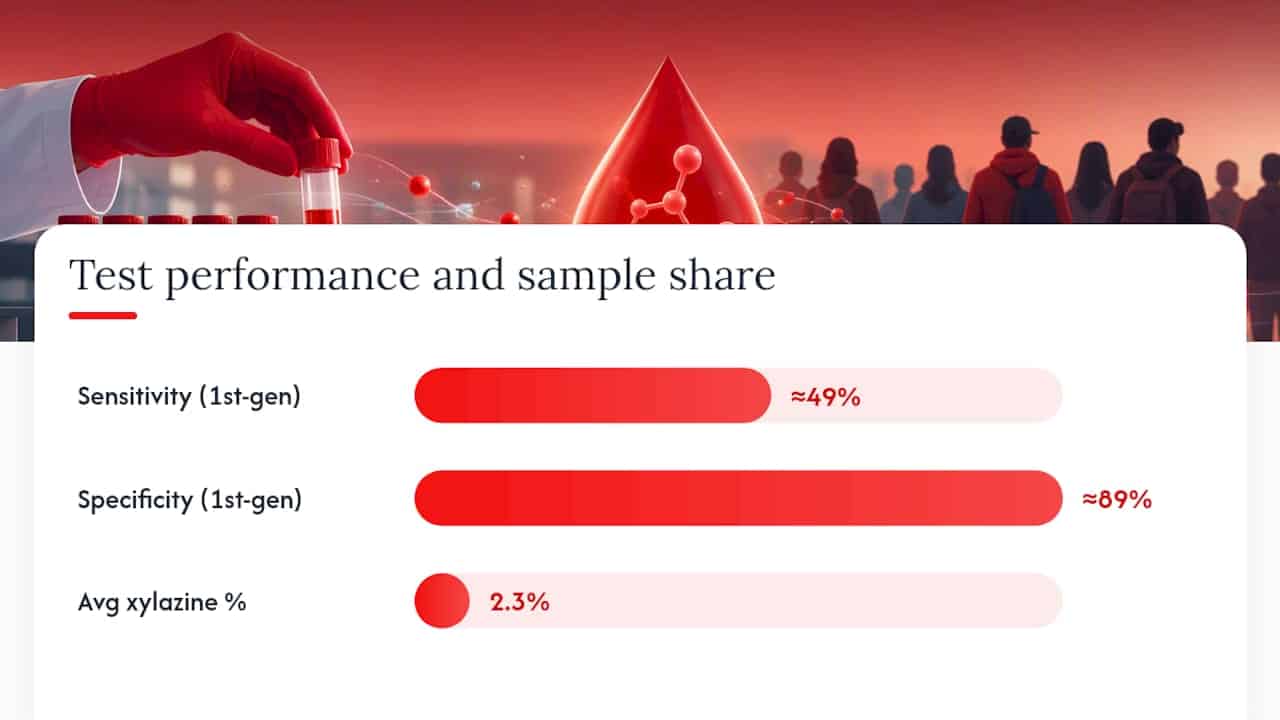
A community-based study using first-generation strips on fentanyl-positive samples in Los Angeles found sensitivity around 49% and specificity around 89%. In other words, the strips missed roughly half of the xylazine-positive samples in that dataset, largely because many samples contained xylazine at low concentrations, averaging just 2.3% by mass. The gap illustrates a simple point: performance depends heavily on sample type, concentration, and strip generation, not just the underlying technology.
Why results go wrong in both directions:
- False negatives happen most often when xylazine concentration in the sample is low, when the substance is unevenly mixed, or when too much water dilutes the effective concentration below the strip’s detection threshold.
- False positives are less common but documented. Lidocaine, a common cutting agent, is a known interferent that can trigger a positive line even without xylazine present, according to the same NCBI review.
- Lot-to-lot variability matters too. Newer strip generations are designed to reduce cross-reactivity and improve sensitivity at lower concentrations, but not every strip on the market has been updated to the same standard.
Because of this variability, confirmatory testing with LC-MS/MS or DART-MS is worth pursuing whenever a result needs to hold up legally, when a clinical picture doesn’t match a negative screen, or when a research or surveillance program needs verified data rather than a presumptive read. A rapid strip is a first pass, not a final answer, and separate multitechnique research found that general-purpose color reagent tests can cross-react or miss xylazine entirely, which is exactly why choosing a product labeled specifically for xylazine matters.
What to Do After You Get a Result
A test result only matters if it changes what you do next. Here’s how to act on either outcome.
If the result is positive:
- Assume xylazine may be mixed with fentanyl or another opioid, since CDC surveillance found roughly 80% of fentanyl-positive paraphernalia samples in one pilot also tested positive for xylazine.
- Keep naloxone on hand. It won’t reverse xylazine’s sedative effects, but CDC guidance stresses naloxone remains critical for the opioid component of a mixed exposure.
- Avoid using alone, and consider a non-injection route if you’re planning to use regardless of the result.
- Seek medical attention immediately if you or someone nearby shows severe sedation, slow or shallow breathing, or unresponsiveness.
If the result is negative:
- Remember detection thresholds mean a negative doesn’t guarantee absence, particularly at low concentrations.
- Keep using other harm-reduction layers rather than treating a single negative strip as a clean bill of health.
- Community drug-checking programs, where available, often run more sensitive equipment than a single field strip and can add another layer of confidence.
Pro Tip: Testing works best as one part of a broader safety routine, not a stand-alone guarantee. Public health guidance frames strip testing alongside naloxone access, safer-use practices, and wound care outreach, since xylazine exposure is also linked to severe skin wounds that need early attention.
If you need a confirmatory lab result, most public health departments and university toxicology labs can point you toward accredited testing options, and many harm-reduction organizations maintain lists of local naloxone distribution points and wound care clinics.
How Long Xylazine Stays Detectable in Your System
Detection windows for xylazine are less standardized than for drugs like opioids or benzodiazepines, mostly because human pharmacokinetics data is still limited. That’s not a gap in testing technology, it’s a gap in the underlying science.
Urine is the most commonly tested matrix for exposure, and the metabolites a validated assay targets can be picked up using a 10 ng/mL cutoff shortly after exposure. How long that window stays open after use varies by dose, frequency of use, and individual metabolism, and researchers don’t yet have the kind of large-scale, dose-controlled data that exists for more established drugs.
Blood testing can capture more recent exposure and is more common in clinical or emergency settings, particularly when a patient presents with unexplained sedation that doesn’t respond to naloxone the way an opioid overdose typically would. Saliva testing for xylazine is far less established in routine practice and mostly appears in research or specialized clinical contexts rather than everyday screening.
The practical takeaway: don’t treat any negative result, urine or otherwise, as absolute proof of no exposure. CDC guidance is direct on this point, describing the testing landscape and detection windows as still evolving, which means clinicians and harm-reduction workers alike should interpret a negative in context rather than as a closed case, especially when symptoms suggest otherwise.
Xylazine Pharmacology, in Plain Terms
Xylazine is a veterinary sedative, an alpha-2 adrenergic agonist, not an opioid, and that distinction is the single most important thing to understand about testing and treatment.
Because it works on a completely different receptor system than fentanyl or heroin, naloxone has no direct effect on xylazine’s sedative or respiratory-depressing effects. That’s why CDC guidance repeatedly separates the two: naloxone treats the opioid piece of a mixed exposure, while the xylazine piece has to run its course or be managed with supportive medical care.
This same pharmacology is what makes urine testing tricky. Because xylazine metabolizes differently than opioids, immunoassays have to be built around specific metabolites, and cutoffs need to be tuned separately from opioid panels. A generic opioid test won’t catch it, and a xylazine-specific test won’t tell you anything about the opioid content of a sample, which is exactly why CDC recommends running fentanyl and xylazine tests separately rather than assuming one covers the other.
For residue testing, pharmacology matters less than raw concentration. A strip doesn’t care about receptor activity, it’s reacting to the chemical structure of xylazine itself in solution. That’s a simpler chemistry problem than the human metabolism question, which is part of why residue strips can hit workable sensitivity even while urine-based science is still catching up.
Is It Legal to Test for Xylazine?
Testing a substance for xylazine content sits in a gray area that shifts depending on where you live. Drug-checking equipment, including test strips, is treated as drug paraphernalia under some state laws, while other states have specifically exempted testing supplies to support harm-reduction efforts.
Clinical urine testing carries far less legal ambiguity since it’s performed within a medical context, typically ordered by a provider and processed through a licensed lab. The complications tend to arise around residue testing, where the legality often hinges on your state’s paraphernalia statutes and whether local harm-reduction exemptions apply.
If you’re an individual trying to check a substance before use, checking your state’s current paraphernalia laws or contacting a local harm-reduction organization is the safest first step, since these groups usually track legal changes far more closely than a general search would surface. If you’re a clinician, lab technician, or program administrator, the legal considerations shift toward compliance topics like CLIA waivers, FDA clearance status, and documentation standards, particularly since no rapid xylazine diagnostic had FDA clearance as of the most recent validation study published. That status can change, so it’s worth checking current regulatory standing before deploying any product in a clinical or forensic setting.
Where Xylazine Shows Up and Why That Matters for Testing
Xylazine entered the illicit drug supply primarily as an adulterant in fentanyl, not as a stand-alone recreational drug people seek out on purpose. It’s cheap, it extends the sedative effects of opioids, and it’s not tightly controlled the way scheduled opioids are, which made it an easy addition for suppliers looking to stretch product.
That context shapes how you should think about testing. Someone checking a fentanyl sample for xylazine isn’t usually testing for a drug they intended to buy, they’re testing for an unlisted additive that changes the risk profile substantially. That’s part of why the concentration issue matters so much in accuracy studies: when xylazine shows up as a minor adulterant rather than the primary substance, it’s often present at low percentages by mass, which is exactly the condition where strip sensitivity drops.
Geographically, xylazine’s prevalence in the drug supply varies significantly by region and has shifted over time as supply chains and local drug markets change. That’s another reason blanket assumptions don’t work well here. A negative test in one city doesn’t tell you much about risk in another, and testing programs that track local trends tend to be more useful than relying on national averages alone.
Veterinary settings remain the only legitimate legal source of xylazine, since it has no approved use in human medicine. Diversion from veterinary supply chains, along with international sourcing, feeds the illicit supply, which is part of why enforcement and regulatory responses have focused on tightening veterinary distribution controls alongside public health testing initiatives.
Why Testing Alone Isn’t the Full Picture
The conventional wisdom around drug checking treats a test strip almost like a verdict: dip it, read it, act accordingly. That framing undersells how much interpretation actually matters, and it’s where a lot of well-meaning testing programs fall short.
A 49% sensitivity rate, which is what real-world data showed for first-generation strips on low-concentration samples, means a negative result is genuinely uninformative in a meaningful share of cases. That’s not a strike against the technology, it’s a reason to treat a negative as “no information gained” rather than “confirmed safe.” The instinct to treat any negative test as reassurance is understandable, but it’s also the exact gap that leads to preventable harm.
What gets underestimated even more is the value of pairing testing with basic preparedness. Carrying naloxone, avoiding solo use, and knowing where the nearest wound care resource is do more collective good than obsessing over strip accuracy percentages. Testing informs a decision, it doesn’t replace the safety net around that decision. Programs that lead with naloxone access and only treat test strips as one input, rather than the centerpiece, tend to see better outcomes than programs built entirely around the test result itself.
The other underappreciated point: buying a xylazine-specific strip instead of a generic multi-drug color reagent test isn’t a minor detail, it’s the difference between a targeted immunoassay and a tool that was never built to catch this particular compound. That choice, more than almost anything else in this article, is the one most likely to affect whether a test result means anything at all.
— Justin
Where to Buy Xylazine Test Strips and Related Supplies
If you’re ready to start testing, Rapidtestcup stocks xylazine test strips built specifically for residue screening, along with the fentanyl test strips you’ll want to run alongside them, since the two compounds require separate tests and so often appear together in the supply.
For clinics, labs, and treatment programs that need broader coverage in one device, the 24-panel drug test cup with an XYL target combines xylazine screening with a wide panel of other substances in a single urine collection cup, useful when a facility needs one workflow instead of several separate strips.
Before ordering, confirm the intended matrix on the product page, residue versus urine, check the datasheet for listed detection limits, and note the lot and expiration date, since strip performance can shift between manufacturing batches. The site offers product categories labeled as CLIA-waived and FDA-approved where applicable, alongside bulk ordering options and prompt shipping services. If your program needs technical datasheets or institutional pricing, contact Rapidtestcup’s support team directly for guidance.
Get the Right Xylazine Testing Supplies for Your Situation
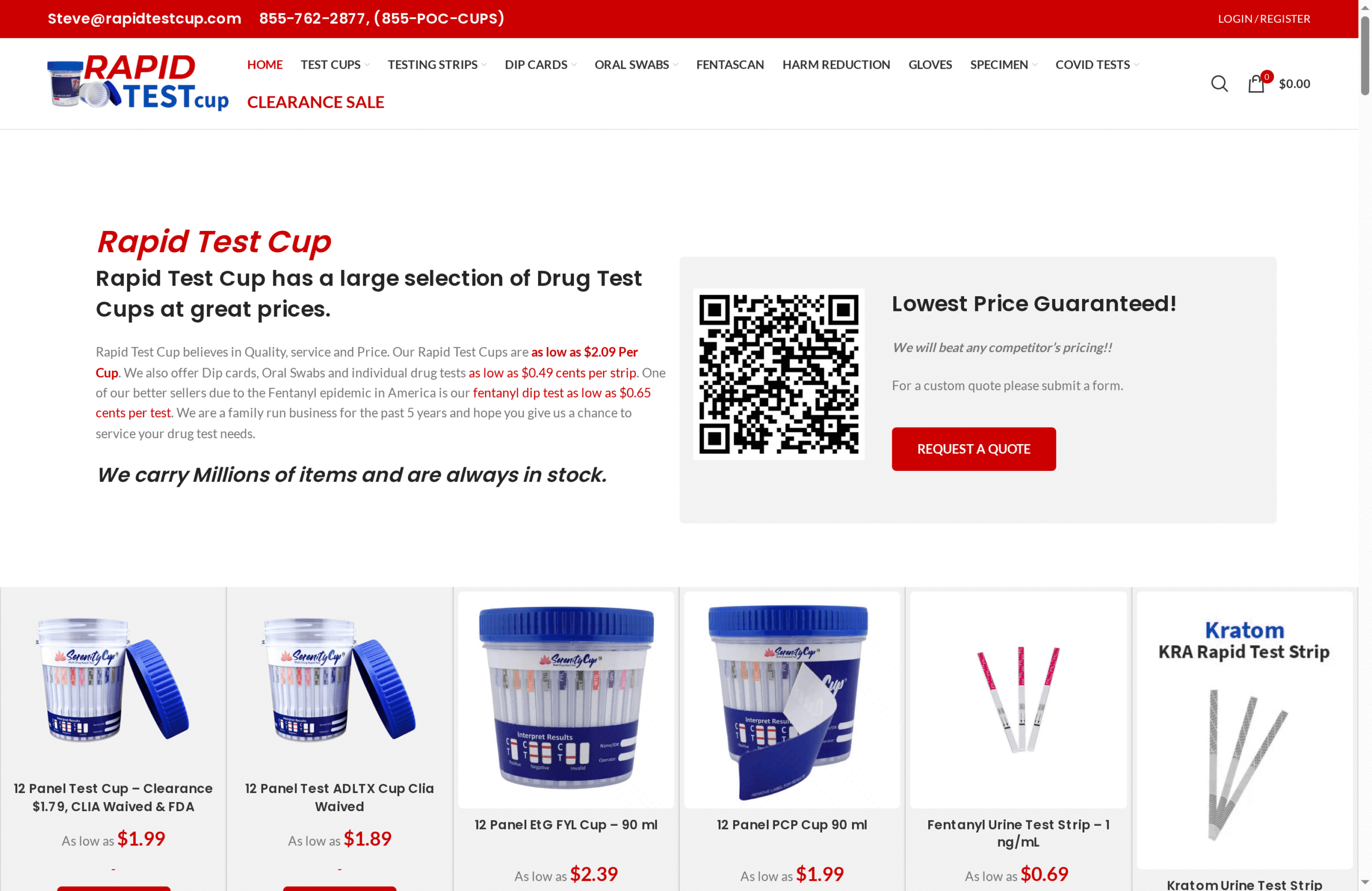
Whether you’re an individual checking a personal supply, a harm-reduction worker running a community drug-checking table, or a clinic that needs xylazine coverage built into a standard urine panel, the right product depends on the question you’re actually trying to answer. The store carries a range of products including residue-focused strips for quick field screening and multi-panel urine cups for clinical or institutional settings requiring broader drug coverage in one test.
Rapidtestcup’s full catalog of test cups, dip cards, and test strips covers everything from single-analyte strips to comprehensive panels, with bulk pricing for organizations ordering in volume and same-day shipping for anyone who needs supplies now rather than next week. If you’re not sure which product matches your testing goal, browse the shop page or reach out for a custom quote, and get the right kit in hand before you need it, not after.
This article is general information, not a substitute for advice from a qualified doctor. Consult a qualified healthcare professional about your own circumstances before acting on anything here.
Sources
- Validation study of a xylazine urine assay (PubMed entry)
- Xylazine test strips for drug checking (NCBI Bookshelf)
FAQ
What Does a Xylazine Test Strip Actually Test Positive For?
A xylazine test strip reacts to the chemical presence of xylazine itself in a dissolved sample, not to any other sedative or opioid. A positive line means xylazine was present at or above the strip’s detection threshold, which studies place around 2.5 µg/mL for consistent positive results, not that the sample is free of other adulterants like fentanyl.
Is Xylazine an Opioid Agonist?
No, xylazine is an alpha-2 adrenergic agonist, a veterinary sedative, not an opioid. That’s why naloxone doesn’t reverse its sedative effects, though CDC guidance still recommends carrying naloxone since xylazine so frequently appears mixed with opioids like fentanyl.
Can I Buy Xylazine Test Strips at a Pharmacy Like Walgreens?
Availability varies significantly by retailer and location, and xylazine-specific strips are far less commonly stocked on pharmacy shelves than standard drug test kits. Suppliers focused specifically on drug-testing products, including Rapidtestcup’s xylazine test strips, are typically a more reliable source for this specific product.
How Do You Read a Xylazine Test Strip?
Dip the strip in your dissolved sample for the time listed on the packaging, then lay it flat and wait for the full read window, generally around 5 minutes. A single line usually indicates a positive result and two lines a negative, but check your specific product’s instructions since line interpretation can vary between manufacturers, and a faint line should prompt a retest with a fresh strip.
How Long Does Xylazine Stay Detectable in Urine?
There’s no firmly established detection window yet, since CDC guidance notes human pharmacokinetics for xylazine remain incompletely understood. A validated urine assay can detect metabolites at a 10 ng/mL cutoff shortly after exposure, but how long that window stays open depends on dose, frequency, and individual metabolism factors researchers are still studying.