Blog
DOT vs Non DOT: How Employers Avoid Costly Compliance Mistakes


DOT drug tests are federally governed by 49 CFR Part 40 and must be conducted separately from any employer-authority, or non-DOT, testing. A non-DOT test, no matter how thorough, cannot fulfill a DOT testing obligation. If you have a safety-sensitive employee who needs a DOT test, running a company panel instead doesn’t check that box. It has to be the real thing, done the DOT way.
TL;DR:
- DOT tests are strictly regulated under 49 CFR Part 40 and must be separate from any non-DOT employer or state testing, with no exceptions.
- The five drugs tested by DOT include marijuana, cocaine, opiates, amphetamines, and PCP, all confirmed through certified urine laboratory analysis.
- Employers must conduct DOT drug tests at specific times, including pre-employment, random, post-accident, reasonable suspicion, and follow-up after violations.
- Non-DOT drug tests are more flexible regarding specimen types and drug panels but carry no federal consequences and cannot be labeled as DOT tests.
- When both programs are run, collection events must be separate, with DOT tests performed first and left completely distinct from non-DOT testing.
Table of Contents
- What Is a DOT Drug Test and Who Has to Take One?
- What Counts as a Non-DOT Drug Test?
- Which Drugs and Specimen Types Does DOT Require?
- How Do Collection and Lab Rules Differ Between DOT and Non-DOT?
- What Happens After a DOT Violation Versus a Non-DOT Positive?
- How Can Employers Build a Non-DOT Program That Doesn’t Conflict With DOT Rules?
- Common Mistakes Employers Make With DOT and Non-DOT Testing
- Where to Source Cups, Swabs, and Supplies for Your Non-DOT Program
- Key Regulatory Links Worth Bookmarking
- Sources
- FAQ
What Is a DOT Drug Test and Who Has to Take One?
A DOT drug test exists because Congress told the Department of Transportation to keep certain safety-sensitive jobs free of drug and alcohol impairment, and DOT wrote that mandate into Part 40. Part 40 sets the procedures, but each modal agency, FMCSA for trucking, along with the FAA, FRA, FTA, PHMSA, and the Coast Guard, decides which employees and job functions actually fall under it. That’s a detail a lot of employers miss: coverage isn’t uniform across every DOT-regulated industry, so a rule that applies to an airline mechanic doesn’t automatically apply to a pipeline technician in the same way.
DOT testing gets triggered at specific, defined moments, not whenever an employer feels like it:
- Pre-employment, before a safety-sensitive employee performs covered duties for the first time
- Random testing, pulled on an unannounced schedule set by the agency’s minimum rate
- Reasonable suspicion, when a trained supervisor observes specific, documented signs of impairment
- Post-accident, following qualifying crashes that meet DOT’s criteria
- Return-to-duty and follow-up testing, after a violation and clearance by a Substance Abuse Professional
For CDL drivers specifically, employers must also run a query in the FMCSA Clearinghouse, a full query before hire and at least a limited query annually for current drivers. Not sure if a role is covered? DOT’s own frequently asked questions page walks through several edge cases, and it’s worth checking before you assume either way. One useful reference for mapping job duties to coverage is what DOT drug testing actually requires.
What Counts as a Non-DOT Drug Test?
Non-DOT testing runs on a completely different authority. Instead of federal regulation, it comes from the employer’s own policy, a state law, a client contract, or an insurance carrier’s requirement. That’s a much looser leash, and it’s exactly why non-DOT programs look so different from one company to the next.
Because there’s no Part 40 constraint, non-DOT programs give employers real flexibility:
- Choice of specimen type: urine, oral fluid, hair, or even sweat patches, depending on state law and the employer’s goals
- Expanded panels beyond DOT’s five drugs, covering things like fentanyl, benzodiazepines, or synthetic cannabinoids
- Employer-set consequences, from mandatory counseling to termination, defined entirely by internal policy
The catch: a non-DOT positive never carries DOT weight, and a non-DOT program can never be mislabeled as DOT. Employers running both need clear, separate paperwork so nobody downstream confuses one for the other. Even a urinalysis collected during a DOT physical isn’t automatically a DOT drug test if it was done for medical qualification rather than Part 40 purposes, according to DOT’s own guidance. That distinction trips up more compliance officers than you’d expect.
Which Drugs and Specimen Types Does DOT Require?
DOT tests for five drug classes: marijuana, cocaine, opiates, amphetamines, and phencyclidine (PCP). Every one of those requires laboratory-based urine testing, and DOT alcohol testing uses an approved breath or saliva device to screen at a 0.02 alcohol concentration threshold, according to FMCSA guidance on tested substances.
Pro Tip: Rapid test cups and dip cards are excellent screening tools for non-DOT programs, but they’re not evidentiary substitutes for DOT’s certified lab process. Use them to screen fast, then send anything that needs federal-grade proof to a certified lab.
Non-DOT panels routinely go further than DOT’s list:
- Fentanyl and other synthetic opioids, now common additions given overdose trends
- Benzodiazepines, methadone, and expanded opioid markers
- Synthetic cannabinoids (K2/Spice) and alcohol biomarkers like ETG
- Alternative specimens such as oral fluid or hair, where state law permits
DOT continues to require urine specifically for its drug panel, a standard SAMHSA’s guidance on federal testing programs confirms even as oral fluid gains traction in some federal contexts. If your program mixes screening technology, understanding what rapid screening devices can and can’t do will save you from a compliance headache later.
How Do Collection and Lab Rules Differ Between DOT and Non-DOT?
Part 40 turns drug testing into a documented chain of custody, not a quick cup handed across a counter. Collectors have to be trained, use the federal Custody and Control Form, and follow strict procedures that hold up if a result is ever challenged. Specimens go to labs certified under SAMHSA’s Mandatory Guidelines, and a Medical Review Officer, or MRO, reviews every non-negative result before it becomes official.
- Certified labs and trained collectors are mandatory for every DOT specimen, no exceptions
- The MRO conducts a verification interview with the employee before reporting anything as positive
- Employees who test positive have the right to request a split-specimen retest, generally at their own expense unless local rules say otherwise
- Learn more about how the MRO verification process actually plays out step by step
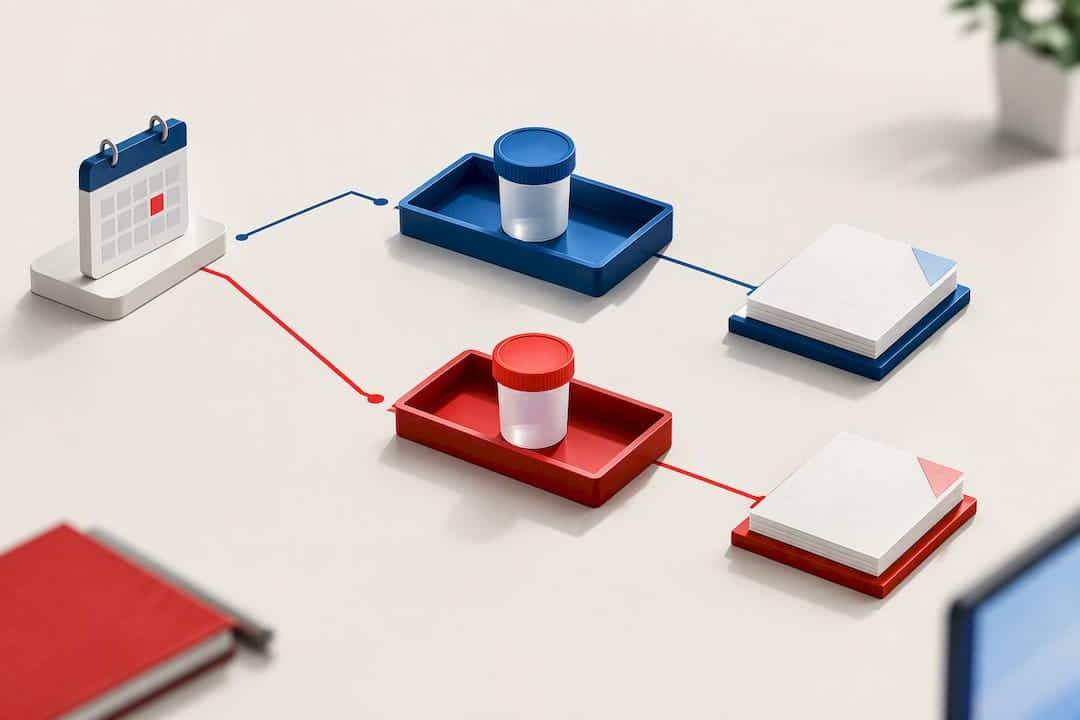
The rule that trips up the most employers, though, is separation. Under Part 40 §40.13, if one employee needs both a DOT and a non-DOT test, the DOT test has to happen first and be completed as its own distinct event. Any leftover DOT specimen gets discarded, never repurposed for a company panel. You collect a fresh void for non-DOT testing, full stop.
Pro Tip: Never let a single collection serve two purposes. If your policy requires both a DOT test and a company panel on the same visit, budget for two separate collection cups and two separate forms.
What Happens After a DOT Violation Versus a Non-DOT Positive?
A DOT violation, whether it’s a confirmed positive or a refusal to test, triggers immediate removal from safety-sensitive duties. There’s no discretion here. The employee has to complete evaluation by a Substance Abuse Professional (SAP), follow a prescribed treatment or education plan, and pass a return-to-duty test before going back to safety-sensitive work, plus a minimum schedule of follow-up testing set by the SAP.
- Removal from safety-sensitive functions happens the moment a violation is confirmed, before any appeal process
- SAP evaluation and a documented return-to-duty test are mandatory before reinstatement
- Follow-up testing continues on a schedule the SAP sets, often for an extended period
For CDL drivers, employers also have to report violations and clear return-to-duty status into the FMCSA Clearinghouse, with specific timelines the Clearinghouse’s own monthly reporting data tracks closely. Miss that reporting window and you’re the one out of compliance, not just the driver.
Non-DOT consequences look nothing like this. An employer decides internally, based on policy or a union agreement, whether a positive means termination, suspension, or a second chance with monitoring. None of it touches the Clearinghouse, because non-DOT results simply aren’t part of that federal system. If you’re building out a consequence policy, handling positive results correctly is worth reading before you write anything down.
How Can Employers Build a Non-DOT Program That Doesn’t Conflict With DOT Rules?
Running both programs under one roof works fine, as long as you keep them in separate lanes from day one.
- Determine coverage first. Confirm which employees and job functions actually fall under your DOT agency’s rules before designing anything.
- Label every program by its authority. Company policy documents should say plainly “non-DOT” or “DOT” so nobody downstream gets confused.
- Keep consent forms, collection events, and paperwork completely separate for each program.
- Never reuse a DOT specimen for a non-DOT test, and never let a single collection serve both purposes.
- Train supervisors and collectors on which rules apply to which program, since mixing them up is the single most common error.
- Choose non-DOT panels deliberately, based on your industry’s actual risk profile, not just whatever panel is cheapest.
- Document consequences for each program separately, so enforcement is consistent and defensible.
Designate a consortium or third-party administrator (C/TPA) if you need Clearinghouse query support, and lock in a relationship with a certified lab before you need one urgently. A practical compliance guide can help map out policy language, and HR teams building from scratch may also want a step-by-step best practices reference.
Pro Tip: If coverage is ambiguous, a driver works across state lines with conflicting rules, or a union contract complicates testing authority, get legal counsel or contact ODAPC directly before you finalize policy. Guessing here is expensive.
Common Mistakes Employers Make With DOT and Non-DOT Testing
The error we see most often is treating a rapid screen result as if it carries DOT weight, or worse, trying to stretch one collection across both a DOT and a company panel. Neither works. Employers building non-DOT programs usually come to us deciding on panel breadth and specimen type first, cups versus swabs, five-panel versus eighteen-panel, based on what their industry actually risks. A supplier’s role in that process is straightforward: providing multi-panel cups, oral swabs, and collection accessories that support well-labeled, properly separated non-DOT programs.
— Justin
Where to Source Cups, Swabs, and Supplies for Your Non-DOT Program
Building a compliant non-DOT program means picking the right specimen type and panel for your workforce, not just grabbing whatever’s cheapest at checkout. Multi-panel test cups, oral swabs, dip cards, and specimen collection accessories are available that suit company-authority testing, including options with CLIA waived and FDA-approved certifications where applicable.
Start by deciding your specimen type and panel breadth, urine cup versus oral swab, five-panel versus an expanded panel with fentanyl and adulterant screening, then browse the full shop catalog to compare options side by side. Employers ordering in volume can request a bulk quote directly, and product pages like the 18-panel cup with fentanyl and ETG detection show exactly what an expanded non-DOT panel can cover. If your program needs oral fluid collection instead, the oral swab product line covers that specimen type as well. Confirm CLIA and FDA status on the product page before ordering if your state or client contract requires it, then place your order and get supplies shipped out same day.
Key Regulatory Links Worth Bookmarking
For anyone who wants to read the source rules directly rather than take a summary at face value, these are the documents that actually govern DOT testing:
- 49 CFR Part 40 §40.13: the separation rule requiring DOT and non-DOT tests to stay distinct
- FMCSA substance guidance: the five tested drug classes and alcohol thresholds
- FMCSA Clearinghouse FAQ: query requirements and reporting duties for CDL employers
- DOT’s FAQ page: clarifications on edge cases like physical-exam urinalysis
- 49 CFR Part 382 via eCFR: coverage definitions for FMCSA-regulated employees
This article is general information, not a substitute for advice from a qualified lawyer. Consult a qualified legal professional about your own circumstances before acting on anything here.
Sources
- DOT Rule 49 CFR Part 40 Section 40.13 | US Department of Transportation
- What substances are tested? | FMCSA
- FMCSA Clearinghouse FAQ | FMCSA
- Frequently Asked Questions | US Department of Transportation
FAQ
What Is the Difference Between DOT and Non-DOT Drug Tests?
DOT tests are federally regulated under 49 CFR Part 40 and apply to safety-sensitive employees in transportation industries. Non-DOT tests run entirely on employer, state, or contract authority, and the two can never substitute for each other.
Which Is More Serious, a DOT or Non-DOT Drug Test?
A DOT positive or refusal is more serious in practical terms because it triggers mandatory removal from safety-sensitive duties, SAP evaluation, and FMCSA Clearinghouse reporting. A non-DOT positive still carries real consequences, but they’re set entirely by employer policy rather than federal mandate.
What Does It Mean If a Drug Test Is Non-DOT?
A non-DOT drug test means the testing authority comes from the employer, a state law, or a contract rather than federal transportation regulation. It typically allows more flexibility in specimen type and drug panel, but the results don’t trigger DOT consequences of Clearinghouse entry or mandatory SAP referral.
What 5 Drugs Does DOT Test For?
DOT tests for marijuana, cocaine, opiates, amphetamines, and phencyclidine (PCP), all confirmed through laboratory urine testing according to FMCSA guidance. Non-DOT panels frequently expand beyond these five to include fentanyl, benzodiazepines, and synthetic cannabinoids.
Can I Use the Same Specimen for a DOT and Non-DOT Test?
No. Under Part 40 §40.13, the DOT test must be completed first as a separate event, and any leftover DOT specimen must be discarded rather than reused for company testing.