

Blog
Antibiotics and False Positive Drug Tests: Amoxicillin Claims Fail


Most antibiotics will not trigger a false positive on a drug screen. The documented exceptions are specific: certain fluoroquinolones, levofloxacin and ofloxacin, and rifampin, which has caused false-positive opiate results in clinical cases and lab experiments. Any positive immunoassay screen is presumptive, not final, and should be confirmed with GC-MS or LC-MS/MS before anyone treats it as proof of drug use.
TL;DR:
- Levofloxacin and ofloxacin have cross reacted with opiate and amphetamine panels, while rifampin interference is documented on certain KIMS opiate assays.
- Amoxicillin showed no reproducible cross reactivity in a controlled study, and doxycycline lacks reliable supporting evidence; investigate other medications or timing instead.
- Interference depends on the assay manufacturer, antibodies, and cutoffs, so a result on one platform does not predict results on another.
- Tell the collector the antibiotic and dose timing, keep prescription records, and request mass spectrometry confirmation before anyone makes a final decision.
Table of Contents
- Which antibiotics have actually caused false positives
- Why do some antibiotics trip up immunoassay screens?
- What happens after a positive screen: confirmatory testing explained
- What to do if you test positive while on antibiotics
- Does amoxicillin or doxycycline really cause false positives?
- How we think about minimizing screening errors
- How often do antibiotics actually cause false positives?
- Does sample type change the risk of a false positive?
- Choosing screening kits that reduce antibiotic interference risk
- Interpreting results in forensic, clinical, and workplace settings
- My take after looking at the evidence
- A practical option for reliable screening and clear results
- FAQ
- Sources
Which antibiotics have actually caused false positives
The evidence on antibiotic interference is narrow and specific, not a blanket warning about the whole drug class. A handful of antibiotics show up repeatedly in case reports and lab studies, while others that get blamed in online forums simply do not hold up under controlled testing.
- Fluoroquinolones, especially levofloxacin and ofloxacin, have cross-reacted with opiate and amphetamine immunoassays in multiple case reports and analytical studies.
- Rifampin has produced apparent opiate positives on certain Time-based immunoassays, confirmed through both clinical cases and spiking experiments.
- Amoxicillin showed no reproducible cross-reactivity with cocaine metabolites in a controlled study, despite persistent anecdotal claims.
- Doxycycline has no reliable published evidence tying it to false positives on standard urine immunoassays.
The strength of evidence varies by drug. Fluoroquinolones and rifampin have case reports plus analytical confirmation behind them, while the amoxicillin findings come from a controlled trial that fails to show cross-reactivity, refuting a common myth. Cross-reactivity is also assay- and manufacturer-specific: the same antibiotic can trigger one brand’s immunoassay and not another’s.
Why do some antibiotics trip up immunoassay screens?
Immunoassay screens work by using antibodies designed to bind to a target drug or its metabolites. The problem is that antibodies are not perfectly selective. When a medication shares enough structural similarity with the target molecule, the antibody can bind to it too, producing a positive signal even though no illicit drug is present.
The specific assay technology matters as much as the antibiotic itself. EMIT, KIMS, and FPIA platforms do not all use the same antibodies or cutoffs, so documented interference with one method does not guarantee the same result on another. This is part of why a systematic review of immunoassay interferences stresses that cross-reactivity knowledge is incomplete and varies by manufacturer.
- Fluoroquinolones have been linked to false positives on opiate, amphetamine, and buprenorphine panels.
- Rifampin interference has been documented specifically on certain KIMS opiate assays.
- Federal workplace testing guidance notes that assay calibration and antibody specificity directly affect cross-reactivity profiles.
A positive screen only tells you a class of substances may be present, not which specific drug caused it. That distinction is exactly why confirmatory testing exists, and why a screen alone should never be the final word in a workplace or clinical decision.
What happens after a positive screen: confirmatory testing explained
A positive immunoassay is a starting point, not a verdict. Laboratories and testing administrators generally follow a defined sequence to resolve a presumptive result, especially when a known interfering antibiotic is in the picture. Our guide on presumptive versus confirmatory testing breaks down this distinction in more detail.
- The initial immunoassay screen flags a presumptive positive based on antibody binding, not molecular identification.
- The lab or collection site sends the specimen for confirmatory testing using GC-MS or LC-MS/MS, methods that identify the exact molecule rather than a class of compounds.
- Confirmatory results typically take longer than the rapid screen, since mass spectrometry requires specialized equipment and trained technicians.
- If the confirmation comes back negative despite a positive screen, that mismatch points to assay interference, consistent with the antibiotic cross-reactivity reported in spiking and clinical studies.
- The reader’s documented antibiotic use, dosage, and timing get logged alongside the confirmatory result for the administrator’s or clinician’s records.
Our confirmation testing overview walks through how these methods differentiate specific compounds at a molecular level, which is why they carry far more weight than any screening result on its own.
What to do if you test positive while on antibiotics
A presumptive positive while you are taking a prescribed antibiotic is not a crisis, but it does call for a prompt, documented response. Acting quickly protects you from unnecessary escalation in a workplace or clinical setting.
- Tell the testing administrator or collector immediately and provide a complete list of current medications, including the antibiotic name and dosage.
- Request confirmatory testing by GC-MS or LC-MS/MS rather than accepting the screening result as final.
- Keep your pharmacy records or prescription paperwork accessible, since these documents support your case if questions arise later.
- Note the time of your last dose relative to when the sample was collected, and hold onto any remaining medication packaging.
- If the situation requires it, ask your prescriber to provide a written statement or contact the testing authority directly.
Pro Tip: Keep a photo of your prescription label and pharmacy receipt on your phone; it takes seconds to show and can resolve a dispute faster than tracking down paperwork later.
Our walkthrough on identifying false positives covers how to document a suspected interference case step by step, which pairs well with the sequence above.
Does amoxicillin or doxycycline really cause false positives?
Amoxicillin is one of the most common antibiotics blamed for false positives online, but the evidence does not support it. A controlled study of patients taking amoxicillin found no meaningful cross-reactivity with cocaine metabolites on standard screening assays.
- Amoxicillin has not shown reproducible cross-reactivity with cocaine or other routine urine drug panels in controlled research.
- Doxycycline has no reliable published evidence linking it to false positives on standard immunoassays.
- Many anecdotal reports trace back to coincidental timing, other co-exposures, or unrelated medications rather than the antibiotic itself.
The gap between anecdote and evidence matters here. Case reports and spiking studies back the fluoroquinolone and rifampin findings, while the antibiotics most often named in casual conversation, amoxicillin and doxycycline, are the ones controlled trials have specifically cleared.
How we think about minimizing screening errors
Assay choice and kit quality shape how often a screen produces an unresolved presumptive positive in the first place. Not every immunoassay cartridge on the market uses the same antibodies or cutoffs, and that variability is part of why the interference literature calls for mass spectrometry confirmation rather than relying on the screen alone.
- We stock multi-panel cups and dip cards built around standard cutoffs and documented antibody specificity.
- Built-in adulterant checks on many of our panels help flag specimen tampering before a result is even reported.
- Pairing a quality screening kit with a confirmatory workflow is the most reliable way to resolve a presumptive positive tied to medication use.
Our educational pages on identifying false positives go into more depth on choosing the right screening supplies for your setting.
How often do antibiotics actually cause false positives?
There is no single, agreed-upon rate for how often antibiotics cause false-positive drug screens, because the available evidence comes from case reports and small spiking experiments rather than large population studies. A pharmacovigilance analysis of false-positive amphetamine results found that many reported false positives trace back to coincidental timing or co-exposures rather than a direct chemical cross-reaction with the antibiotic itself.
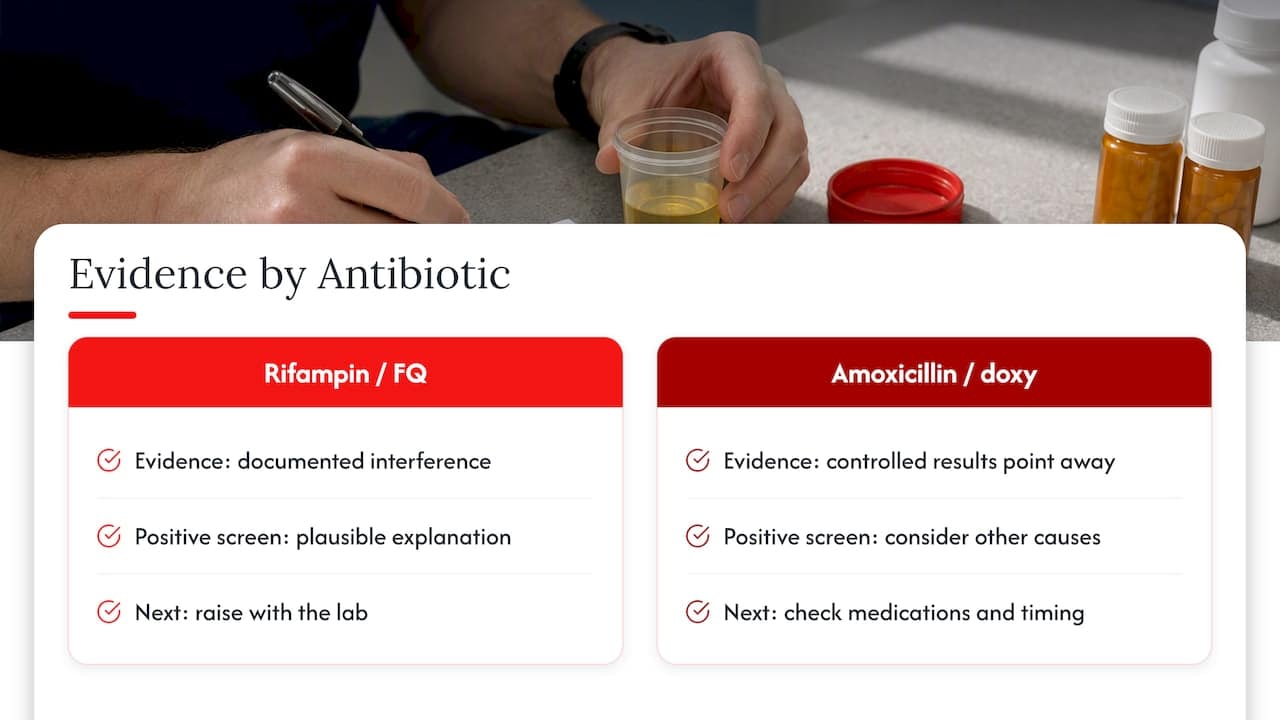
That distinction matters for how you interpret your own situation. If you took a fluoroquinolone or rifampin shortly before a positive screen, the documented interference with those specific drugs is a plausible explanation worth raising with the lab. If you took amoxicillin or doxycycline, the controlled evidence points away from the antibiotic as the cause, and it is worth considering other medications, supplements, or timing factors instead.
Clinicians and lab staff are encouraged to review a patient’s full medication list and communicate directly with the laboratory before concluding that a positive screen reflects illicit drug use. This back-and-forth, rather than a fixed statistic, is how most antibiotic-related presumptive positives actually get resolved. The rarity of confirmed cross-reactivity cases in the fluoroquinolone and rifampin literature suggests these events are uncommon relative to the volume of antibiotic prescriptions filled each year, but no source quantifies an exact frequency, so treat any specific percentage you see elsewhere with caution.
Does sample type change the risk of a false positive?
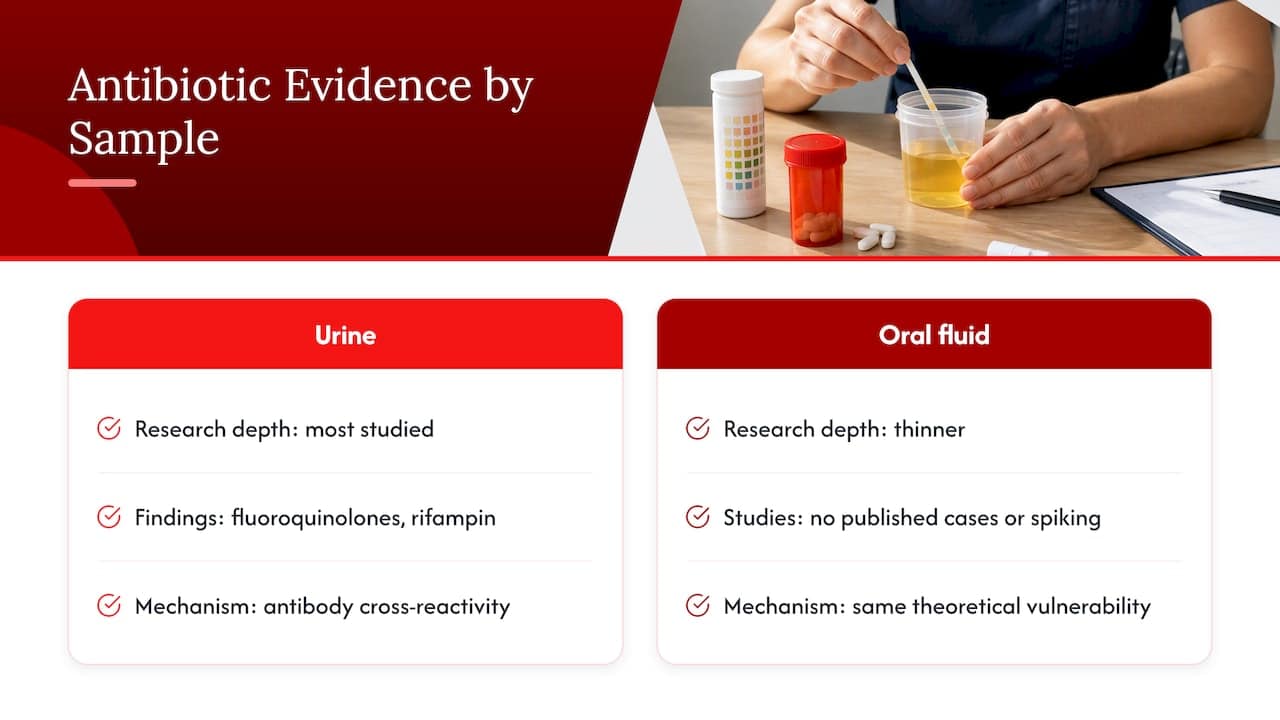
Urine remains the most studied specimen type for drug screening, and nearly all the antibiotic cross-reactivity evidence, including the fluoroquinolone and rifampin findings, comes from urine immunoassays. The antibody-based chemistry that creates cross-reactivity in urine testing is the same basic mechanism that could affect other fluid-based screens, but the antibiotic-specific research has not been replicated across oral fluid or other matrices with the same depth.
Oral swab testing detects drugs present in saliva, and its antibody-based immunoassay chemistry carries the same theoretical vulnerability to structural cross-reactivity as urine testing. Without published case reports or spiking studies specific to oral fluid antibiotic interference, it is not accurate to claim oral swabs carry a higher or lower false-positive risk than urine when it comes to antibiotics. The honest answer is that the research base for oral fluid and other specimen types is thinner, not that the risk is necessarily different.
What does differ by sample type is the detection window and collection method, which affects how timing interacts with any potential interference. A urine sample collected hours after an antibiotic dose may carry a different drug concentration than an oral swab collected at the same moment, simply because the two fluids clear medications at different rates. If you are on a fluoroquinolone or rifampin and facing any type of screen, documenting your dosing schedule alongside the sample collection time is useful regardless of which specimen type is used.
Choosing screening kits that reduce antibiotic interference risk
Because cross-reactivity is assay- and manufacturer-specific, the choice of screening kit itself plays a real role in how often antibiotic use produces a confusing result. A kit built around well-documented antibody specificity and consistent cutoffs is less likely to produce a presumptive positive that later requires lengthy explanation.
A few practical factors are worth checking before you select a test cup or dip card for professional or personal use.
- Favor CLIA waived, FDA approved kits, since these have undergone a formal review of their performance characteristics.
- Check whether the panel includes adulterant testing, which helps separate specimen tampering from genuine screening interference.
- When screening someone on a known antibiotic like a fluoroquinolone or rifampin, plan for confirmatory testing as a standard next step rather than an exception.
Our 8 panel urine test cup and other multi-panel formats in our shop are built around these same cutoffs and quality standards, which is part of why labs and clinics use them for both routine and higher-scrutiny screening. Our comparison of top urine drug test cups covers panel selection in more detail for readers weighing different options.
Interpreting results in forensic, clinical, and workplace settings
Context changes how much weight a presumptive positive should carry. In a forensic setting, where legal consequences are on the line, a positive screen should never stand alone; confirmatory testing by GC-MS or LC-MS/MS is the expected standard before any conclusion is documented. Employers running workplace drug testing programs typically follow a similar principle, and federal guidelines for workplace drug testing address calibration and cross-reactivity as technical factors that certified labs must manage.
Clinical settings carry a different kind of stakes. A physician reviewing a patient’s urine screen needs to know about current antibiotic use before interpreting an unexpected positive, since a confirmed negative after a positive screen is a meaningful clinical signal pointing to interference rather than drug use. Employers and testing administrators generally rely on medical review officers for exactly this kind of interpretation.
Turnaround time also affects how these cases get handled. According to guidance on employer drug screen turnaround expectations, many workplace screens and their confirmations are expected to resolve within one to two business days, which gives both the employer and the employee a reasonable window to document antibiotic use before a final decision is made. Whatever the setting, the same principle holds: a presumptive positive tied to a known interfering antibiotic deserves a documented review, not an automatic assumption of drug use.
My take after looking at the evidence
The antibiotic false-positive scare is smaller than the internet makes it sound. Real cross-reactivity exists for a short list of drugs, mainly certain fluoroquinolones and rifampin, and in nearly every documented case, confirmatory testing resolved the confusion. The bigger risk isn’t the antibiotic itself, it’s skipping the confirmation step or staying quiet about your medications.
— Justin
A practical option for reliable screening and clear results
If you’re responsible for screening others, whether in a clinic, a workplace program, or a treatment setting, the antibiotics issue is really a case for using well-documented kits and building confirmatory testing into your workflow from the start. We carry multi-panel cups and dip cards with documented cutoffs, so a presumptive result is easier to explain and resolve when a known interference like rifampin or a fluoroquinolone is in the picture.
- Our multi-panel test cups and dip cards cover standard screening panels for clinics, workplaces, and treatment programs.
- Our dip card testing guide explains when a dip card format fits better than a cup-based test.
- Our false-positive identification guide walks through documenting a suspected interference case before it becomes a dispute.
Browse our full shop for current panel options, or reach out to our customer service team for help matching a kit to your screening setting.
This article is general information, not a substitute for advice from a qualified doctor. Consult a qualified healthcare professional about your own circumstances before acting on anything here.
FAQ
What is the most common false-positive drug test result?
Opiate and amphetamine immunoassays are the panels most often linked to false positives from medications, including the documented fluoroquinolone and rifampin interference cases. Structural similarity between certain drugs and the assay’s target antibody is the usual cause, and any positive result should go through confirmatory testing before being treated as final.
Will amoxicillin cause me to fail a drug test?
No, a controlled study of patients taking amoxicillin found no reproducible cross-reactivity with cocaine metabolites or other routine screening panels. Reports linking amoxicillin to false positives are largely anecdotal and not supported by controlled research.
Will doxycycline cause a false-positive drug test?
There is no reliable published evidence tying doxycycline to false positives on standard urine immunoassays. If a positive result follows doxycycline use, it is worth looking at other medications, supplements, or timing factors rather than assuming the antibiotic is the cause.
Can antibiotics be detected in a drug test?
Standard drug test panels are not designed to detect antibiotics directly, since they screen for substances like opiates, amphetamines, and other controlled drugs rather than antibiotic compounds themselves. The concern with antibiotics is indirect: certain ones, like levofloxacin, ofloxacin, and rifampin, can cross-react with the antibody used in specific immunoassays and trigger an unrelated false positive.
Sources
- Commonly used fluoroquinolones cross-react with urine drug screens for opiates, buprenorphine, and amphetamines
- Case reports and experimental confirmation of rifampin interference with opiate immunoassays
- Study: amoxicillin and urine drug-screen cross-reactivity (no reproducible association)
- Pharmacovigilance analysis: drugs causing false-positive amphetamine urine tests