Blog
CLIA Waived Requirements: 3 Steps U.S. Clinics Must Take Now


If you perform any waived test on human specimens for diagnosis, prevention, treatment, or health assessment, you generally need a CLIA Certificate of Waiver. Three things to do right now: confirm your test’s waived status on the FDA/CLIA list, complete Form CMS-116 and send it to your State Agency, and keep the manufacturer’s current instructions on site. Certificates run for two years and must be renewed biennially.
TL;DR:
- Verify each test system, analyte, and specimen type in the FDA database; waived status can differ by specimen, and listings change.
- Submit the completed CLIA application to your State Agency, check for additional state licensing rules, and pay only after CMS issues an invoice.
- A Certificate of Waiver lasts two years; changing a test’s specimen, timing, or components, or adding nonwaived tests, requires a higher certificate.
- Keep current manufacturer instructions, quality control logs, lot records, and staff training documentation on site; complaint investigations and targeted inspections remain possible.
- Treat waived drug screens as presumptive; when results could affect employment, disclose their limits and arrange confirmation through a certified laboratory.
Table of Contents
- Who needs a Certificate of Waiver and what it allows
- Which tests are CLIA-waived and how to verify a test’s status
- How to apply for a Certificate of Waiver (Form CMS-116): step-by-step
- Key compliance obligations for CoW holders (daily operations and recordkeeping)
- Common pitfalls: modifying tests and off-label uses that remove waived status
- Practical checklist and resources for implementation
- Quality assurance for waived drug tests beyond the package insert
- Personnel qualifications and training for waived testing
- Handling and reporting waived test results accurately
- Why waived testing deserves the same discipline as any clinical process
- Stocking compliant CLIA waived kits for your Certificate of Waiver
- FAQ
- Sources
Who needs a Certificate of Waiver and what it allows
CLIA applies to any facility in the United States that tests human specimens for diagnosis, prevention, treatment, or health assessment, whether that facility is a hospital lab, a urgent care clinic, a physician’s office, or a workplace testing program. The CLIA certification process requires that facility to hold the certificate matching the complexity of testing it performs.
A Certificate of Waiver (CoW) covers only tests categorized as waived under CLIA. Other certificate types exist for sites doing provider-performed microscopy (PPM), moderate complexity, or high complexity testing, and each carries its own personnel and quality standards. If your site ever adds a test outside the waived category, the CoW no longer covers that testing.
A few states run their own CLIA-related programs with extra requirements:
- New York and Washington operate state licensure programs that can add steps beyond the federal CLIA application.
- Some states require separate lab licenses even for sites that only perform waived tests.
- Contacting your State Agency early avoids delays once you’re ready to submit Form CMS-116.
Which tests are CLIA-waived and how to verify a test’s status
Waived tests are simple, low-risk methods that carry a minimal chance of an incorrect result when performed as directed. This category includes tests the FDA has cleared for home use and tests that meet the specific waiver criteria set out in 42 CFR Part 493, which also defines the regulatory basis for the waiver designation. CDC’s test complexity guidance confirms that waived status depends on both the test system and the specific analyte or specimen type, not just the general category of test.
Before you rely on any kit, verify its waived status directly:
- Search the FDA’s CLIA waived-test database by manufacturer name, test system, or analyte.
- Confirm the specimen type listed matches what you intend to collect, since the same analyte can be waived for one specimen type and non-waived for another.
- Check the date of the listing, since FDA updates the waived-test list periodically as new devices clear review.
Commonly waived tests include blood glucose meters, many urine pregnancy tests, certain urine dipstick panels, and a range of point-of-care drug test cups and cards used in clinics and workplace programs. Because the list changes, re-verify status whenever you adopt a new device or lot from a different manufacturer. Our overview of what CLIA waived means covers this distinction in more detail.
How to apply for a Certificate of Waiver (Form CMS-116): step-by-step
Applying for a CoW is a paperwork process, not an inspection process, but the form has to be filled out correctly the first time to avoid delays. The CMS CLIA Certification Quick Start Guide lays out exactly which sections apply to waiver-only applicants.
- Download Form CMS-116 and complete Sections I through VI: facility identification, type of facility, director and owner information, and the certificate type requested.
- In Section II, select the certificate corresponding to the highest complexity of testing you will perform. For a CoW, that means waived tests only.
- List your waived test menu and estimate your annual test volume per analyte.
- Complete Sections IX and X, which cover certification statements and signatures from the authorized official.
- Mail or submit the completed form to your State Agency, not to CMS directly.
- Wait for CMS to issue an invoice containing your assigned CLIA identification number before sending any payment.
- Pay the invoiced fee to activate the certificate; a modest fee increase for CoW certificates took effect under a recent CMS final rule.
Pro Tip: Keep a copy of your submitted Form CMS-116 and the resulting invoice together in your compliance file. You’ll need both when it’s time to renew or if your State Agency requests confirmation of your CLIA ID.
Your CoW is valid for two years from the date of issue. If you later decide to add a non-waived test, you cannot start performing it under your existing CoW. You must apply for the appropriate higher-level certificate, such as a Certificate of Compliance or Certificate of Accreditation, and you may not begin that testing until the new certificate is issued and any applicable fee is paid.
Key compliance obligations for CoW holders (daily operations and recordkeeping)
Holding a CoW comes with day-to-day obligations that matter more than the application itself. The CDC’s “Ready? Set? Test!” guidance identifies following the manufacturer’s current instructions as the central requirement for every waived test you run, covering timing, storage conditions, and any quality control steps the manufacturer specifies.
Daily and ongoing obligations include:
- Running quality control exactly as the manufacturer’s package insert requires and treating control samples with the same care as patient specimens.
- Keeping QC logs, lot numbers, and expiration dates on file so you can reconstruct testing history if questioned.
- Notifying your State Agency within 30 days of any change in ownership, facility name, physical location, or laboratory director.
- Renewing your CoW every two years and paying the CMS-issued invoice promptly to avoid a lapse in certification.
A Certificate of Waiver is valid for two years and must be renewed on that cycle; CoW sites are not routinely surveyed like higher-complexity labs but remain subject to complaint investigations and targeted inspections. This means the absence of a scheduled inspection doesn’t mean the absence of oversight, according to CMS.
CMS or your State Agency can inspect a CoW site in response to a complaint, evidence that a facility is performing testing outside its waived scope, or indications of risk of harm to patients. Keeping your QC logs, training records, and manufacturer inserts organized and accessible is what lets you demonstrate compliance quickly if that happens. Our guide on complying with CLIA regulations for drug testing accuracy walks through these recordkeeping habits in practical detail.
Common pitfalls: modifying tests and off-label uses that remove waived status
The fastest way to lose waived status without realizing it is modifying the test itself. Using a different specimen type than the package insert specifies, changing the read time, or physically altering any kit component all convert a waived test into a non-waived one under CLIA, even if nothing else about your process changes.
Once a test becomes non-waived, your lab has to upgrade to a Certificate of Compliance or Certificate of Accreditation and meet additional requirements for personnel qualifications, proficiency testing, and quality control.
- Keep current manufacturer package inserts on site for every test system in use, not just the original version.
- Log every lot change and instruction update, since manufacturers revise instructions over time.
- Retrain staff whenever a new lot, kit version, or instruction update arrives, rather than assuming prior training still applies.
Practical checklist and resources for implementation
Before you start waived testing, run through a short setup checklist so nothing falls through during your first weeks of operation.
- Verify waiver status for every test system against the FDA database.
- Submit Form CMS-116 and obtain your CoW before testing patients.
- Place manufacturer instructions and QC logs at each testing station.
- Document personnel training for every staff member performing tests.
- Set calendar reminders for your biennial renewal and invoice payment.
| Resource | What it provides |
|---|---|
| FDA CLIA waived-test database | Verification of waived status by test system and analyte |
| CMS Form CMS-116 and quick-start guide | Application sections and submission instructions for a CoW |
| CDC “Ready? Set? Test!” booklet | Practical testing procedures and quality control templates |
Keep a QC log, a current inventory list of test kits and lot numbers, and a notification template ready for any change you need to report to your State Agency. Having these on file before an inspection or complaint investigation saves time and reduces stress.
Quality assurance for waived drug tests beyond the package insert
Manufacturer instructions set the floor for waived drug test quality, not the ceiling. Even though CLIA doesn’t mandate proficiency testing for waived tests, running periodic proficiency checks, comparing results against a known positive and negative control, and documenting the outcome gives your site an early warning system for reagent or device problems that routine QC might miss.
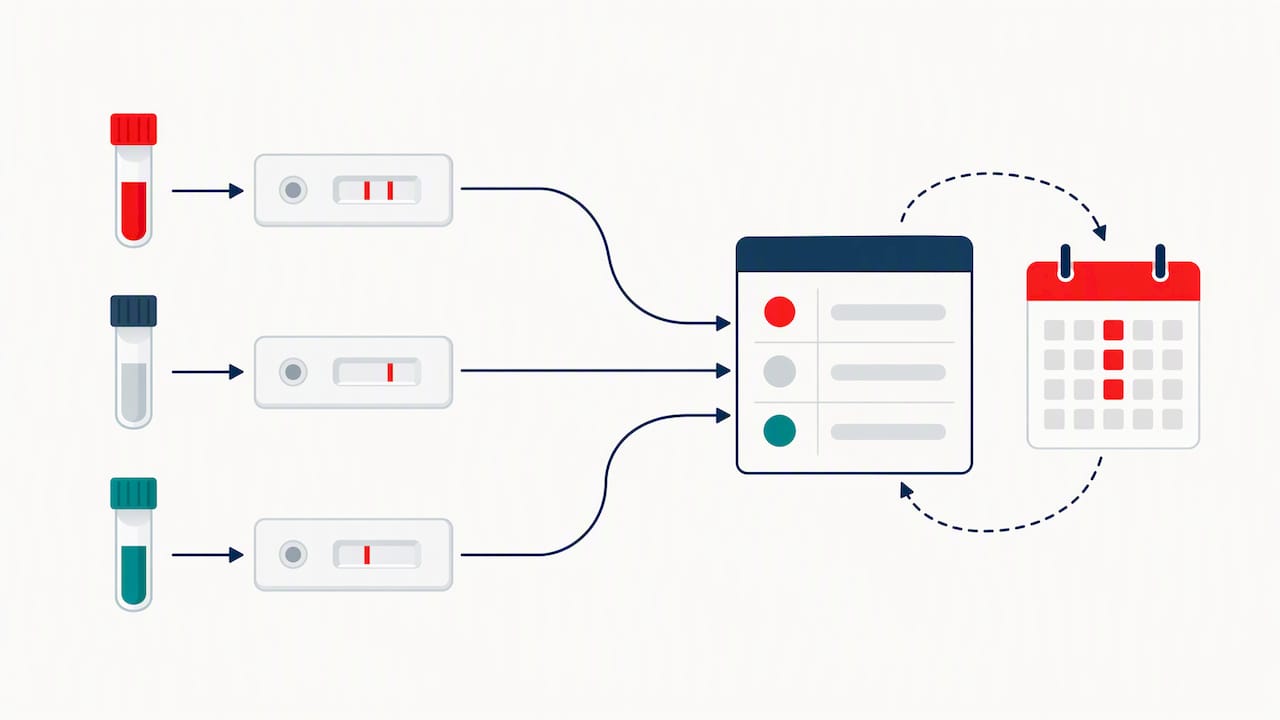
Rapid immunoassay cups, dip cards, and oral swabs used for drug screening are among the most common waived test formats, and their accuracy depends heavily on specimen handling, correct read-time windows, and storage temperature. Building a simple internal proficiency check, say, testing a known control sample monthly alongside regular patient testing, helps catch a failing lot before it affects a real result.
CDC’s good laboratory practices guidance for waived-testing sites notes that while most waived sites take reasonable steps to test correctly, quality problems still arise from staff turnover, inconsistent training, and gaps in documented practices. Written procedures and a named person responsible for QC oversight address that gap directly. Pairing your test kits with compatible control materials, rather than relying on the kit alone, is a low-cost way to close this loop.
Personnel qualifications and training for waived testing
CLIA does not impose the strict personnel qualification requirements on waived testing that it applies to moderate and high complexity labs. There’s no mandated minimum degree or certification to perform a waived test under a CoW. That said, “no federal requirement” doesn’t mean “no responsibility.”
Every person running a waived test should be trained specifically on that test system: how to collect the specimen, how to time the read window, what an invalid result looks like, and when to repeat a test rather than report a questionable one. Document that training with a date and the trainee’s name, and repeat it whenever instructions or kit lots change materially.
Many state programs and employers choose to require more than the federal floor, including documented competency checks or periodic retraining. Checking your State Agency’s expectations alongside the federal baseline keeps you from assuming CLIA’s minimum is automatically sufficient for your market. CDC’s waived-tests resource page offers checklists and training materials built specifically for this kind of in-house program.
Handling and reporting waived test results accurately
A waived test is only as reliable as the process around it. Reading a result outside the manufacturer’s specified time window, whether early or late, can be a source of error in point-of-care and drug testing settings, and it can produce a false positive or false negative that has nothing to do with the test’s underlying chemistry.
Document each result with the date, time read, operator initials, and lot number, not just the outcome. That record is what lets you investigate a discrepancy later or respond to a complaint investigation with specifics rather than memory.
Waived tests, by design, carry real limitations: they’re built for simple, presumptive answers, not confirmatory ones. Any result used for a consequential decision, such as a workplace drug test result that will affect employment, should be reported with its limitations noted, and confirmatory testing through a certified laboratory should follow when the stakes call for it. Our point-of-care testing primer covers this handoff between screening and confirmatory testing in more depth.
Why waived testing deserves the same discipline as any clinical process
“Waived” describes regulatory complexity, not clinical stakes. A result from a waived test still shapes a diagnosis, a treatment decision, or an employment outcome, so it deserves the same rigor around instructions and quality control that any lab test gets. Clinics that build organized testing processes, with current instructions on hand, QC logged consistently, and staff retrained on schedule, see fewer errors, fewer complaints, and far less exposure if a surveyor ever shows up.
— Justin
Stocking compliant CLIA waived kits for your Certificate of Waiver
Once your CoW is in place, the next step is sourcing test kits that actually match your certificate. We supply CLIA-waived, FDA-cleared test cups, dip cards, oral swabs, and specimen collection supplies built for exactly this kind of clinic and workplace testing program.
When you’re choosing products, check each listing for its CLIA and FDA details before ordering, request a bulk quote if you’re outfitting more than one testing station, and stock control materials alongside your test kits so proficiency checks are easy to run. Browse our full shop for panel cups, dip cards, and oral swabs, or reach out for bulk pricing. For programs structuring broader compliance workflows, a resource like this guide to practice compliance program benefits is worth reviewing alongside your CLIA setup.
This article is general information, not a substitute for advice from a qualified doctor. Consult a qualified healthcare professional about your own circumstances before acting on anything here.
FAQ
Is CLIA certification mandatory for testing sites?
Yes. Any U.S. facility testing human specimens for diagnosis, prevention, treatment, or health assessment generally must hold a CLIA certificate matching its testing complexity, including a Certificate of Waiver for sites that only run waived tests, according to CMS.
What qualifications does a laboratory director need?
Director qualifications depend on the certificate type and testing complexity your facility performs, with CLIA setting no specific federal degree requirement for Certificate of Waiver sites. Higher complexity certificates carry stricter director qualification standards, so check the requirements tied to your specific certificate type with your State Agency.
What is a CLIA number and what does it represent?
A CLIA identification number is the unique number CMS assigns to your facility once your Form CMS-116 application is processed and your invoice is issued. It identifies your specific certificate, its type, and its expiration date, and you’ll need it on file for renewals and any inspection.
What lab tests are CLIA waived?
Waived tests include simple, low-risk test systems such as many glucose meters, urine pregnancy tests, certain dipstick urinalysis tests, and various point-of-care drug test cups, cards, and oral swabs. The definitive list is maintained in the FDA’s CLIA waived-test database and updated periodically as new devices clear review.