
Blog
Detectable 1–10 Days: Ketamine Urine Testing, Clinician Steps


Standard workplace and DOT urine panels do not screen for ketamine, so a routine 5, 10, or 12 panel test will almost always come back negative even if someone has recently used it. Ketamine only appears when a lab runs an expanded panel or a targeted confirmatory method like LC/MS/MS or GC/MS. Detection windows vary from about a day on basic screens to well over a week with sensitive lab methods, depending on which metabolite is measured.
TL;DR:
- Standard drug tests rarely detect ketamine unless an expanded panel or targeted confirmatory test is performed, as routine screens do not include it.
- Rapid immunoassay screens provide quick results but have lower specificity, risking false positives that need laboratory confirmation with GC/MS or LC-MS/MS.
- Sensitive lab methods can detect ketamine metabolites up to 10 days after use, especially with heavy or repeated dosing, which surpasses standard screening windows.
- Positive screening results should always be followed by confirmatory testing and verification of prescriptions to prevent misinterpretation, with specimen validity checks to identify tampering.
- Testing supplies with ketamine detection capability are available in multi-panel cups and dip cards, suitable for various programs from probation to clinical monitoring, with confirmatory testing recommended for borderline or legal cases.
Table of Contents
- Point-of-care dip cards versus laboratory confirmatory testing
- How long ketamine stays detectable in urine
- What ng/mL cutoffs actually mean for a result
- What to do after a positive screening result
- Sample validity checks that catch tampering
- When ketamine-specific testing gets ordered
- Choosing the right test for professional screening programs
- A fair testing process protects everyone involved
- Where to find ketamine-capable testing supplies
- Sources
- FAQ
Point-of-care dip cards versus laboratory confirmatory testing
Rapid dip cards and cup-based immunoassays give a result in minutes, which is why they show up at collection sites, probation offices, and clinics that need an on-the-spot answer. These devices work by detecting antibody reactions to drug compounds in urine, and many multi-panel products now include a dedicated ketamine (KET) marker alongside standard analytes. Turnaround is fast, cost per test is low, and the format suits high-volume screening where a quick yes-or-no answer is enough.
The tradeoff is specificity. Immunoassays can cross-react with structurally similar compounds, which occasionally produces a positive result for a substance that isn’t actually present. That’s part of why manufacturer guidance on esketamine urine screening flags cases where an immunoassay flagged ketamine, but a confirmatory test came back negative.
Laboratory confirmatory testing solves that gap. GC/MS and LC-MS/MS separate and identify compounds by mass and structure rather than by antibody reaction, which makes them the accepted standard whenever a result carries legal, employment, or clinical consequences.
Typical use cases break down like this:
- On-site or probation checks: dip cards or cups for a fast preliminary read.
- Pre-employment or program screening: multi-panel cups that may include a KET cutoff.
- Legal disputes or clinical monitoring: samples sent for GC/MS or LC-MS/MS confirmation.
- Research or forensic casework: targeted mass spectrometry methods built around specific analytes.
How long ketamine stays detectable in urine
Detection windows depend heavily on which compound the test is actually looking for. Ketamine itself clears relatively quickly, while its metabolites, norketamine and dehydronorketamine, linger longer and are what sensitive lab methods often target.
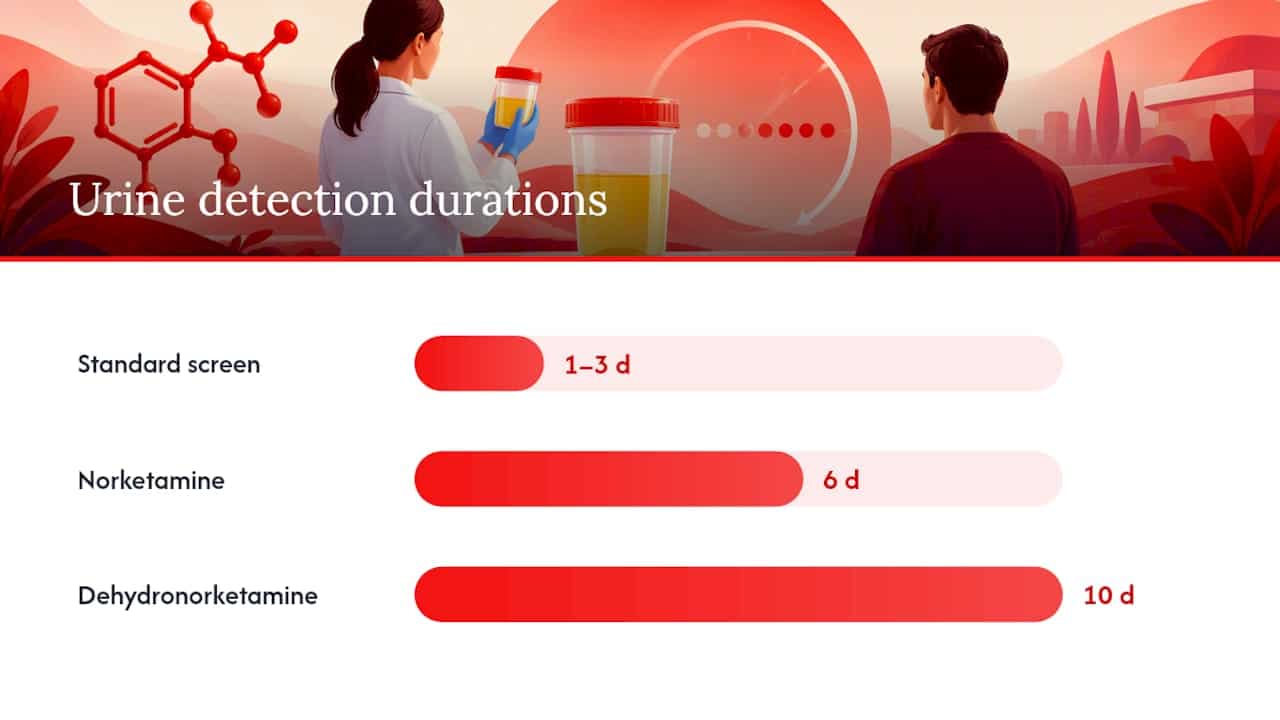
A study using UHPLC-MS/MS detected norketamine for up to 6 days and dehydronorketamine for up to 10 days after a single dose, far longer than a basic screening cutoff would catch. That gap between what a rapid immunoassay reports and what a sensitive lab method can still find is the main reason detection windows get quoted so inconsistently online.
Several factors push the window longer or shorter for any individual:
- Dose and frequency: heavier or repeated use extends how long metabolites remain measurable.
- Metabolism and body composition: faster clearance shortens the window, slower clearance extends it.
- Hydration at the time of collection: diluted urine can lower measured concentrations below a cutoff.
- The cutoff and method used: a low-cutoff sensitive assay will catch what a higher-cutoff rapid test misses.
Someone using ketamine occasionally at a lower dose will likely fall closer to the one to three day range on standard screens, while frequent or higher-dose use can keep metabolites detectable well past a week under sensitive testing.
What ng/mL cutoffs actually mean for a result
Every drug test reports results against a cutoff, a concentration threshold measured in nanograms per milliliter (ng/mL) below which the sample is called negative regardless of what’s technically present. A product labeled “KET/1000,” for instance, is set to flag positive only once ketamine concentration reaches 1000 ng/mL.
Rapid, point-of-care kits generally use cutoffs in the 500 to 1000 ng/mL range, prioritizing speed and low false-positive rates over maximum sensitivity. Laboratory LC-MS/MS methods operate at a different scale entirely, with analytical chemistry literature reporting detection limits in the sub-ng/mL to low-ng/mL range, letting labs confirm far smaller trace amounts than a dip card ever would.
That difference explains a lot of confusion around results:
- Higher cutoffs reduce false positives but can miss light or older use.
- Lower cutoffs catch more trace-level use but raise the odds of borderline calls needing confirmation.
- Program goals decide the choice: casual workplace screening usually favors a higher cutoff, while clinical monitoring paired with confirmatory testing can justify a lower one.
What to do after a positive screening result
A positive on a rapid screen is not a final answer, it’s a flag that triggers a specific process. Under standard protocol, a screening positive gets sent to a laboratory for confirmatory testing using GC/MS or LC-MS/MS, and a Medical Review Officer (MRO) reviews the confirmed result alongside any documented medical explanation before it’s reported as final.
Case reports and manufacturer guidance have documented immunoassay positives for ketamine that did not hold up under GC/MS confirmation, which is exactly why orthogonal confirmation matters rather than treating a single screen as conclusive.
If you’re facing a positive result, take these steps in order:
- Ask for confirmatory testing rather than accepting the screening result as final.
- Document any legitimate prescription, such as esketamine treatment, and provide it to the MRO.
- Request the specific cutoff and method used so you understand what triggered the flag.
- Follow up in writing if the confirmatory result differs from the initial screen.
Managers and clinicians should mirror that process: verify prescriptions before assuming misuse, and never treat an unconfirmed immunoassay result as a final determination. Our guide to identifying false positives walks through common cross-reactivity patterns in more detail.
Pro Tip: Always request the reported cutoff level alongside a positive result, it tells you how close the sample was to the threshold and whether confirmation is worth pursuing.
Sample validity checks that catch tampering
Labs don’t just test for drugs, they check whether the sample itself is legitimate human urine collected under normal conditions. SAMHSA guidance on urine biomarker validity testing lists the standard ranges labs use to flag a specimen as invalid or substituted.
Typical validity markers include:
- Creatinine above 20 mg/dL, confirming the sample is consistent with human urine.
- Specific gravity between roughly 1.001 and 1.030, ruling out excessive dilution.
- pH between about 4.5 and 9.0, outside of which tampering is suspected.
- Temperature of 90 to 100°F at collection, checked within minutes to catch substituted samples.
Exogenous markers, compounds that don’t occur naturally in urine such as certain preservatives, also get screened as tampering evidence. When a sample fails these checks, labs typically refuse to report a standard result, request a recollection under direct observation, or run additional assays to identify what was added.
When ketamine-specific testing gets ordered
Routine employer and DOT panels are built around marijuana, cocaine, opioids, amphetamines, and PCP, not ketamine, so it only appears in results when someone deliberately orders an expanded panel or a targeted assay.
That happens in a handful of predictable situations:
- Forensic and court-ordered monitoring, where a specific substance history is under scrutiny.
- Probation or treatment program compliance checks requiring documented abstinence.
- Clinical monitoring during esketamine (Spravato) treatment, where prescription verification through an MRO matters for accurate interpretation.
- Research settings studying ketamine metabolism or pharmacokinetics.
Outside of these contexts, a standard panel simply won’t catch it, which is worth knowing before assuming a clean routine result rules out ketamine use.
Choosing the right test for professional screening programs
Programs running drug testing at scale need to match the test format to the decision it’s actually supporting. Point-of-care cups and dip cards work well for fast, on-site checks where a same-day answer matters more than sub-ng/mL sensitivity. Multi-panel cups and dip card lines include options with a dedicated KET marker for programs that specifically need ketamine coverage alongside standard analytes.
A few decision points make the choice easier:
- Match the panel to the goal: casual workplace screening rarely needs the same cutoff sensitivity as clinical monitoring.
- Look for CLIA-waived, FDA-approved products when running point-of-care testing in a clinical or workplace setting.
- Add an adulterant or validity panel to any program handling samples that could be tampered with.
- Send borderline or consequential results to a lab for GC/MS or LC-MS/MS confirmation rather than relying on the screen alone.
A fair testing process protects everyone involved
Testing programs work best when confirmatory standards are non-negotiable and cutoffs are disclosed rather than hidden. People taking prescribed ketamine treatments deserve a clear path to document that with an MRO, and labs owe everyone consistent sample-validity procedures so a diluted or mishandled specimen doesn’t get mistaken for tampering or use.
— Justin
Where to find ketamine-capable testing supplies
If your program needs ketamine coverage built into a screening workflow, RapidTestCup carries multi-panel cups and dip cards with a KET entry alongside standard analytes, plus specimen collection cups for programs that separate screening from confirmatory shipping. Inventory stays in stock with same-day shipping and a selection of CLIA-waived, FDA-approved products to choose from.
- Compare the 15-panel cup with KET/1000 and 16-panel cup with KET/1000 for adulterant coverage alongside ketamine.
- Browse urine specimen cups for collections headed to confirmatory labs.
- Visit the full shop to compare panels or contact sales for bulk pricing and custom panel requests.
Sources
- Detection of Ketamine and Its Metabolites in Urine by Ultra High Pressure Liquid Chromatography-Tandem Mass Spectrometry
- Ketamine and phencyclidine (PCP) – Merck Manual
- Use of urine biomarkers in validity testing; strategies and complexities – SAMHSA
- SPRAVATO – Urine Drug Screen (manufacturer guidance)
- Determination of ketamine and metabolites in urine by liquid chromatography–mass spectrometry
FAQ
Does ketamine show up on a standard drug test?
No, most standard workplace and DOT panels do not include ketamine because they’re built around marijuana, cocaine, opioids, amphetamines, and PCP. Ketamine only appears when an expanded panel or targeted assay specifically includes a KET marker.
How long does ketamine stay in urine?
It depends on the method: routine screening cutoffs typically catch use within one to three days, while sensitive lab methods have detected norketamine up to 6 days and dehydronorketamine up to 10 days after a single dose. Heavier or repeated use tends to extend that window further.
What should I do if a ketamine screen comes back positive?
Request confirmatory laboratory testing using GC/MS or LC-MS/MS rather than accepting the screening result as final, and if you have a legitimate prescription such as esketamine treatment, document it for the Medical Review Officer. This two-step process exists specifically because immunoassay positives don’t always confirm under lab analysis.
What cutoff level do ketamine test cups typically use?
Point-of-care cups and dip cards commonly use a cutoff around 1000 ng/mL, often labeled “KET/1000” on the product. Laboratory LC-MS/MS methods detect far lower concentrations, into the sub-ng/mL to low-ng/mL range, which is why consequential results should go to confirmatory testing rather than resting on a screening cutoff alone.
Can a diluted urine sample cause a false negative for ketamine?
Yes, diluted urine can push a genuinely present drug concentration below the test’s cutoff, producing a false negative. That’s why labs check specimen validity markers like creatinine, specific gravity, and temperature alongside the drug screen itself.