Blog
Psilocybin Drug Tests: Routine Screens Miss It; Labs Find Psilocin


No, standard 5- and 10-panel workplace drug tests do not typically detect psilocybin. These panels screen for a fixed set of common substances, and psilocybin isn’t one of them. Specialized lab assays can detect psilocin, the active compound your body converts psilocybin into, but the detection window is short, and HHS/SAMHSA federal testing panels don’t include it as a routine biomarker.
TL;DR:
- Targeted testing is generally reserved for forensic investigations, legal disputes, clinical research, or cases where an employer or program specifically suspects use and requests it.
- Urine testing may detect psilocin for hours to a few days with sensitive processing, while blood and oral fluid usually offer only a few hours.
- Ask whether the laboratory uses enzymatic hydrolysis and its validated quantitation limit, because untreated urine can conceal conjugated psilocin and produce a false negative.
- A validated forensic urine method reported a quantitation limit near 10 ng/mL after hydrolysis and chemical derivatization, showing the trace level specialized testing must detect.
- For employment, legal, or medical decisions, choose laboratory confirmation by mass spectrometry; rapid screens are preliminary, and a negative result cannot rule out recent use.
Table of Contents
- Do standard workplace and common panels test for psilocybin or psilocin?
- Detection windows by specimen: urine, blood, oral fluid, hair, fingernail
- Specialized testing methods: LC-MS/MS, GC/MS, hydrolysis, and confirmatory workflows
- Factors that influence detectability: dose, metabolism, frequency, and lab methods
- Federal workplace panels and policy: what SAMHSA/HHS authorize and practical implications
- How to get tested for psilocybin: steps and what to expect
- Why accurate screening and lab confirmation both matter
- RapidTestCup options for psilocybin screening
- FAQ
- Sources
Do standard workplace and common panels test for psilocybin or psilocin?
Most employment drug screens rely on immunoassay technology built to flag a specific, limited list of substances. These panels were designed decades ago around the drugs employers and regulators cared about most at the time, and that list has changed slowly.
A typical 5-panel screen checks for:
- Marijuana metabolites (THC)
- Cocaine metabolites
- Opiates
- Amphetamines
- Phencyclidine (PCP)
A 10-panel version adds categories like benzodiazepines, barbiturates, methadone, and propoxyphene, and many modern panels now include fentanyl given its prevalence in overdose cases. Psilocybin and psilocin appear on none of these standard lists.
The reason traces back to federal guidance. Mandatory guidelines published by HHS and SAMHSA dictate which analytes are authorized for federal workplace and DOT testing programs, and recent notifications haven’t added psilocybin or psilocin as a routine biomarker. Private employers who model their programs on federal guidelines inherit the same blind spot.
That doesn’t mean psilocybin is untestable, just that someone has to specifically order it. This happens in a handful of situations: forensic investigations tied to an overdose or a crime, legal proceedings where drug use is at issue, clinical research settings studying psilocybin’s therapeutic potential, or targeted testing when an employer or program has a specific reason to suspect use and requests a specialty panel. Outside those contexts, a routine cup, dip card, or lab screen simply isn’t looking for it.
Detection windows by specimen: urine, blood, oral fluid, hair, fingernail
How long psilocybin stays detectable depends heavily on which specimen gets tested, and the honest answer across all of them is “not very long” compared to drugs like THC or benzodiazepines.
Psilocybin converts rapidly in the body to psilocin, the compound actually responsible for its effects and the target of most specialized tests. A systematic review and post-hoc pharmacokinetic analysis found psilocin’s terminal half-life runs roughly 1.23 to 4.72 hours, and only about 1.5% to 3.4% of a psilocybin dose gets excreted in urine as unconjugated psilocin. That narrow excretion fraction is a major reason detection windows stay short even with sensitive equipment.
| Specimen | Typical practical window | Primary use case |
|---|---|---|
| Urine | Hours up to roughly a few days with sensitive lab processing | Specialized lab confirmation |
| Blood | A few hours | Toxicology and emergency settings |
| Oral fluid | A few hours, similar to blood | Rarely used for psilocin specifically |
| Hair | Theoretically weeks to months with advanced forensic assays | Rare, research or forensic use only |
| Fingernail | Theoretically weeks to months, similarly rare | Rare, research or forensic use only |
A few practical notes shape how these numbers play out:
- Urine detection depends on dose size, how recently the person used, and the lab’s limit of quantitation.
- Blood and oral fluid windows are short enough that routine screening almost never catches psilocin unless testing happens within hours of use.
- Hair and nail testing for psilocin remain largely experimental and are not standard offerings at most labs.
Our guide to substance detection windows breaks down how these same variables play out across other drug classes, and our primer on what a detection window actually means is useful background if these concepts are new to you. None of these figures are absolute. Individual metabolism, hydration, dose, and lab sensitivity all shift the real-world window up or down.
Specialized testing methods: LC-MS/MS, GC/MS, hydrolysis, and confirmatory workflows
Routine drug screens use immunoassay technology: fast, inexpensive strips or cups that react to antibodies targeting specific drug classes. Immunoassays are built for speed and cost efficiency, not for detecting a substance like psilocin that isn’t part of their target list.
Detecting psilocin specifically requires targeted mass spectrometry, either liquid chromatography tandem mass spectrometry (LC-MS/MS) or gas chromatography mass spectrometry (GC/MS). These methods separate and identify compounds by mass and structure rather than relying on antibody cross-reactivity, which makes them far more specific.
A complicating factor: much of the psilocin excreted in urine is conjugated (bound to other molecules) rather than free. Labs commonly use enzymatic hydrolysis to break those conjugates apart before analysis, which recovers more of the compound and improves sensitivity. GC/MS methods often add a derivatization step, chemically modifying the molecule so it behaves predictably during analysis.
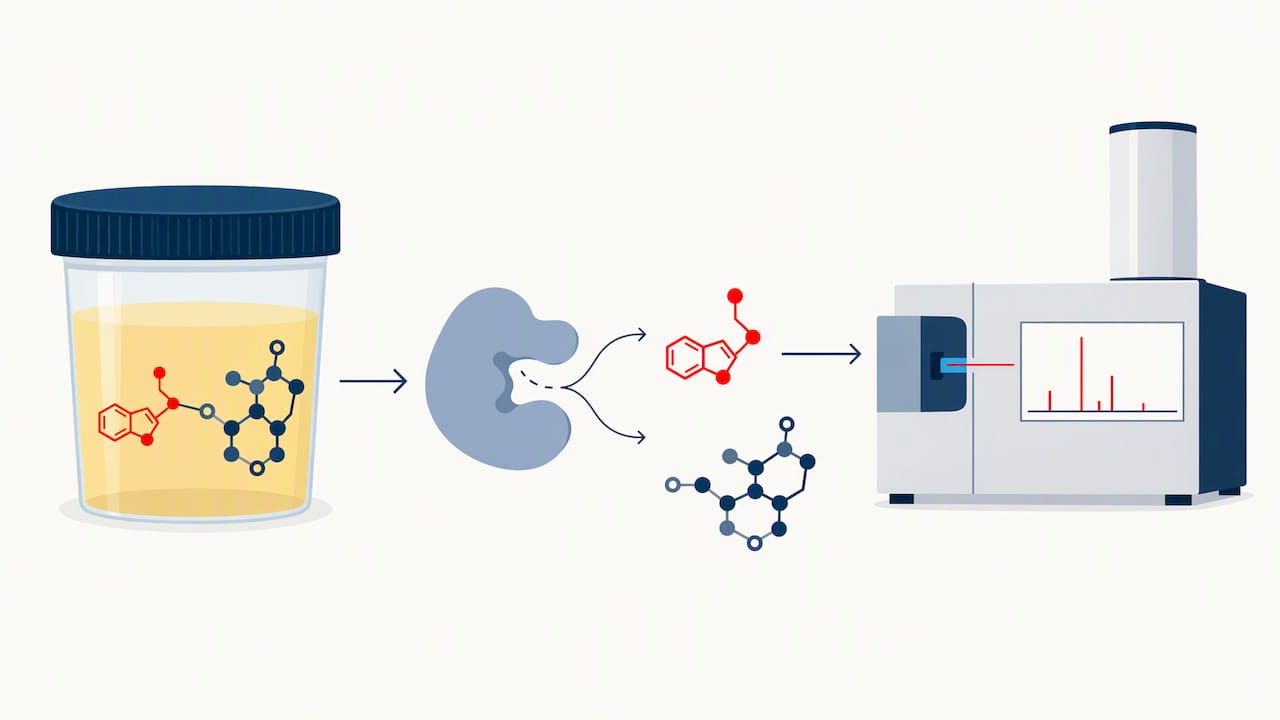
One validated forensic method reported a limit of quantitation of about 10 ng/mL for psilocin in urine after hydrolysis and derivatization, and the same method successfully detected psilocin in real case samples. That figure illustrates just how sensitive confirmatory testing has to be, since this is a trace-level target even in someone who used psilocybin recently.
Key takeaways on method differences:
- Immunoassay screening is fast and cheap but does not target psilocin at all.
- LC-MS/MS and GC/MS are slower and more expensive but can confirm psilocin at low concentrations.
- Confirmatory testing after a positive or suspected screen reduces false positives tied to cross-reactivity with unrelated compounds.
Turnaround for mass spectrometry confirmation typically runs longer than a same-day rapid screen, since samples usually get sent to an accredited lab rather than read on-site.
Factors that influence detectability: dose, metabolism, frequency, and lab methods
Several variables determine whether a specialized test catches psilocybin use, and none of them work in isolation.
Dose matters directly. A larger dose produces more psilocin circulating in the body and more excreted in urine, which widens the practical detection window somewhat. Frequency plays a role too: repeated use in a short period can keep psilocin levels elevated longer than a single isolated dose.
Metabolism varies from person to person. Enzymes including CYP2D6 and CYP3A4 help process psilocin, and UGT enzymes handle glucuronide conjugation, the process that binds psilocin to other molecules before excretion. People metabolize these pathways at different rates, and other medications can compete for the same enzymes, shifting how quickly psilocin clears.
Lab technique matters as much as biology. A test run without enzymatic hydrolysis will miss most conjugated psilocin and report a false negative even in someone who used psilocybin recently. The lab’s own limit of quantitation also sets a hard floor: concentrations below that threshold simply won’t register, regardless of how sensitive the underlying chemistry is in principle.
Timing ties all of this together:
- Testing sooner after use dramatically increases the odds of a positive result given psilocin’s short half-life.
- Hydrolysis before analysis recovers conjugated psilocin that would otherwise go undetected.
- A lab’s specific cutoff and equipment sensitivity can make two labs report different results from the same sample.
Pro Tip: If timing matters to your situation, ask the testing lab directly whether their method includes hydrolysis and what limit of quantitation they validate against, since both details change what counts as a negative result.
Federal workplace panels and policy: what SAMHSA/HHS authorize and practical implications
Federal workplace drug testing doesn’t operate on a free-for-all basis. HHS and SAMHSA mandatory guidelines set the specific analytes that federal agencies and DOT-regulated employers are authorized to test for, and labs certified for federal work follow that list precisely. These guidelines exist to standardize testing across agencies and keep results legally defensible.
Psilocybin and psilocin are not currently part of that authorized list. Recent notifications in the Federal Register have not added them as routine biomarkers, which means employers following federal panel structures, even voluntarily, aren’t screening for psilocybin by default.
This has a few practical consequences:
- A federal employee or DOT-regulated worker subject to standard random testing will not be screened for psilocybin under current guidelines.
- An employer that wants to test for psilocybin specifically has to order a non-standard, targeted panel outside the federal list, usually through a specialty or forensic lab.
- Adding a substance to federal guidelines is a deliberate regulatory process, not something an individual employer or lab can do unilaterally.
In practice, this means psilocybin testing stays rare outside forensic, legal, or research contexts where someone has a specific reason to order it and the budget to pay for mass spectrometry confirmation.
How to get tested for psilocybin: steps and what to expect
If you need clarity on psilocybin specifically, whether for personal reassurance, a workplace question, or a legal matter, the process looks different from a routine employment screen.
- Decide what you actually need first. A rapid screening product gives a quick preliminary read, while lab-based LC-MS/MS confirmation is what you need for legal, medical, or high-stakes situations where the result has to hold up.
- Order the right test or sample collection. For preliminary screening, a psilocybin urine drug test can be ordered directly. For confirmatory testing, samples typically need to go to an accredited laboratory, and any result intended for legal use requires documented chain-of-custody procedures during collection.
- Understand what the result means. Screening results usually read positive, negative, or invalid, while lab confirmation adds a quantitative concentration against a validated cutoff. Turnaround for rapid screening is typically immediate, while lab confirmation can take several days.
When a result carries real consequences, legal, employment, or medical, confirmatory testing through an accredited lab is the more defensible route.
Why accurate screening and lab confirmation both matter
Rapid screening products serve a real purpose: they’re fast, affordable, and useful for a first read on a situation. But psilocin’s short half-life and low urinary excretion mean a negative screen never fully rules out recent use, and a result with real consequences deserves lab-grade mass spectrometry confirmation rather than a single strip reading alone. Pairing a quality screening product with accredited confirmatory testing gives a far more complete picture than either step alone.
— Justin
RapidTestCup options for psilocybin screening
When you need a preliminary read, we carry a psilocybin urine drug test built for exactly this situation, alongside broader multi-panel cups and dip cards for programs that need to screen for several substances at once.
Reach for a rapid screening product when you need a fast, preliminary answer and understand its limits around psilocin’s short detection window. Reach for lab confirmation through an accredited facility when the result needs to hold up legally or medically. Either way, our full shop carries CLIA-waived, FDA-approved testing supplies with bulk pricing for labs, clinics, and individual buyers alike.
- A psilocybin urine drug test covers preliminary screening for this specific substance.
- Our dip card options and multi-panel cups cover broader workplace or program screening needs.
- Same-day shipping and large in-stock inventory mean you’re not waiting days to get a test in hand.
Browse the full catalog to find the right format for your situation, or reach out for a custom quote on bulk orders.
FAQ
Will psilocybin show up on a standard drug test?
No, standard 5- and 10-panel workplace drug tests do not include psilocybin or psilocin among their target analytes. Detecting it requires a specialized test specifically ordered for that purpose, typically using LC-MS/MS or GC/MS.
How long does psilocybin stay in your system?
Psilocin, the active compound psilocybin converts into, has a terminal half-life of roughly 1.23 to 4.72 hours, and only a small fraction is excreted unconjugated in urine. Practical detection windows in urine can extend up to a day or two with sensitive lab processing, while blood and oral fluid windows are limited to a few hours.
What lab method is used to detect psilocybin or psilocin?
Specialized labs use LC-MS/MS or GC/MS, often after enzymatic hydrolysis to free conjugated psilocin and, for GC/MS, a derivatization step. One validated forensic method reported a limit of quantitation near 10 ng/mL after this process.
Does a psilocybin test show up on federal or DOT-regulated workplace screens?
No, current HHS/SAMHSA mandatory guidelines do not authorize psilocybin or psilocin as a routine biomarker on federal workplace panels. An employer would need to order a separate, targeted test outside the standard federal panel to screen for it.
Can a rapid test strip detect psilocybin as accurately as a lab test?
A rapid screening product offers a fast preliminary read, but lab-based LC-MS/MS or GC/MS confirmation offers far greater sensitivity and specificity for trace-level psilocin. Results with legal or medical consequences generally call for confirmatory lab testing rather than a screening strip alone.
Sources
- Clinical Pharmacokinetics of Psilocin After Psilocybin Administration: A Systematic Review and Post‑Hoc Analysis
- The detection of psilocin in human urine
- Mandatory Guidelines for Federal Workplace Drug Testing Programs—Authorized testing panels (Federal Register, 2026)