Blog
Urine pH: How 4.0 and 9.0 Change Drug Test Results for Clinicians


Urine pH can meaningfully shift urinary drug concentrations for ionizable compounds and also functions as a specimen-validity marker independent of drug use. When a result looks discordant, two steps come first: interpret the finding alongside the full validity panel and patient context, and order confirmatory testing before any care decision rests on the screen alone.
TL;DR:
- Alkaline urine can reduce amphetamine excretion by about 90% and double systemic exposure, potentially turning a borderline immunoassay negative without changed use.
- Federal rules treat pH below 4.0 as deliberate acidification and pH from 9.0 to below 11.0 as invalid, prompting repeat testing and review.
- Marginal readings around pH 9.1 to 9.3 often follow warm, delayed transport; check collection and receipt times, temperature, medications, diet, and urinary infection symptoms.
- Review pH with creatinine, specific gravity, medication and diet history, symptoms, and transport records; confirm by GC MS or LC MS/MS before care decisions.
Table of Contents
- How urine pH alters renal excretion and detection windows
- Specimen validity: pH cutoffs and what an invalid result means
- Causes and confounders of abnormal urine pH
- A practical interpretation workflow for discordant results
- Lab and collection practices that limit pH-driven artifacts
- Balancing clinical care and forensic rigor when pH flags occur
- How Rapidtestcup supports specimen validity in clinical collections
- FAQ
- Sources
How urine pH alters renal excretion and detection windows
Renal clearance of weak bases and weak acids follows the Henderson-Hasselbalch relationship: the ionized fraction of a drug is trapped in the tubular lumen and excreted, while the non-ionized fraction gets passively reabsorbed back into circulation. Acidic urine ionizes weak bases more heavily, pushing more drug into the urine. Alkaline urine does the opposite, letting more drug slip back into the bloodstream instead of being eliminated.
Methamphetamine and amphetamine are the clearest clinical examples. Mechanistic PBPK modeling shows that alkaline urine can reduce urinary amphetamine excretion by roughly 90% compared to an uncontrolled pH state, while acidifying the urine increases excretion. The same modeling found that urine alkalinization can roughly double systemic exposure (AUC) to amphetamine-type stimulants, which matters for both toxicology interpretation and pharmacologic risk.
Practical consequences for screening:
- Weak bases (amphetamines, methamphetamine) are excreted less efficiently in alkaline urine, which can shorten the detection window and raise false-negative risk.
- Weak acids behave in the opposite direction, with acidic urine favoring reabsorption and alkaline urine favoring excretion.
- A single pH-driven shift can move a borderline specimen from positive to negative on an immunoassay without any real change in use pattern.
A quarter to near-total swings in excretion are possible from pH alone: alkaline urine can cut amphetamine excretion by about 90% relative to uncontrolled conditions, a large enough effect to flip a screening result.
Specimen validity: pH cutoffs and what an invalid result means
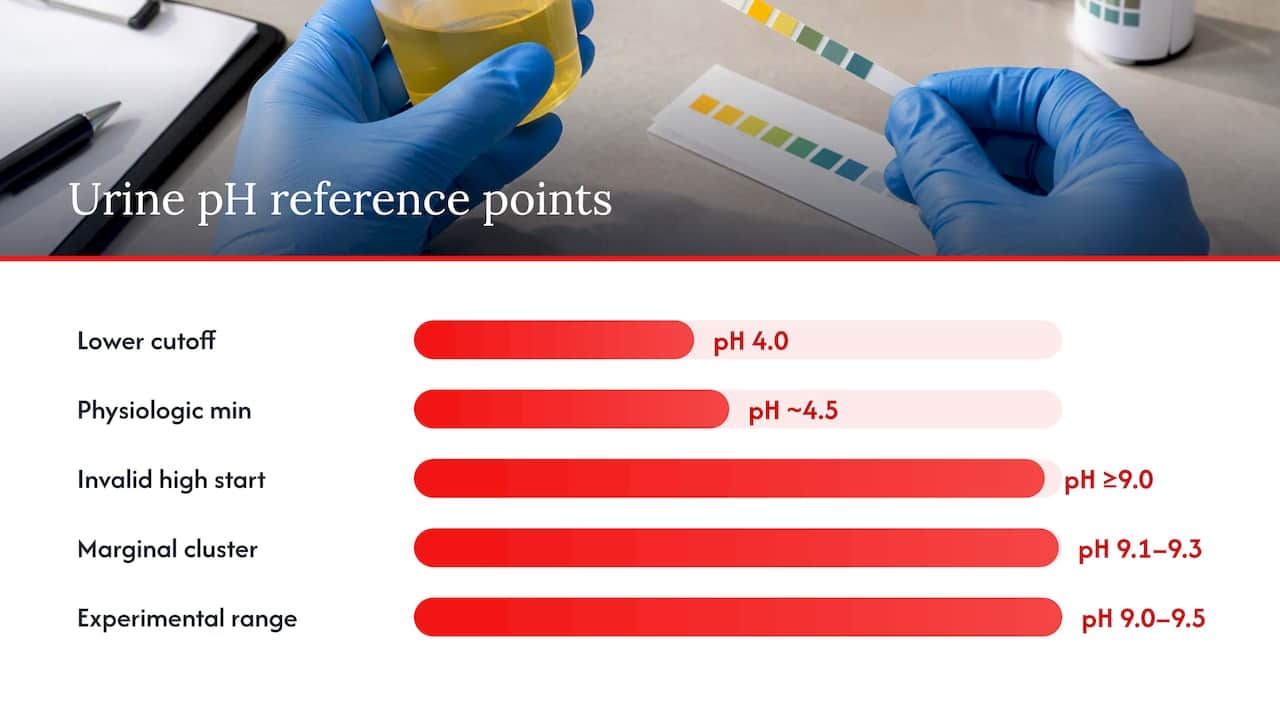
Federal workplace testing rules set explicit pH boundaries for specimen validity, and these cutoffs are the backbone of how labs flag a sample before a drug result is even reported. The Mandatory Guidelines for Federal Workplace Drug Testing Programs moved the lower adulteration cutoff toward pH 4.0, since the minimum physiologic urine pH in humans is about 4.5. Anything below that is treated as a strong signal of deliberate acidification rather than a normal physiologic state.
On the high end, a SAMHSA evaluation of the invalid pH cutoff defines the invalid high-pH range as ≥9.0 and <11.0. Within that range:
- Most marginal high-pH results cluster around pH 9.1 to 9.3, a pattern more consistent with transit or storage temperature increases than intentional tampering.
- Only a small subset of analytes, including benzoylecgonine, PCP, and 6-AM, were affected when researchers experimentally adjusted pH to 9.0 to 9.5, while others like THC-COOH, codeine, and morphine were not.
- An invalid pH triggers a defined lab workflow: repeat testing with a pH meter, MRO review, and often an observed recollection, not an automatic adverse finding.
An invalid pH is a signal that the specimen’s integrity needs review. It is not, by itself, evidence that someone used or avoided a drug.
Causes and confounders of abnormal urine pH
Distinguishing a physiologic or transport-driven pH shift from deliberate adulteration starts with knowing what normally pushes urine pH up or down.
- Urea-splitting urinary tract infections, most notably from Proteus mirabilis, convert urea to ammonia and raise urine pH toward alkaline, according to Mayo Clinic Laboratories.
- Medications including sodium bicarbonate, potassium citrate, and acetazolamide are common alkalinizing agents clinicians should check against the patient’s med list.
- Vegetarian or high-produce diets tend to push urine pH higher, while high-protein diets and metabolic acidosis push it lower.
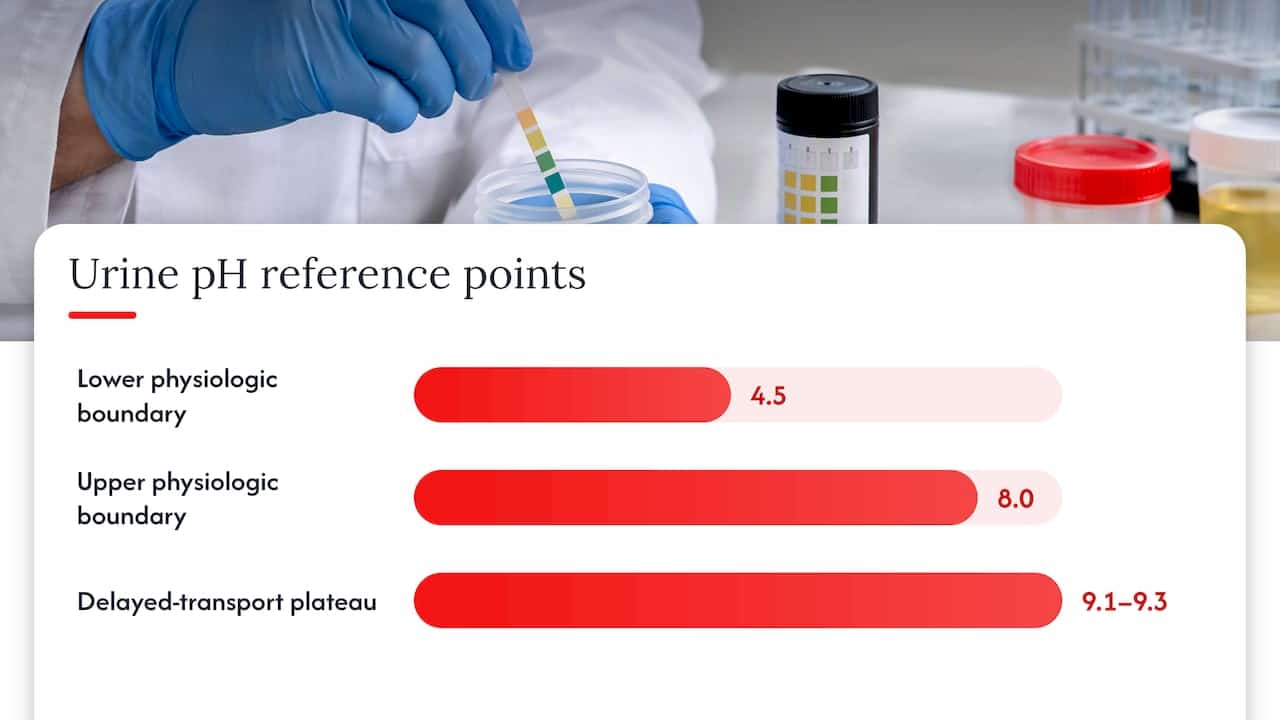
- Acidifying agents and certain metabolic states (such as ketoacidosis) lower urine pH, with the normal physiologic range generally running from about pH 4.5 to 8.0.
Delayed transport compounds the picture. When a specimen sits at room temperature or warmer, bacterial activity converts urea to ammonia and the pH drifts upward, often plateauing around 9.1 to 9.3, the same range flagged in SAMHSA’s cutoff evaluation. Seasonal heat makes this pattern more common, which is one reason labs see more marginal high-pH flags in summer months.
Pro Tip: Before assuming adulteration, check the collection timestamp against the lab receipt time: a multi-hour gap in warm conditions explains most pH values sitting just above 9.0.
A practical interpretation workflow for discordant results
When a urine drug result does not match the clinical picture, work through the validity data before questioning the patient.
- Start with the full validity panel, not pH alone: creatinine, specific gravity, and an adulterant strip together tell you whether the specimen itself is sound. Our urine specimen validity guidance walks through how these markers interact.
- Review the medication list, diet, and any UTI symptoms, since several of the causes above are entirely physiologic.
- Pull the collection and transport documentation, including the time from void to lab receipt and any recorded temperature, to judge whether a pH shift looks transport-related.
- Order confirmatory GC-MS or LC-MS/MS testing whenever the result will influence a care decision, since immunoassays are presumptive screens and more susceptible to pH-related artifacts than confirmatory chromatography.
Immunoassays rely on antibody binding affinities that can be sensitive to the concentration shifts pH produces, while GC-MS and LC-MS/MS directly identify and quantify the analyte, making them far less vulnerable to that same artifact. A negative immunoassay paired with ongoing clinical suspicion is a reasonable trigger for confirmatory testing rather than acceptance at face value. Our step-by-step guide to detecting adulterants covers when a repeat or observed collection is the right next move, and current guidelines also allow oral fluid as an alternate matrix in some programs when urine collection is impractical.
Pro Tip: Document the rationale for ordering confirmatory testing in the chart; it protects both the patient’s care plan and the integrity of any later review.
Lab and collection practices that limit pH-driven artifacts
Most pH-related artifacts trace back to specimen handling rather than the patient. A few operational habits close that gap:
- Record temperature at the moment of collection and keep transit time short; same-day transport to the lab avoids the bacterial urea breakdown that drives pH upward.
- Use specimen cups with built-in temperature strips and on-cup validity panels, including pH and creatinine indicators, so the first read happens at the point of collection rather than hours later.
- Log collection time, last void, current medications, and storage conditions on the chain-of-custody form, since that context is what lets an MRO or lab toxicologist correctly interpret a borderline pH value. Our adulterant detection methods overview details which on-cup indicators catch these issues early.
Balancing clinical care and forensic rigor when pH flags occur
An out-of-range pH is a validity flag, not a verdict on whether someone used or abstained from a drug. The most useful habit is to document the surrounding context, medications, diet, symptoms, transport timing, before drawing a conclusion, and to loop in the lab or MRO rather than adjusting a care plan on a single screen. Confirmatory testing earns its cost whenever a result will actually change what happens next for the patient.
— Justin
How Rapidtestcup supports specimen validity in clinical collections
We provide specimen cups, multi-panel test cups, and adulterant and validity test strips aimed at helping clinics and labs identify pH-related issues at the point of collection.
- Some clinics running bulk collections use cups with built-in temperature and pH indicators to flag a compromised specimen before it leaves the room.
- Observed-collection kits and adulterant strips are a common order for higher-risk settings where tampering is a real concern.
- Our specimen cups and multi-panel options are stocked for same-day shipping so a validity-focused collection protocol does not stall on supply.
This article is general information, not a substitute for advice from a qualified doctor. Consult a qualified healthcare professional about your own circumstances before acting on anything here.
FAQ
What drugs cause high urine pH?
Drugs themselves rarely raise urine pH directly; it is usually medications like sodium bicarbonate, potassium citrate, and acetazolamide, along with urea-splitting infections, that push pH upward, according to Mayo Clinic Laboratories. A high pH mainly matters because it can suppress urinary excretion of weak bases such as amphetamines, lowering their detectable concentration.
Will I fail a drug test if my pee is bright yellow?
Urine color is not part of the validity panel and has no established link to pass or fail outcomes; bright yellow is typically just concentrated riboflavin from multivitamins or hydration status. Labs assess validity through pH, creatinine, and specific gravity, not visual color.
What can throw off urine pH?
Diet, certain medications, urinary tract infections from urea-splitting bacteria like Proteus mirabilis, and delayed or warm specimen transport can all shift urine pH, per Mayo Clinic Laboratories and SAMHSA’s cutoff evaluation. Many marginal high-pH results reflect transport conditions rather than intentional adulteration.
What does it mean if the pH of my drug test is too high?
A pH result at or above 9.0 and below 11.0 falls into the federally defined invalid range, which prompts a repeat pH test and often an MRO review or observed recollection, per the Mandatory Guidelines for Federal Workplace Drug Testing Programs. It flags a specimen integrity concern, not a confirmed finding about drug use.
Sources
- Mechanistic PBPK modeling of urine pH effect on renal and systemic disposition of methamphetamine and amphetamine (PMC)
- SAMHSA — Evaluation of the cutoff for invalid pH (DTAB materials)
- Federal Register — Mandatory Guidelines for Federal Workplace Drug Testing Programs
- Mayo Clinic Laboratories — Urinalysis overview (pH causes)