

Blog
Tianeptine Drug Testing: FDA Warns Routine Screens May Miss Use


Short answer: routine urine drug screens usually will not detect tianeptine. Standard employment and clinical panels are not built to catch it, so confirmation requires a dedicated assay using LC-MS/MS or GC-MS. If a provider or employer needs a definitive answer, a negative routine screen alone does not rule out recent use.
TL;DR:
- With opioid intoxication or withdrawal symptoms and a negative routine panel, request expanded toxicology and specify quantitative tianeptine confirmation by liquid chromatography tandem mass spectrometry.
- Rapid strips return presumptive results within minutes, while reference laboratory confirmation commonly takes several business days and is required before clinical or legal decisions.
- Urine detection typically lasts less than a few days, and the window shifts with dose, use frequency, assay sensitivity, and collection timing.
- Workplace or forensic testing requires a certified laboratory and documented chain of custody; collect enough urine for confirmation and follow the laboratory’s storage instructions.
Table of Contents
- How Laboratories Screen for and Confirm Tianeptine in Urine
- Where to Get Tianeptine Testing: Lab Services and Product Options
- How to Interpret Results and Expected Urine Detection Windows
- When to Request a Tianeptine Test and Which Labs Should Be Involved
- How We Support Tianeptine Testing Needs
- Potential Cross-Reactivity of Tianeptine With Other Substances in Common Drug Tests
- Overview of False Positives and False Negatives Specifically Related to Tianeptine Testing
- Detailed Guidance on Collecting and Handling Samples to Maintain Tianeptine Integrity
- Available Commercial Test Kits Specific to Tianeptine and Their Accuracy/Sensitivity Profiles
- Author Perspective: Quick Checklist by Audience
- Products and Ordering: Solutions for Expanded Testing
- FAQ
- Sources
How Laboratories Screen for and Confirm Tianeptine in Urine
Most urine drug screens rely on immunoassay technology, a quick chemical reaction that flags classes of drugs like opioids, benzodiazepines, or amphetamines. Tianeptine does not fit neatly into any of those standard antibody targets, so routine panels generally skip it entirely. A lab has to build and run a test specifically designed to catch tianeptine or its metabolites.
That specialized testing comes down to two gold-standard methods: liquid chromatography tandem mass spectrometry (LC-MS/MS) and gas chromatography mass spectrometry (GC-MS). Both separate compounds in a sample and then identify them by mass, which makes them far more specific than an immunoassay screen. Validated LC-MS/MS methods can quantify tianeptine along with its active metabolite, giving labs a reliable way to confirm exposure rather than guess at it.
A few practical points matter here:
- Immunoassay cross-reactivity with opioid panels can occur at very high tianeptine doses, but it is inconsistent and not something a lab can count on for detection.
- Any presumptive signal from a screening test needs chromatographic confirmation before it means anything clinically or legally.
- Labs must validate their tianeptine assay and publish a limit of detection before using it for reporting.
The FDA has warned that tianeptine is not FDA-approved and may not be identified by routine toxicology screening, a gap that has contributed to delayed recognition of serious harm.
Where to Get Tianeptine Testing: Lab Services and Product Options
Tianeptine testing is not something you pick up at a standard occupational health clinic. It lives in a narrower set of providers: hospital toxicology labs, commercial reference labs with expanded drug panels, and forensic laboratories that handle novel psychoactive substances. Calling ahead and asking specifically whether a lab offers a tianeptine assay saves time, since many front-desk staff will default to describing their standard panel.
On the product side, a few categories apply:
- Dedicated rapid tianeptine strips, often used in forensic or harm-reduction settings, which give a presumptive result quickly.
- Expanded laboratory panels that include tianeptine alongside other novel substances.
- Confirmatory LC-MS/MS services, typically sent out to a reference lab rather than run on-site.
Turnaround varies by path. A rapid strip gives a result in minutes, while LC-MS/MS confirmation through a reference lab commonly takes several business days once chain-of-custody and shipping are factored in. Cost climbs with each added step: screening alone is cheapest, and confirmatory testing adds lab fees for the mass spectrometry run.
Pro Tip: Always collect a larger urine volume than you think you need. Labs frequently require a separate aliquot reserved specifically for confirmatory testing if the screen comes back non-negative.
How to Interpret Results and Expected Urine Detection Windows
A screening result and a confirmed result are not the same thing, and mixing them up causes real problems. A presumptive positive from a rapid strip or immunoassay means the sample reacted in a way consistent with tianeptine, nothing more. A confirmatory positive from LC-MS/MS means the lab has actually identified and quantified the compound. Clinical and forensic documentation should always distinguish the two, using language like “presumptive positive, pending confirmation” rather than reporting a screen as a final result.
Detection windows for tianeptine in urine run short compared with many opioids, usually lasting less than several days with a specialized assay, though the window shifts with dose, frequency of use, and how sensitive the particular assay is.
- A negative result on a routine employment or hospital panel tells you almost nothing about tianeptine status, since it was never looking for it.
- A negative result on a dedicated tianeptine assay, run within the expected detection window, carries far more weight.
- When clinical suspicion is high (unexplained opioid-like symptoms, reported gas station heroin use, or withdrawal signs) expanded testing should be pursued even after a clean routine screen.
Because standard panels exclude tianeptine, clinician awareness to order expanded toxicology remains one of the biggest barriers to catching cases early.
When to Request a Tianeptine Test and Which Labs Should Be Involved
Knowing when to escalate beyond a routine panel matters as much as knowing the test exists.
- Clinical suspicion: order expanded toxicology when a patient shows opioid-like intoxication or withdrawal signs with a routine screen that came back negative, or when tianeptine use is reported or suspected.
- Workplace or forensic cases: route the sample through a certified lab that maintains chain-of-custody, since results tied to discipline or legal action depend on documented specimen validity.
- Exact requisition wording: ask for “tianeptine quantitative confirmation by LC-MS/MS” and specify whether forensic reporting or chain-of-custody documentation is required.
- Specimen handling: collect an adequate urine volume, store it at the temperature the lab specifies, and retain an aliquot in case reanalysis is needed.
How We Support Tianeptine Testing Needs
Our catalog includes multi-panel test cups, dip cards, and a dedicated Zaza tianeptine drug test strip for programs that need a presumptive screening option before sending a sample out for confirmation. We also publish explainer content on how drug metabolites are detected and on detection window concepts so buyers can match a product to their actual testing goal rather than guessing.
- Multi-panel cups and dip cards for broad-spectrum screening programs.
- A tianeptine-specific rapid strip for presumptive results.
- CLIA-waived, FDA-approved product selections across our catalog for programs that need compliant supplies.
Potential Cross-Reactivity of Tianeptine With Other Substances in Common Drug Tests
Cross-reactivity is the phenomenon where an immunoassay’s antibodies bind to a compound they were not designed to detect, producing a misleading signal. Because tianeptine shares some structural features with tricyclic compounds and, at high doses, can produce opioid-like effects, there has been interest in whether it might trigger a positive on an opioid or tricyclic antidepressant panel.
The honest answer is that this cross-reactivity is inconsistent. Toxicology research on tricyclic and psychoactive drug detection shows that immunoassays vary widely in sensitivity and specificity, and tianeptine is not a standard target for any commercial antidepressant or opioid screen. A lab cannot rely on an opioid panel lighting up as a stand-in for tianeptine detection, and a negative opioid screen should never be read as evidence against tianeptine use.
This matters most in overdose situations, where a patient’s symptoms look opioid-like but the opioid panel comes back clean. That mismatch is itself a clue. Rather than treating a negative opioid screen as reassuring, it should prompt a request for an expanded or tianeptine-specific assay, especially when the clinical picture does not add up.
Overview of False Positives and False Negatives Specifically Related to Tianeptine Testing
False positives in tianeptine testing are rare precisely because so few routine assays target the compound at all, which means most “positives” that occur happen on dedicated tianeptine screens rather than by accident on unrelated panels. When a presumptive strip or immunoassay does flag a non-negative result, it should always be treated as preliminary. Chromatographic confirmation is the only way to rule out a false positive caused by cross-reacting compounds or assay variability.
False negatives are the more common and more consequential problem. Since standard urine panels were never designed to detect tianeptine, a negative result on a routine screen is not a true negative for tianeptine at all, it simply reflects a test that was not looking. Even on a dedicated assay, a false negative can occur if the sample is collected outside the narrow detection window or if the dose was too low relative to the assay’s limit of detection.
The practical takeaway is to treat any non-negative presumptive result as a prompt for lab confirmation, and to treat any negative routine panel as uninformative about tianeptine status unless the panel specifically included it.
Detailed Guidance on Collecting and Handling Samples to Maintain Tianeptine Integrity
Sample integrity determines whether a confirmatory result holds up, and tianeptine testing has a few specific requirements worth following closely. Collect an adequate urine volume, typically enough to allow both an initial screen and a reserved aliquot for confirmatory testing if needed, since asking a patient or subject to provide a second sample later introduces delay and chain-of-custody complications.
Store the specimen at the temperature the receiving lab specifies, usually refrigerated, and avoid temperature swings that can degrade the compound before analysis. Label the container clearly with collection time, since detection windows for tianeptine run short and timing affects interpretation.
For workplace or forensic cases, documented chain-of-custody procedures, as outlined in SAMHSA’s workplace testing guidance, protect the sample’s legal usability. That means sealed containers, signed transfer logs, and a certified lab handling every step from collection to final report. Skipping any of these steps can make an otherwise accurate result unusable in a legal or employment dispute.
Available Commercial Test Kits Specific to Tianeptine and Their Accuracy/Sensitivity Profiles
Commercial options for tianeptine testing split into two tiers. The first is rapid presumptive strips, built for quick screening in forensic, harm-reduction, or clinical settings, which give a visual result in minutes but cannot serve as a final determination on their own. The second tier is laboratory-based confirmatory testing using LC-MS/MS, which offers the sensitivity and specificity needed for definitive identification and quantification.
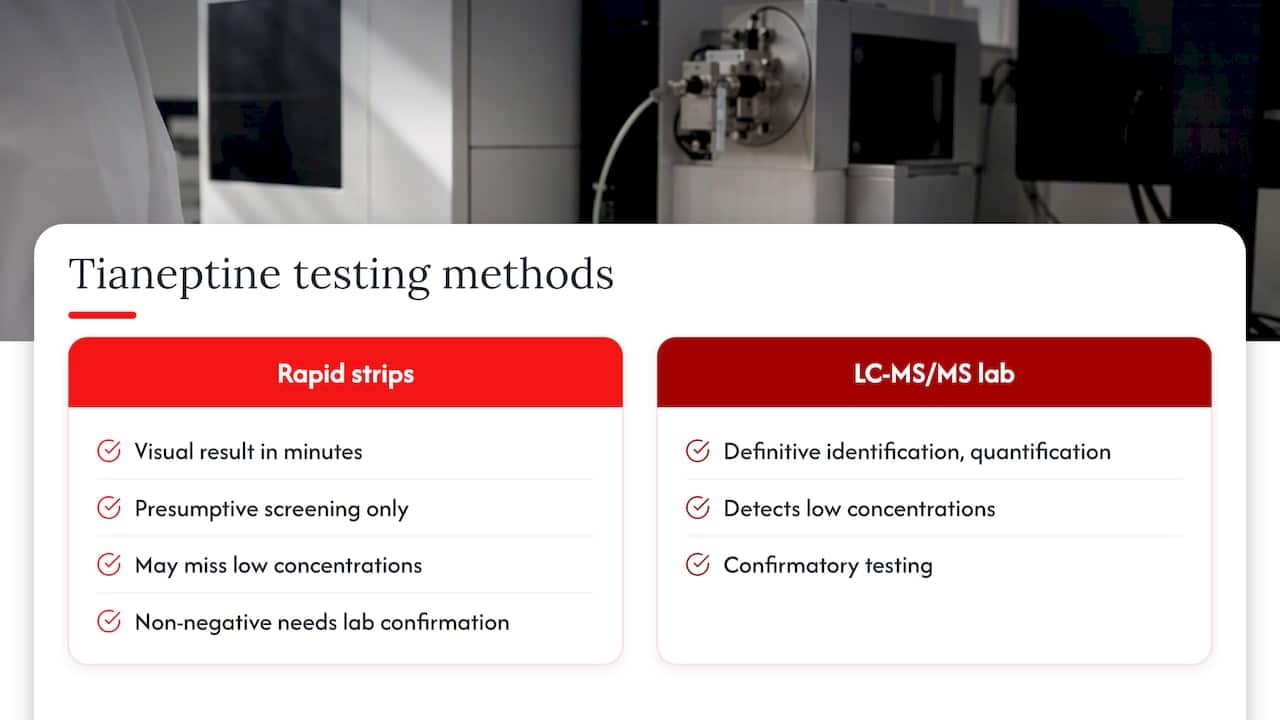
Accuracy claims for rapid strips should always be paired with the understanding that any non-negative result needs lab confirmation before anyone acts on it in a clinical or legal context. Validated LC-MS/MS methods remain the accepted benchmark for sensitivity, since they can detect and quantify tianeptine and its active metabolite at low concentrations that a screening strip might miss entirely.
When comparing kit options, the question to ask a manufacturer or lab is whether the assay has been validated specifically for tianeptine, what its published limit of detection is, and whether confirmatory follow-up is built into the workflow. A strip without a documented validation study is not a substitute for one that has published its sensitivity and specificity data.
Author Perspective: Quick Checklist by Audience
Clinicians: order confirmation whenever opioid-like symptoms appear without an opioid-positive screen, and document findings as presumptive until LC-MS/MS confirms them. Employers: involve an MRO and a certified lab before any disciplinary action rests on a tianeptine result. Individuals: seek testing through a toxicology lab rather than assuming a routine panel covers it, and treat clinical context as the deciding factor.
— Justin
Products and Ordering: Solutions for Expanded Testing
If you are building a testing program that needs to account for tianeptine alongside more common substances, we carry the supplies to match. Our tianeptine drug test strips work well as a presumptive front-line screen, and our broader multi-panel test cup lineup covers opioids, fentanyl, and other common targets in the same collection step.
- Dedicated tianeptine strips for presumptive screening at the point of collection.
- Multi-panel cups and dip cards for programs covering multiple substances at once.
- CLIA-waived, FDA-approved product lines with bulk pricing for labs and clinics.
Reach out through our shop for bulk orders, custom panel configurations, or expedited shipping on lab-grade supplies.
FAQ
Can a urine drug test show how much you take?
A standard urine drug test only indicates whether a substance is present above a cutoff level, not the exact dose taken. Quantitative results are possible through confirmatory methods like LC-MS/MS, which measure concentration, but this detail is not part of typical screening reports.
Is tianeptine a full opioid agonist?
Tianeptine is primarily known as an atypical antidepressant used in some countries, but at high doses it produces opioid-like effects through action at opioid receptors. The FDA has warned that this activity contributes to serious harm, overdose, and dependence risk, separate from its approved antidepressant use elsewhere.
What medications cause you to fail a drug test?
Certain prescription medications, including some antidepressants, decongestants, and prescribed opioids, can trigger a positive or cross-reactive result on standard immunoassay panels. Because cross-reactivity varies by assay and manufacturer, any unexpected positive should be confirmed with chromatographic testing before drawing conclusions.
What will buprenorphine show up as on a drug test?
Buprenorphine typically requires a specific assay rather than a standard opioid panel, since it does not reliably cross-react with tests designed for morphine-based opioids. Labs offering expanded panels usually list buprenorphine as its own target, similar to how tianeptine requires its own dedicated assay.
Sources
- FDA: Tianeptine products linked to serious harm, overdoses, and death
- Simultaneous determination of tianeptine and its active metabolite MC5 using LC‑ESI‑MS/MS