

Blog
Test sensitivity and specificity: A practical drug testing guide


TL;DR:
- A single positive drug test result can be misleading without understanding sensitivity and specificity. High sensitivity screening detects most true positives but risks false positives, while confirmatory tests prioritize specificity to eliminate cross-reactivity. Employing a two-step process with immunoassay screening followed by mass spectrometry confirmation ensures accurate, defensible drug testing results.
A positive drug test result feels definitive. It seems to say everything you need to know. But without a firm grasp of sensitivity and specificity, that single result can be deeply misleading. Immunoassay screening methods carry high sensitivity but lower specificity due to cross-reactivity, which means false positives are a genuine, documented risk. This guide walks you through what these two metrics actually mean, how they interact under real lab conditions, and how you can use that understanding to build workflows that hold up under compliance scrutiny and clinical review.
Table of Contents
- What are sensitivity and specificity?
- Why both sensitivity and specificity matter in drug testing
- The sensitivity-specificity trade-off: Real consequences in the lab
- Applying sensitivity and specificity for reliable drug testing: Pro tips
- Our take: What most guides miss about sensitivity and specificity
- Enhance your drug testing accuracy with trusted solutions
- Frequently asked questions
Key Takeaways
| Point | Details |
|---|---|
| Sensitivity finds positives | High sensitivity helps make sure drug cases aren’t missed during screening. |
| Specificity confirms accuracy | High specificity is essential to rule out false positives before action is taken. |
| Cutoffs change results | Setting test cutoffs impacts both sensitivity and specificity—and risk of error. |
| Both metrics are vital | Using screening plus confirmation maximizes drug test reliability. |
| Real-world workflow matters | Sample handling and prevalence affect test meaning as much as the numbers do. |
What are sensitivity and specificity?
These two terms define the backbone of any diagnostic testing program, yet they get muddled constantly in lab settings. Getting them straight is not just academic. It shapes every decision from which screening kit you order to how you document and report results.
Sensitivity is the proportion of true positives a test correctly identifies. In drug testing terms, a highly sensitive test catches nearly every sample that truly contains the target analyte. It minimizes false negatives, meaning very few actual drug users slip through undetected. When sensitivity is your priority, you are prioritizing the risk of missing a positive.
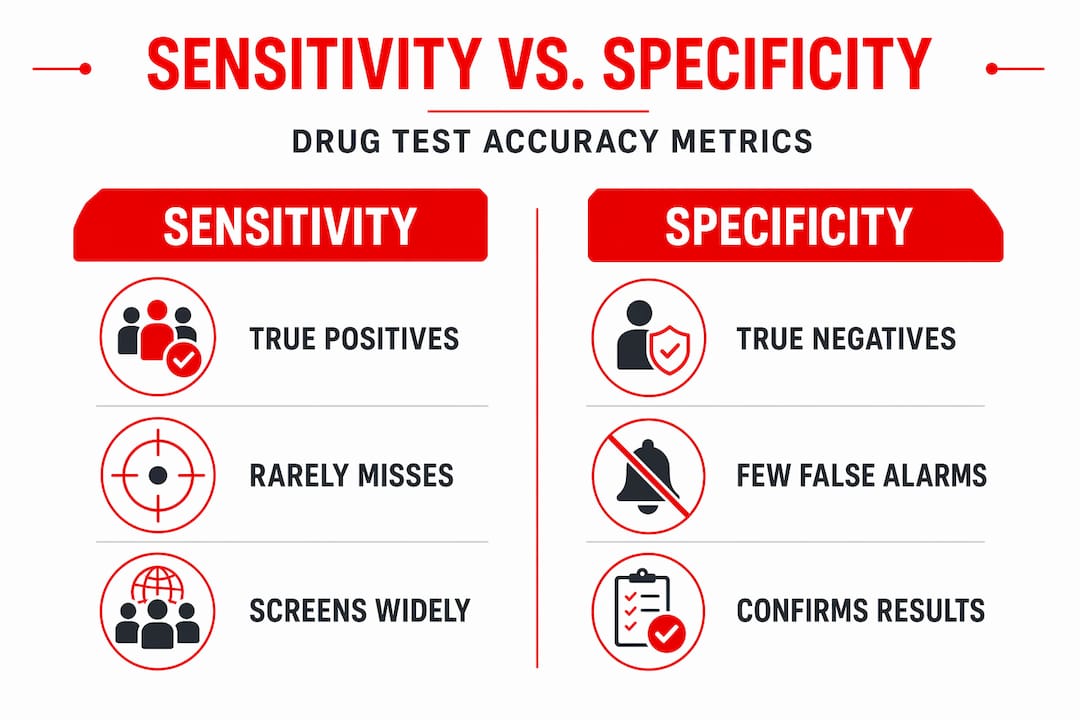
Specificity, on the other hand, is the proportion of true negatives a test correctly identifies. A highly specific test produces very few false positives. It confidently clears samples that truly do not contain the drug. When specificity is your priority, you are prioritizing the risk of falsely flagging a clean sample.
A useful memory tool: the mnemonics SnNOut and SpPin. SnNOut and SpPin summarize it neatly: a highly Sensitive test, when Negative, rules Out the condition; a highly Specific test, when Positive, rules In the condition. Tape that on your workstation if you need to.
Key distinctions at a glance:
- High sensitivity: fewer false negatives, better for screening
- High specificity: fewer false positives, better for confirmation
- Neither metric alone tells the full story
- Both values are affected by where you set cutoff thresholds
| Metric | What it measures | Risk when low | Best for |
|---|---|---|---|
| Sensitivity | True positive rate | False negatives | Screening |
| Specificity | True negative rate | False positives | Confirmation |
Pro Tip: When evaluating a new drug test product, always request the published sensitivity and specificity data from the manufacturer, not just the claimed detection panel. Numbers grounded in independent validation studies tell you far more than marketing materials.
Why both sensitivity and specificity matter in drug testing
With clear definitions in hand, it is essential to see why both metrics are critical, especially when accuracy is on the line. Drug testing is not a single step. It is a layered process, and each layer has a different job shaped by a different metric.
Immunoassay screening kits, such as urine drug test cups, are designed with high sensitivity in mind. They cast a wide net. The goal is to flag any sample that might contain a drug above the cutoff threshold, without missing genuine positives. The tradeoff is that these tests can cross-react with structurally similar compounds, including certain over-the-counter medications and foods, producing false positives. That is by design, not a flaw, as long as your workflow accounts for it.

Confirmatory testing, almost always gas chromatography-mass spectrometry (GC-MS) or liquid chromatography-mass spectrometry (LC-MS/MS), flips the priority. These methods are built for high specificity. They identify specific molecular signatures, eliminating cross-reactivity. As noted in published clinical guidance, immunoassay screens produce false positives due to cross-reactivity, while GC-MS and LC-MS/MS deliver both high specificity and high sensitivity for confirmed identification.
The relationship between these two metrics is also a trade-off. Raising sensitivity lowers specificity, and vice versa. This sensitivity-specificity trade-off is typically visualized using ROC (Receiver Operating Characteristic) curves, which plot performance across every possible cutoff threshold. Understanding this curve helps labs select the cutoff that best fits their specific compliance or clinical objective.
“Using a highly sensitive screening test followed by a highly specific confirmatory test is not redundancy. It is the only defensible two-step workflow in professional drug testing.”
Here is how the two test types compare in practice:
| Feature | Immunoassay screening | MS confirmation |
|---|---|---|
| Sensitivity | High | High |
| Specificity | Moderate | Very high |
| Speed | Fast (minutes) | Slower (hours/days) |
| Cost | Low | Higher |
| Cross-reactivity risk | Yes | No |
| Regulatory defensibility | Presumptive | Definitive |
Understanding immunoassay and MS methods is foundational before you can make informed decisions about either. And for labs that frequently encounter disputed results, a strong grasp of understanding false positives in immunoassay testing becomes a direct operational asset.
The sensitivity-specificity trade-off: Real consequences in the lab
Now that we understand why both concepts are vital, let us look at the real impacts of the choices you make around them. The most immediate lever a lab controls is the cutoff concentration. This single number, expressed in nanograms per milliliter (ng/mL), determines whether a sample is flagged as positive or reported as negative. Move it up, and sensitivity drops. Move it down, and specificity drops. There is no neutral setting.
SAMHSA (Substance Abuse and Mental Health Services Administration) publishes federally mandated cutoffs for workplace drug testing. SAMHSA cutoff standards specify, for example, that the initial immunoassay threshold for amphetamines is 500 ng/mL, with confirmatory GC-MS set at 250 ng/mL. For opiates, both initial and confirmatory thresholds sit at 2,000 ng/mL. These values represent a carefully calibrated balance between catching real use and avoiding false accusations.
Why these numbers matter to you:
- Cutoffs set too high miss actual drug use (lower sensitivity, compliance risk)
- Cutoffs set too low catch more use but generate more false positives (lower specificity, legal risk)
- Regulatory programs like DOT mandate specific cutoffs, leaving labs no room for adjustment
- Non-regulated programs, such as pain management clinics, can customize cutoffs based on clinical judgment
The statistics behind immunoassay performance underscore the stakes. Immunoassay false negative rates for certain drug classes versus LC-MS/MS benchmarks can reach 16 to 40%, depending on the substance and test format. That is not a marginal error rate in clinical or forensic contexts. That is a meaningful gap that affects patient safety, employment decisions, and legal proceedings.
Prevalence adds another layer of complexity that many guides understate. Prevalence and predictive value interact directly: in a low-prevalence testing population, even a test with 98% specificity will generate a disproportionate number of false positives relative to true positives. If only 2% of your tested population actually uses the drug, a large share of your positive results will be false flags. This is not a defect in the test. It is a predictable mathematical consequence of low base rates.
Numbered steps for managing trade-off consequences:
- Define your testing population’s likely prevalence before selecting thresholds
- Document the clinical or compliance purpose behind your cutoff selection
- Never treat an immunoassay result as definitive without confirmation
- Track your false positive and false negative rates over time using internal QC data
- Review cutoffs annually or when your testing population changes
Addressing lab accuracy challenges proactively, rather than reactively after a disputed result, is what separates a defensible program from a vulnerable one. And maintaining clinical integrity in drug testing means treating each of these metrics as a living part of your protocol, not a one-time setup decision.
Applying sensitivity and specificity for reliable drug testing: Pro tips
To translate these principles into real-world accuracy, here are expert, actionable steps for your setting. These are not theoretical. They reflect the patterns that distinguish compliant, defensible programs from those that generate disputes, grievances, and liability.
The non-negotiable two-step workflow:
- Screen with a high-sensitivity immunoassay to identify all presumptive positives
- Confirm every presumptive positive with a high-specificity MS method before taking action
- Report confirmed positives only; document the full chain of custody at every step
- Retain samples per your regulatory or institutional requirements for potential reanalysis
- Build a clear escalation protocol for donors who dispute their results
This sequence is not optional in any regulated program. High-sensitivity immunoassay screening followed by MS confirmation is the standard precisely because of cross-reactivity risks like bupropion triggering a false amphetamine positive. Skipping confirmation in these cases creates real legal and clinical exposure.
Pro Tip: If your program sees frequent diluted specimens, do not simply lower your creatinine threshold and call it resolved. Instead, combine specimen validity testing with a lower limit of quantitation (LOQ) strategy for confirmed positives. This gives you defensible data even when concentrations are near the cutoff boundary.
Diluted urine specimens are a documented source of false negatives. When a donor consumes excess fluid before testing, drug concentrations drop below the detection cutoff even when actual use occurred. Collecting first-morning specimens where feasible, especially in pain management or treatment settings, significantly reduces this problem because drug concentrations peak before dilution from daily fluid intake.
Additional implementation considerations:
- Align your cutoff selection with your specific regulatory framework (DOT, SAMHSA, state board guidelines)
- Train staff to recognize validity flags like low creatinine or unusual pH before reporting results
- Use adulteration panels when specimen integrity is in question
- Document the clinical rationale for any deviation from standard cutoffs
Reviewing best practices for accurate results in your specific setting gives you a foundation to standardize around. For clinics streamlining clinic testing workflows while maintaining accuracy, the goal is always the same: fast screening with reliable confirmation. Understanding the factors influencing test accuracy helps you anticipate and prevent errors before they become disputes.
Our take: What most guides miss about sensitivity and specificity
Here is something worth saying plainly. Most lab errors we see documented in quality review literature do not come from choosing the wrong sensitivity value or miscalculating specificity. They come from workflow gaps, mishandled samples, miscommunicated results, and a failure to account for population prevalence.
The numbers on the test specification sheet assume you collected the sample correctly, stored it at the right temperature, ran it within the stability window, and interpreted the result in the context of a known prevalence. Change any one of those variables and your theoretical sensitivity and specificity become irrelevant.
The real lesson is that sensitivity and specificity are not just test metrics. They are outcomes of your entire system. A technically sensitive test run on a poorly collected or adulterated sample is not a sensitive test anymore. It is an unreliable one. Labs that understand this move beyond obsessing over product specs and start investing equally in collection protocols, staff training, and documentation discipline.
There is also an underappreciated implication for staff education. When frontline collectors and clinic staff do not understand why a positive immunoassay result is presumptive rather than definitive, they may communicate results to donors or employers in ways that cause real harm before confirmation is complete. This is a systemic gap that no test product can fix on its own.
Looking at law enforcement best practices for drug screening offers a useful perspective here. In high-stakes contexts where results drive arrest decisions, agencies have long understood that a presumptive result is just the beginning of a chain of evidence, not the end. That same discipline belongs in every clinical and compliance program.
Enhance your drug testing accuracy with trusted solutions
Ready to put these concepts to work? Equip your lab with proven resources below.
At RapidTestCup.com, our catalog is built for professionals who understand that accuracy starts with the right tools. Whether you need a reliable daily screening solution or a multi-panel option with built-in adulteration detection, we carry CLIA waived, FDA-cleared products designed to meet the sensitivity and specificity demands of real compliance programs. Our 12 panel drug test cup delivers a fast, dependable screening baseline for high-volume programs. For programs requiring broader coverage and specimen validity testing in a single step, the 18 panel test cup with adulterants removes guesswork from the process. And for labs managing complex panels, the ADLTX panel test brings expanded detection with integrated adulteration controls. Contact our team for a custom quote or bulk pricing that fits your testing volume.
Frequently asked questions
How do you remember the difference between sensitivity and specificity?
Use the mnemonics: SnNOut and SpPin remind you that a high-Sensitivity Negative rules Out, while a high-Specificity Positive rules In.
Why do cutoff concentrations affect test accuracy?
Cutoffs set the detection threshold that determines positive or negative results. SAMHSA cutoff values like 500 ng/mL for amphetamines reflect a calibrated balance between catching real use and avoiding false accusations.
What causes a highly sensitive test to still miss drugs?
Diluted specimens drop drug concentrations below the cutoff, producing false negatives even when actual use occurred. First-morning collection or lower LOQ confirmation testing helps close this gap.
How does drug prevalence change test meaning?
Prevalence affects PPV and NPV directly. In low-prevalence populations, even a highly specific test generates more false positives relative to true ones, which is a math problem, not a product defect.
Which comes first: high sensitivity or high specificity testing?
Always screen with high-sensitivity immunoassay first, then confirm with MS methods before reporting any actionable positive. Reversing this order, or skipping confirmation, creates compliance and legal risk.