
Blog
Laboratory compliance guidelines: a manager’s complete guide


TL;DR:
- Laboratory compliance reflects daily practices, not just documentation, and errors between “what is written” and “what is done” often cause survey failures.
- CLIA regulates U.S. laboratories performing human testing through four certificate types, each with specific survey and operational requirements.
- Effective compliance requires understanding personnel competency, biosafety protocols, leadership engagement, and accurate recordkeeping beyond mere policies.
Compliance is not a binder on a shelf. For laboratory managers in healthcare and forensic settings, laboratory compliance guidelines define how work is actually performed every single day, not just how it is documented. Failing to understand the difference between “what is written” and “what is done” is the most common reason labs fail surveys. This guide walks you through the regulatory framework under CLIA, the mechanics of competency assessments, biosafety obligations, and the operational pitfalls that turn small gaps into significant deficiencies.
Table of Contents
- Understanding laboratory compliance requirements under CLIA
- Mastering competency assessments for laboratory personnel
- Incorporating biosafety and risk management into compliance programs
- Common pitfalls and strategic insights for compliance management
- Comparison of CLIA certificate types and their compliance obligations
- Rethinking compliance: beyond audits to a culture of operational excellence
- Explore reliable drug testing solutions to support your lab’s compliance
- Frequently asked questions
Key Takeaways
| Point | Details |
|---|---|
| Operational compliance matters | True laboratory compliance depends on daily practices, training, and records, not just paperwork. |
| Competency schedule critical | Perform competency assessments twice in year one and annually after for all moderate/high complexity testing personnel. |
| Biosafety guides risk | Use BMBL advisory guidance and institutional risk assessments to establish effective biosafety programs. |
| Avoid compliance pitfalls | Plan assessments by actual test start dates and coordinate oversight for multi-site operations precisely. |
| Choose appropriate CLIA certificate | Select the certificate type aligning with your testing complexity and ensure adherence to survey and fee requirements. |
Understanding laboratory compliance requirements under CLIA
CLIA, the Clinical Laboratory Improvement Amendments of 1988, is the federal regulatory foundation for any U.S. laboratory that tests human specimens for diagnosis, prevention, or treatment. The Centers for Medicare and Medicaid Services (CMS) administers the program, and your certificate type determines exactly which lab safety regulations apply to your facility.
Here is a breakdown of the four main CLIA certificate types:
- Certificate of Waiver (CoW): Covers only simple, FDA-cleared waived tests with minimal risk of error. No routine surveys required.
- Certificate of Registration (CoR): A temporary certificate while a lab awaits its first survey for nonwaived testing. Grants provisional authority to operate.
- Certificate of Compliance (CoC): Requires meeting all applicable CLIA regulations and passing a biannual survey by CMS or a state agency.
- Certificate of Accreditation (CoA): Issued to labs accredited by a CMS-approved organization. Still subject to occasional CMS validation surveys.
Some states, including New York and Washington, operate their own CMS-approved laboratory programs with rules that may exceed federal minimums. If your lab operates in one of these states, federal CLIA rules function as a floor, not a ceiling.
“Surveyors evaluate work ‘as done,’ not merely as documented. Interviews, direct observation, and record review form the core of every survey.”
During a survey, CMS evaluators are not simply reviewing your policy manual. They interview staff at the bench, observe procedures in real time, and cross-reference records to determine whether your written procedures match your actual practice. Understanding CLIA regulations for drug testing compliance becomes especially critical in forensic and substance abuse testing environments where test accuracy carries legal weight.
| Survey element | What evaluators assess |
|---|---|
| Staff interviews | Knowledge of procedures, quality control steps, corrective actions |
| Direct observation | Specimen handling, testing workflow, safety practices |
| Record review | QC logs, competency records, proficiency testing results |
| Policy review | SOPs aligned with actual practice |
If you are newer to the distinction between CLIA waived testing and moderate or high complexity testing, that knowledge gap alone can create real compliance exposure for your facility.
Mastering competency assessments for laboratory personnel
With CLIA certification requirements covered, understanding personnel competency is critical for maintaining compliance and quality. This is also one of the most frequently cited deficiencies during surveys, largely because the rules are more specific than many managers assume.
Under CLIA regulations, competency assessments must cover six required procedures for all personnel performing moderate or high complexity testing:
- Direct observation of routine patient test performance
- Monitoring the recording and reporting of test results
- Review of intermediate test results or worksheets, quality control records, and preventive maintenance records
- Direct observation of performance of instrument maintenance and function checks
- Assessment of test performance through testing previously analyzed specimens, internal blind testing samples, or external proficiency testing samples
- Evaluation of problem-solving skills
Timing matters as much as content. New testing personnel require assessments twice during their first year, ideally around six months apart. After that, annual assessments apply. The critical mistake managers make is tracking “first year” against a calendar year instead of the actual start date of the individual tester. If someone starts in October 2025, their second first-year assessment must occur before October 2026, not in January 2026 just because the calendar turned.
“Competency assessment is not the same as initial training or annual review. It is a separate, documented evaluation of active testing performance.”
Role-based responsibilities add another layer. Technical Consultants (TC), Technical Supervisors (TS), Clinical Consultants (CC), and General Supervisors (GS) each carry specific documentation duties. Only personnel meeting CLIA qualification standards for these roles can perform and sign off on competency assessments. Delegating this to a senior bench tech who does not hold the appropriate designation is a common and costly error.
Pro Tip: Build a simple tracking spreadsheet with each tester’s start date, their first-year completion deadline, and the annual anniversary date. Color-code it by quarter. A single glance replaces hours of manual record-hunting before a survey.

Solid staff training for lab competency supports the assessment process, but training and competency documentation are not interchangeable in the eyes of a CMS surveyor. Following drug testing best practices helps reinforce both elements consistently.
Incorporating biosafety and risk management into compliance programs
Beyond personnel competency, biosafety and risk management are integral to complete lab compliance. The Biosafety in Microbiological and Biomedical Laboratories (BMBL), published by the CDC and NIH, remains the primary reference framework for U.S. laboratories handling infectious agents or biological hazards.
The BMBL’s biosafety framework organizes containment into four biosafety levels (BSL1 through BSL4), each defined by three components:
- Laboratory practices and techniques: Standard microbiological practices that apply at every level, with escalating restrictions as risk increases.
- Safety equipment: Primary barriers such as biosafety cabinets and personal protective equipment appropriate to the agent.
- Facility design: Secondary barriers including HEPA filtration, air pressure differentials, and controlled access at higher biosafety levels.
Risk assessment is where biosafety becomes operational rather than theoretical. Before introducing any new specimen type, testing protocol, or agent into your workflow, you should evaluate both the inherent hazard of the agent and the procedural risks specific to how your staff handles it. A urine specimen with suspected bloodborne pathogen exposure is a different risk profile than a standard drug screen sample.
Pro Tip: Document your biosafety risk assessments and review them annually, or whenever a new agent or procedure is introduced. An Institutional Biosafety Committee (IBC) review is not just for academic research labs. Many accrediting bodies for clinical and forensic labs expect documented risk reviews.
It is worth noting that BMBL guidance is advisory, not regulatory. That said, accrediting bodies like CAP and COLA often incorporate BMBL principles into their inspection criteria. Ignoring BMBL because it is “not legally binding” is a compliance risk dressed as a technicality. The role of biosafety in lab compliance is too significant to treat as optional, particularly in forensic settings where chain of custody and worker protection concerns overlap.
Common pitfalls and strategic insights for compliance management
Understanding these pitfalls refines your compliance approach and prepares your lab for successful audits.
The most recurring compliance problems in laboratory settings are not technical failures. They are scheduling failures, documentation misalignments, and governance oversights that accumulate silently until a surveyor finds them. Here are the most consequential ones to address now:
- Calendar-year thinking on competency. Assuming calendar-based annual assessments fulfill the first-year semi-annual requirement is wrong. CLIA ties assessment timing to the individual’s testing start date, not January 1st.
- Treating orientation as competency. Initial onboarding and skills training are not substitutes for the six-procedure competency assessment. Surveyors know the difference.
- Remote site governance gaps. If your lab operates satellite or remote collection sites under a single CLIA certificate, oversight attaches to the primary lab. Inconsistent practices at a remote site are your deficiency, not theirs.
- Generic training records. Surveyors expect competency evidence that maps directly to the six required CLIA procedures. A certificate of completion from an online course does not satisfy this standard.
- Procedure manual drift. SOPs that have not been reviewed and signed off within the past year are an immediate red flag during document review.
Pro Tip: Walk through a mock survey at least once a year using the actual CMS survey protocol as your checklist. Have someone unfamiliar with daily operations conduct the staff interviews. The gaps they find are the same ones a real surveyor will find.
Sustainable compliance is a system, not an event. Streamlining your compliance processes and maintaining an efficient testing workflow are practical investments that pay off when survey time arrives.
Comparison of CLIA certificate types and their compliance obligations
To round out your foundational knowledge, here is a practical comparison of CLIA certificate types and compliance duties.
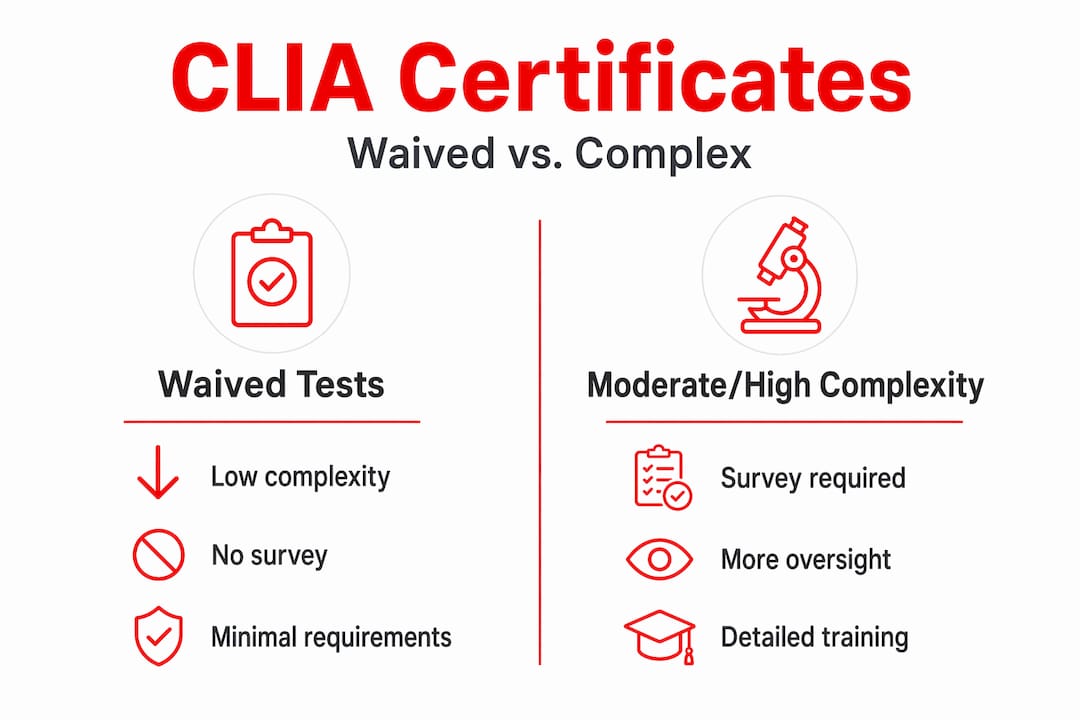
| Certificate type | Test complexity allowed | Routine survey | Key compliance obligation |
|---|---|---|---|
| Certificate of Waiver (CoW) | Waived tests only | No | Follow manufacturer instructions; report adverse events |
| Certificate of Registration (CoR) | Moderate/High (temporary) | Pending first survey | Operate pending full CoC or CoA approval |
| Certificate of Compliance (CoC) | Nonwaived (moderate/high) | Every 2 years | Full CLIA regulations; CMS or state agency survey |
| Certificate of Accreditation (CoA) | Nonwaived (moderate/high) | Every 2 years via accreditor, plus CMS validation | Meet accrediting organization standards; periodic CMS validation |
All CLIA certificates last two years, and fees are paid biennially. Certificate costs vary by lab size and test volume for CoC labs, while CoA fees may differ based on the accrediting organization. Choosing the right certificate type is not just a bureaucratic step. It defines your entire compliance infrastructure.
Key decision points when choosing a certificate:
- If your lab performs only CLIA-waived point-of-care testing, a CoW keeps your administrative burden minimal.
- If you perform any nonwaived testing, you need a CoC or CoA and must fully implement all applicable laboratory quality control and personnel standards.
- Accreditation through a recognized body can offer structured preparation support and may align with payer credentialing requirements.
Understanding the benefits of CLIA-waived tests for clinics helps clarify which certificate fits your operational model without overcomplicating your compliance program.
Rethinking compliance: beyond audits to a culture of operational excellence
Most laboratories approach compliance as a preparation cycle. Survey comes around, binders get updated, staff get reminded of procedures, and everyone exhales when the surveyor leaves. This is compliance as performance, and it fails the moment the auditor walks out the door.
The more experienced compliance officers understand something that newer managers often do not: surveyors evaluate actual work practices through staff interviews and direct observation, not just records. That means your compliance posture is set not during survey prep week, but during every shift, every day of the year. A system where “work as done” matches “work as written” is the only sustainable model.
Leadership engagement is the variable that most compliance guides skip past. When a laboratory director or manager treats quality control documentation as a chore instead of a diagnostic tool, staff internalize that attitude. They see QC as paperwork rather than as a safeguard that protects patients. The best practices for compliance culture are less about checklists and more about what leadership signals every week.
The labs that handle surveys with confidence are not the ones with the most polished binders. They are the ones where staff can explain why they follow each procedure, not just that they do. When a bench technician can tell a surveyor exactly which step prevents a false positive and what corrective action they would take if QC failed, that is a compliance program that actually works. That level of operational fluency does not happen in the week before an inspection. It is built month by month through consistent training, honest competency evaluation, and leadership that holds standards even when no one is watching.
Explore reliable drug testing solutions to support your lab’s compliance
Implementing laboratory compliance guidelines requires more than policies. It requires products that hold up to regulatory scrutiny when accuracy matters most. Whether you run a forensic toxicology program, a clinical substance abuse treatment lab, or an occupational health clinic, the testing tools you choose directly affect your compliance posture.
RapidTestCup offers FDA-cleared, CLIA-waived drug testing products designed for professional settings. Browse 12-panel test cups for comprehensive screening across the most common substances, MET drug test strips for targeted methamphetamine detection, and 22-panel drug test cups with adulterant detection for high-integrity forensic applications. Bulk pricing, fast shipping, and consistent product quality help your lab maintain accurate, defensible results without disrupting workflow.
Frequently asked questions
What types of CLIA certificates exist and how do they differ?
CLIA certificate types include the Certificate of Waiver for simple tests, Certificate of Registration as temporary approval for nonwaived testing, Certificate of Compliance for labs meeting full CLIA requirements with biannual surveys, and Certificate of Accreditation via approved organizations. Each governs which test complexity levels are permitted and what survey obligations apply.
How often must competency assessments be performed under CLIA?
Personnel performing moderate or high complexity testing must be assessed twice in their first year of testing and at least annually after that, covering six specific evaluation procedures. The clock starts on the individual’s actual testing start date, not the calendar year.
Is biosafety guidance legally binding for clinical laboratories?
BMBL guidelines are advisory, not regulatory requirements, meaning no federal law mandates direct compliance. However, accrediting bodies routinely incorporate BMBL principles into inspection standards, making them functionally important even when not legally binding.
Can competency assessments be delegated to unqualified personnel under CLIA?
No. Only qualified TC, TS, or GS personnel may conduct and sign off on competency assessments under CLIA. Delegating this function to a bench technician without the appropriate designation is a direct regulatory deficiency.