

Blog
Specimen temperature monitoring: Protect integrity and compliance


TL;DR:
- Monitoring specimen temperature is a crucial pre-analytical control that detects tampering and ensures specimen validity before analysis. Proper documentation, immediate verification, and combined validity testing solidify a lab’s defensibility and regulatory compliance. Implementing continuous environmental temperature monitoring further safeguards sample integrity during storage and transport, strengthening audit readiness.
Most laboratory managers assume that failed drug tests get caught at the analysis stage. That assumption has cost programs their defensibility. Monitoring specimen temperature is an essential pre-analytical control that establishes specimen recency and detects potential tampering before a single chemical analysis runs. When this step is treated as a formality rather than a scientific gatekeeping measure, labs expose themselves to undetected substitution, adulteration events, and compliance citations that no analytical panel can retroactively fix.
Table of Contents
- Why specimen temperature is a critical integrity control
- How temperature monitoring supports regulatory compliance
- Beyond temperature: Combined validity testing for defensible results
- Implementing continuous environmental temperature monitoring in your lab
- What most labs miss with specimen temperature: Our perspective
- Enhance integrity with trusted temperature-monitored collection solutions
- Frequently asked questions
Key Takeaways
| Point | Details |
|---|---|
| Foundation for integrity | Specimen temperature checks are the first and fastest tool to detect tampering and protect the chain of custody. |
| Regulatory compliance | Documenting temperature readings and corrective actions is essential for audits and defensible drug test results. |
| Holistic validity testing | Temperature checks must be combined with other validity tests for reliable results and to prevent false conclusions. |
| Continuous monitoring | Routine, calibrated temperature tracking preserves sample integrity before and after analysis. |
| Trusted solutions available | Pre-validated collection cups with temperature strips simplify compliance and audit preparation. |
Why specimen temperature is a critical integrity control
Temperature monitoring is not a supplement to laboratory testing. It is the first, and often most decisive, validity gate in any chain-of-custody protocol. The core principle is straightforward: freshly voided urine exits the body within a consistent thermal range, typically 90 to 100°F. A reading outside this window, measured within four minutes of collection, signals that something is wrong before the specimen ever reaches a test cup.
The threats that temperature catches span a predictable set of tampering attempts. Labs that skip or rush this check unknowingly leave the door open to each of them.
Tampering threats detected by temperature monitoring:
- Substitution (synthetic or third-party urine brought in below or above physiological range)
- Adulteration (cold water or bleach added to dilute or destroy analytes)
- Sample switching (pre-collected specimen swapped at collection point)
- Time manipulation (specimen collected off-site and allowed to cool before submission)
Each of these scenarios produces a measurable temperature signature. That’s why ensuring urine specimen validity requires temperature checks to happen immediately after collection, not as an afterthought.
| Tampering attempt | Expected temperature finding | Recommended compliance response |
|---|---|---|
| Synthetic urine (unheated) | Below 90°F | Second collection, document finding |
| Pre-collected specimen | Below 90°F | Treat as potential substitution, escalate |
| Adulterated with cold water | Below 90°F | Adulteration validity panel required |
| Overheated specimen (device use) | Above 100°F | Flag for refusal or observed collection |
| Clean specimen (within range) | 90 to 100°F | Proceed per standard protocol |
Regulatory callout: Studies on pre-analytical errors in drug testing consistently show that initial integrity checks, including temperature, catch the majority of attempted substitutions before any analytical testing begins. Skipping this gate doesn’t just risk one result; it risks the entire chain of custody.
Temperature monitoring is also highly defensible precisely because it is objective and immediate. Follow the step-by-step urine test guide and you’ll see temperature built directly into the collection protocol, not added as an optional step. That integration reflects how seriously regulators and credentialing bodies treat this control.
How temperature monitoring supports regulatory compliance
Understanding the science behind temperature is useful. Understanding what regulators require, and what happens when you fall short, is essential.
Under DOT and SAMHSA-aligned programs, temperature checks are a defined, mandatory step in regulated urine drug testing. The collector is required to observe the temperature strip within four minutes of collection and record the result. This isn’t guidance. It’s a protocol requirement tied directly to chain-of-custody validity.
Steps for compliant temperature recording and disposition:
- Verify timing. Confirm the specimen was presented within four minutes of voiding. Any delay invalidates the temperature reading.
- Read the temperature strip. Observe and document the precise reading shown on the integrated strip or thermometer.
- Record on the chain-of-custody form. Enter the reading immediately; delayed entries undermine the audit trail.
- Evaluate the result. Confirm the reading falls within 90 to 100°F. If within range, proceed. If outside range, escalate per protocol.
- Apply disposition for out-of-range specimens. Options include requesting a second observed collection, notating the discrepancy, and flagging for the medical review officer.
- Document all corrective actions. Any deviation from standard process must be recorded, including who was notified and what action was taken.
- Retain records for the required retention period. Most regulated programs specify a minimum of two years for collection documentation.
When a specimen temperature falls outside the acceptable range, DOT-style operations may classify this, especially combined with other indicators, as a potential refusal to test. That classification triggers a formal adverse action process and creates due process implications for the donor. The compliance stakes are real.
Pro Tip: Never treat the temperature box on a chain-of-custody form as something to fill in later. An entry with no time-stamp correlation to the collection event is an audit liability. Document every reading, every corrective action, and every notification in real time.

Compliance impact: Missing or improperly documented temperature checks are among the most frequently cited deficiencies in regulatory audits of workplace drug testing programs. A single incomplete record can invalidate an otherwise clean chain of custody and expose the program to legal challenge. Interpreting drug test results correctly depends on having every upstream validity step documented and defensible.
Beyond temperature: Combined validity testing for defensible results
Temperature monitoring answers one question: is this specimen consistent with a freshly voided, undiluted sample? It does not confirm drug presence, and it cannot identify every form of specimen manipulation on its own.
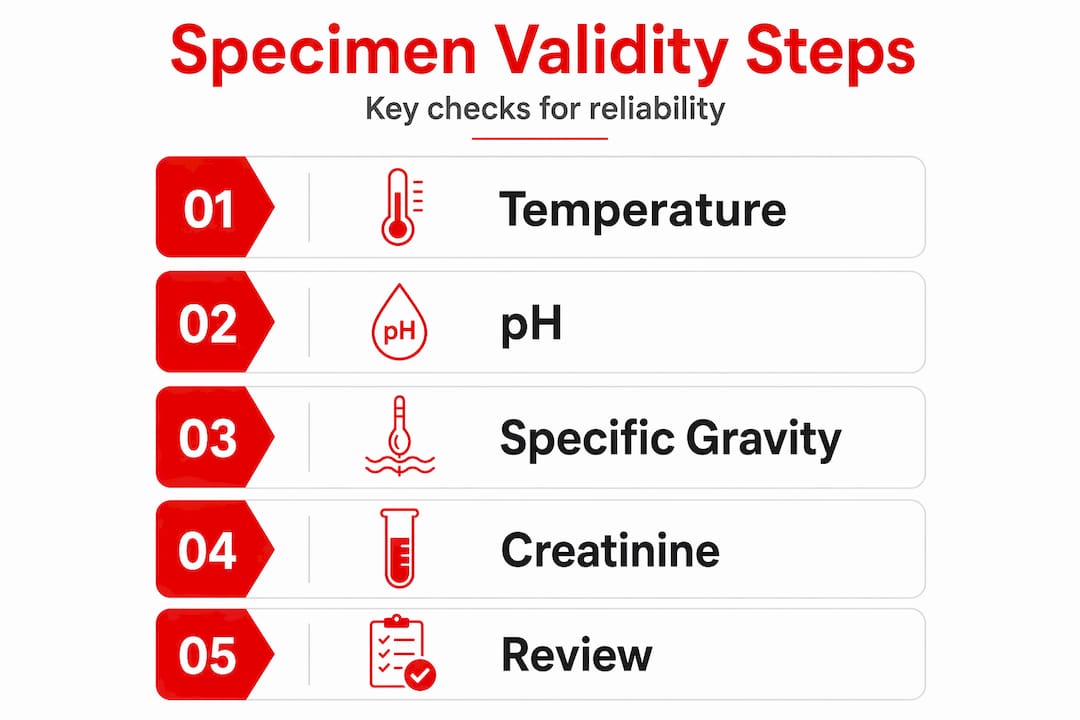
Validity testing in toxicology laboratories commonly combines temperature monitoring with pH, specific gravity, and creatinine measurement to create a multi-layered defense against adulteration, dilution, and substitution. Each measure catches different threats, and their combined picture is far more defensible than any single parameter.
| Validity measure | What it detects | Risk of skipping |
|---|---|---|
| Temperature | Substitution, time manipulation, cold adulteration | Miss substitution events at collection |
| pH | Chemical adulteration (bleach, nitrites, acids) | Miss most chemical tampering events |
| Creatinine | Dilution, synthetic specimen | Diluted specimens pass as valid |
| Specific gravity | Dilution, substitution | Fails to catch borderline dilution |
Common errors when labs rely on temperature alone:
- Accepting a specimen as valid after it passes temperature, even though pH is outside physiological range
- Failing to run creatinine when specific gravity flags borderline dilution
- Treating an in-range temperature as clearing the specimen of adulteration
- Skipping visual inspection for color and clarity anomalies that suggest chemical tampering
Pro Tip: Before certifying any result, review all validity parameters together as a unified picture. A specimen that passes temperature but fails pH is not a valid specimen. The controls work as a system, not as independent checkboxes.
The practical implication is that temperature and chemical validity tests are mutually reinforcing. Temperature operates at the moment of collection; pH, creatinine, and specific gravity testing operates at the lab bench. Together, they close the window for manipulation at every stage of handling. Understanding the full range of urine test strip types helps labs select the right combination of controls for their specific program requirements.
Implementing continuous environmental temperature monitoring in your lab
Temperature monitoring extends beyond the collection cup. Once a specimen is collected, the storage and transport environment creates another vulnerability. Temperature excursions can accelerate biological and chemical degradation, undermining the integrity of samples that passed initial collection checks. Continuous monitoring closes this gap.
Steps for implementing a compliant continuous monitoring system:
- Define critical temperature ranges. Establish written criteria for each storage area: refrigerators for short-term specimen holding, freezers for long-term retention, and ambient laboratory areas.
- Select calibrated monitoring instruments. Use sensors with documented calibration histories and traceable accuracy. Digital data loggers with alarm functions are standard in regulated environments.
- Set automated alerts. Configure sensors to alert designated personnel when readings exceed defined thresholds, reducing response lag during excursions.
- Establish a calibration schedule. Calibrate all monitoring instruments at least annually, or per manufacturer recommendations. Document each calibration event with technician signature and instrument ID.
- Create corrective action procedures. Define written responses for each type of excursion: who to notify, whether specimens are quarantined, and how the event is investigated.
- Maintain auditable logs. Store temperature records in a format that cannot be retroactively altered. Electronic systems with access logs and time stamps are preferred for regulated programs.
- Conduct periodic audit readiness reviews. Quarterly internal reviews of temperature logs, corrective action records, and calibration documentation keep programs prepared for unannounced inspections.
| Temperature deviation | Common root cause | Corrective action |
|---|---|---|
| Refrigerator above 8°C | Door seal failure or overloading | Quarantine specimens, service equipment |
| Ambient above range | HVAC failure or seasonal change | Move specimens, log event, investigate |
| Freezer above threshold | Power interruption | Assess specimen stability, notify supervisor |
| Sensor gap in records | System failure or manual log lapse | Review calibration, retrain staff |
Expert insight: Continuous temperature monitoring logs are not just operational tools. In legal or regulatory challenges, a complete, uninterrupted log showing consistent compliant storage is one of the most powerful pieces of evidence a laboratory can present. Gaps or inconsistencies in those records, even short ones, become the focus of scrutiny in adverse action proceedings.
ACHC laboratory compliance guidance is explicit: laboratories must define critical environmental criteria, monitor and document conditions continuously, and apply documented corrective actions whenever established ranges are exceeded. This is not optional for accredited facilities. It is a condition of maintaining certification.
Connecting your continuous monitoring system to your specimen cups with temperature strip workflow creates a seamless integrity chain from collection through storage. When both ends of that chain are documented and defensible, labs are protected at every stage.
What most labs miss with specimen temperature: Our perspective
Here is an uncomfortable truth most compliance resources won’t say directly: the majority of lab deficiency citations in workplace drug testing programs are not about wrong analytical results. They are about incomplete or poorly documented validity controls, and temperature records are disproportionately represented in those findings.
We have supported labs through regulatory scrutiny, and the pattern is consistent. A program runs hundreds of collections per month without incident. Temperature gets checked, the box gets checked, and the form gets filed. Then a challenged result surfaces, or an audit arrives, and the first question is always: where is the documented corrective action for this out-of-range reading from six months ago? If the answer is “we didn’t record one because it seemed minor,” the program is already in a difficult position.
The “clockwork” approach, treating temperature as a pass/fail stamp rather than a documented scientific observation, creates a specific vulnerability. It looks fine under routine conditions. It collapses under pressure. A calibrated, auditable, interpreted temperature record does the opposite. It might look like extra work on a normal day. When a result is challenged, it becomes the clearest evidence that your program is rigorous and trustworthy.
Staff training is where this gap is most often created. Collectors learn to check the strip and move on. They are not trained to interpret unusual readings, document them with specificity, or escalate based on what they see. Fixing that training gap costs almost nothing. The cost of not fixing it can be substantial.
Editorial summary: Temperature records are defensibility levers, not compliance paperwork. Labs that treat them as the former build programs that withstand scrutiny. Labs that treat them as the latter discover the difference during an audit or legal challenge.
Pro Tip: Conduct a quarterly audit of your temperature documentation. Pull a random sample of chain-of-custody forms and check whether every out-of-range reading has a corresponding corrective action entry. If more than a handful are missing, you have a training problem to address before an external auditor does.
We believe that real-world urine specimen integrity is built on habits, not just knowledge. Knowing the acceptable temperature range is not enough. Building a culture where every collector understands why that range matters, and what documenting it correctly protects, is what separates defensible programs from vulnerable ones.
Enhance integrity with trusted temperature-monitored collection solutions
Labs serious about specimen integrity need tools that make compliant collection easier, not harder.
At Rapid Test Cup, our urine specimen cups with temperature strip are built to make the temperature check immediate, readable, and documentable at the point of collection. For programs requiring multi-panel testing with built-in adulteration detection, the 12 panel ADLTX test cup combines drug screening with validity controls in a single integrated device. Follow our step-by-step urine collection guide to standardize your collector training and ensure every reading is captured correctly the first time. When your collection supplies are validated and your protocols are documented, audit readiness becomes a byproduct of daily practice.
Frequently asked questions
What is the acceptable urine specimen temperature range for validity?
The valid range is typically 90 to 100°F, and regulators require the reading to be taken within four minutes after collection to be considered valid.
Can a specimen with out-of-range temperature still be tested?
An out-of-range temperature generally triggers validity procedures or a second observed collection, and under DOT protocols it can escalate to a formal refusal to test when combined with other indicators.
Why does storage temperature matter after specimen collection?
Improper storage causes biological and chemical degradation that can compromise the analytical markers needed for accurate drug test results.
Is temperature monitoring enough to confirm specimen legitimacy?
No. Temperature should always be combined with pH, creatinine, and specific gravity testing to confirm specimen validity across all major tampering scenarios.
How should labs document temperature monitoring for audits?
Labs should use calibrated instruments and maintain auditable, time-stamped logs that record every reading, every excursion, and every corrective action taken.