Blog
Tips for Clinic Drug Testing: 10 Practical Strategies


TL;DR:
- Effective clinic drug testing requires careful selection of specimen types, validation at collection, and ongoing staff training. Regular review of test menus and strict result interpretation protocols are essential to maintain accuracy, compliance, and patient trust. Collaboration between laboratory and clinical teams, along with proper confirmation of positive results, ensures programs are both legally defensible and clinically effective.
Clinic drug testing sits at the intersection of patient safety, regulatory compliance, and operational efficiency. Get it wrong and you face compromised results, legal exposure, or missed clinical signals. The tips for clinic drug testing covered here are designed for the healthcare professionals and administrators who actually run these programs, not for generalists looking for a surface-level overview. From selecting the right specimen type to handling positive results with Medical Review Officers, this article gives you the specific, experience-backed guidance your clinic needs to build a program that holds up under scrutiny.
Table of Contents
- Key takeaways
- 1. Match the testing method to your clinical purpose
- 2. Understand detection windows for each drug class
- 3. Select specimen collection supplies that meet regulatory standards
- 4. Validate specimens immediately at collection
- 5. Use rapid point-of-care tests strategically
- 6. Build and maintain a strict chain of custody
- 7. Train staff on result interpretation, not just collection
- 8. Review and update your test menu regularly
- 9. Define a clear protocol for positive results
- 10. Foster ongoing collaboration between lab and clinical staff
- My take on what actually moves the needle in clinic drug testing
- How Rapidtestcup supports your clinic drug testing program
- FAQ
Key takeaways
| Point | Details |
|---|---|
| Specimen type drives accuracy | Match your collection method to the clinical question, since urine remains the most reliable option for most screening scenarios. |
| Turnaround time matters clinically | Results needed in under an hour for emergency contexts require rapid point-of-care tests, not lab-based assays. |
| Staff training reduces errors | Regular education on assay limitations and result interpretation prevents the most common and costly mistakes in clinic testing. |
| Specimen validity checks are non-negotiable | Temperature, pH, and creatinine monitoring detect adulteration before it compromises your program’s integrity. |
| Review your test menu periodically | Removing rarely used panels reduces costs and lowers the rate of false positives across your program. |
1. Match the testing method to your clinical purpose
The first and most overlooked tip in clinic drug testing advice is this: define your clinical question before selecting a test. Are you screening for compliance in a pain management program? Triaging an overdose? Monitoring recovery in a substance use disorder clinic? Each scenario demands a different approach.
Urine testing remains the most widely used method in clinical practice because of its ease of collection, broad detection windows, and well-established reference ranges. But it is not universally appropriate. Oral fluid testing suits witnessed collection scenarios where privacy-based adulteration is a concern. Hair testing answers questions about long-term use over 90 days but cannot detect recent ingestion. Blood testing gives you quantitative data for overdose assessment but requires trained phlebotomy staff and is not practical for routine screening.
Pro Tip: Build a simple decision matrix for your clinic that maps clinical question type to specimen type. Share it with every staff member who orders or collects tests. Consistency at the ordering stage prevents a cascade of downstream errors.
2. Understand detection windows for each drug class
Detection windows vary widely by drug and specimen type, and misunderstanding them is a source of both false negatives and unnecessary patient concern. THC stays detectable in urine for days in an occasional user and weeks in a chronic user. Heroin metabolites may clear within 24 hours. Benzodiazepines, depending on the specific compound, can persist for days or even weeks.
This matters clinically because a negative urine result does not rule out recent use, and a positive result does not tell you when or how much was used. Oral fluid testing offers a shorter detection window, which makes it useful for detecting recent use but increases the rate of false negatives compared to urine. Educate your clinical team on these windows so that results are placed in appropriate clinical context before any decision is made.
3. Select specimen collection supplies that meet regulatory standards
Federal workplace drug testing programs require a minimum of 30 mL of urine for a standard test and 45 mL for split-sample protocols. These thresholds exist for good reason: insufficient volume compromises confirmatory testing and chain-of-custody integrity.
Choose collection cups that include built-in temperature strips, tamper-evident seals, and sufficient volume capacity for your testing panel. If your clinic performs split-sample testing, confirm your cups are designed for that purpose. The right collection hardware is not a minor logistic detail. It is the foundation of a defensible result.
4. Validate specimens immediately at collection
Specimen validity testing is where many clinic programs have gaps. Temperature must be measured within four minutes of collection and should fall between 32 and 38 degrees Celsius (90 to 100 degrees Fahrenheit). A reading outside that range is a red flag for substitution.
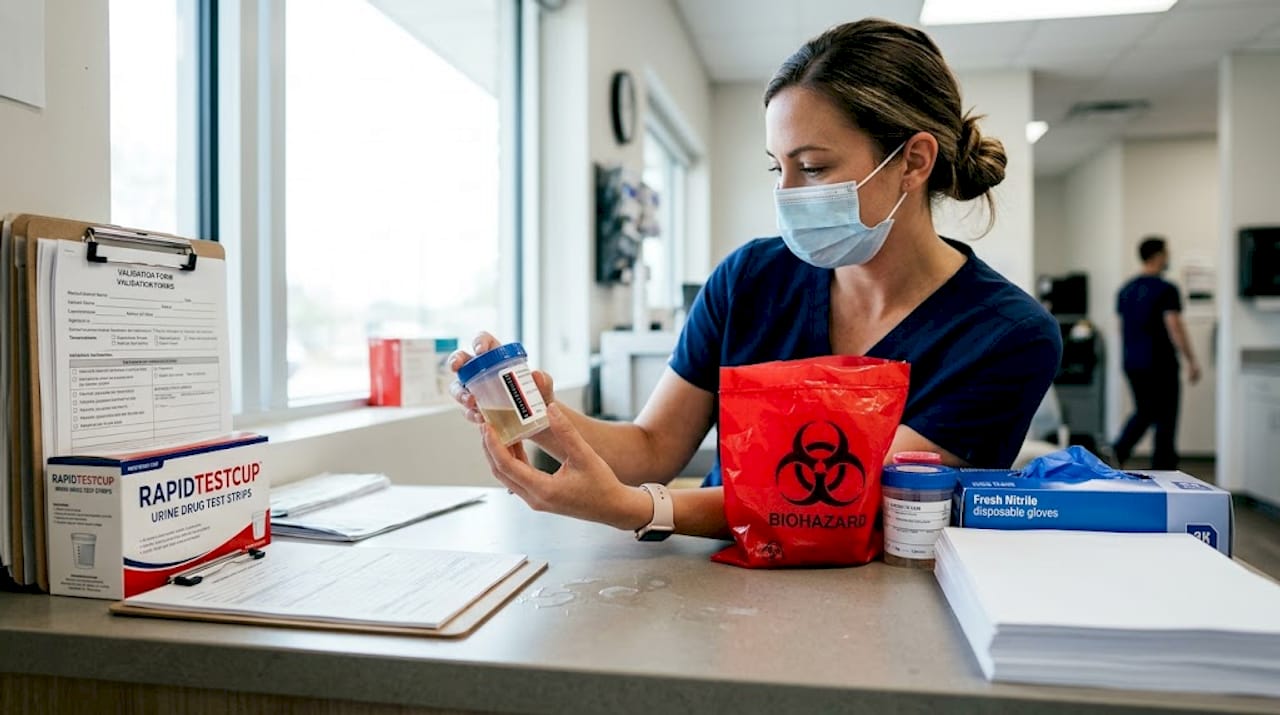
Beyond temperature, creatinine levels and pH testing detect dilution and chemical adulteration. Creatinine below 2 mg/dL indicates a substituted specimen. A pH outside the 4.5 to 9.0 range suggests chemical interference. These checks should be built into your standard collection workflow, not treated as optional add-ons for suspicious cases. Measuring creatinine and temperature together catches the majority of adulteration attempts before the specimen ever reaches the analyzer.
5. Use rapid point-of-care tests strategically
Rapid point-of-care (POC) tests deliver preliminary results in minutes, which makes them indispensable in emergency and urgent care contexts. In emergency settings, results under one hour are generally recommended for clinical relevance. A rapid drug test cup can meet that threshold when the lab cannot.
The trade-off is specificity. POC immunoassay screens produce more cross-reactive results than laboratory-based confirmatory methods. Any positive POC result that will affect a clinical or legal decision must be confirmed by gas chromatography-mass spectrometry or liquid chromatography-mass spectrometry. Build that confirmation step into your written protocol so it is not left to individual clinician judgment. Rapid screening methods are a powerful front-line tool when used with that understanding.
6. Build and maintain a strict chain of custody
Chain-of-custody documentation is the legal backbone of any drug testing program, whether the results are used clinically, forensically, or for employment decisions. Every step from collection to reporting must be documented: who collected the specimen, when it was collected, how it was stored, and who handled it at each transfer point.
Gaps in chain of custody can invalidate results in legal proceedings and create liability for your clinic. Use pre-printed chain-of-custody forms, ensure collectors sign and date at every handoff, and store documentation alongside the specimen record. For clinics running high-volume programs, a laboratory information system that auto-generates chain-of-custody records dramatically reduces manual documentation errors.
7. Train staff on result interpretation, not just collection
Collecting a specimen correctly is only half the job. How your team interprets and communicates results determines the clinical outcome. Laboratories consistently recommend that clinical staff receive formal education on assay limitations, including what causes false positives, what causes false negatives, and what a positive result actually tells you about timing and quantity.
Common sources of false positives include over-the-counter medications like certain antihistamines, NSAIDs, and proton pump inhibitors that cross-react with immunoassay antibodies. Staff who do not know this will misinterpret a positive screen as confirmed drug use. Periodic staff training sessions tied to your updated test menu keep interpretation skills current. Schedule them at least annually and after any significant change to your panel.
Pro Tip: Create a one-page quick-reference guide listing common cross-reactive medications for each drug class on your panel. Post it in your collection area and include it in new staff onboarding.
8. Review and update your test menu regularly
A drug test menu that was designed three years ago may no longer reflect the substances your patient population is actually using. Fentanyl analogs, synthetic cannabinoids, and novel benzodiazepines continue to emerge faster than standard immunoassay panels can adapt. Test menus should be reviewed routinely to reflect local drug use trends and eliminate panels that are rarely positive in your population.
Unnecessary panels cost money and generate false positives. Every test you run that has a near-zero true positive rate in your patient population adds noise without clinical signal. Work with your laboratory director or reference lab to review utilization data at least annually. Remove low-yield panels and add emerging substance screens where the data supports it. This is one of the most financially and clinically impactful effective drug screening tips that most clinics skip.
9. Define a clear protocol for positive results
What happens after a positive screen is where clinic drug testing programs most commonly fail. Without a documented protocol, staff improvise, patients receive inconsistent communication, and compliance with legal requirements gets patchy.
A Medical Review Officer (MRO) plays a central role in federally regulated testing programs. MROs interpret results in the context of the donor’s medical history and prescription medications before a final determination is made. Even in non-regulated clinical settings, having a designated physician review positive results before they reach the patient adds a critical layer of accuracy and fairness. Pair that with a clear patient communication script and a documented referral pathway for follow-up care.
Some states now have statutory requirements around positive result handling. As one example, Maine’s 2026 law requires employers to offer rehabilitation before taking disciplinary action for a first positive result, including up to 12 weeks of rehabilitation opportunity. Know the legal requirements in your jurisdiction and build them into your written policy.
10. Foster ongoing collaboration between lab and clinical staff
The most effective clinic drug testing programs treat the laboratory as a clinical partner, not a processing center. Labs can tell you which assays have the most cross-reactivity in your specific patient population, which panels have the lowest yield, and when confirmatory testing is worth the added cost.
Labs and clinical staff working together on test selection and result interpretation consistently produce better patient outcomes than siloed teams. Schedule quarterly meetings between your lab director or toxicologist and your clinical leadership. Use those sessions to review cases where results led to unexpected clinical findings, and audit your false positive and false negative rates together. The data from that collaboration will drive better decisions than any guideline document. You can also review resources on clinic drug test workflow to identify where collaboration gaps typically form.
My take on what actually moves the needle in clinic drug testing
I’ve spent years watching clinics invest in testing hardware and updated panels while leaving their biggest vulnerabilities completely unaddressed. The pattern is consistent. The equipment is rarely the problem. The gaps show up in three places: inconsistent staff training, no formal process for reviewing positive results, and a test menu that no one has looked at critically in years.
What I’ve learned is that the clinics running the tightest programs are not necessarily using the most sophisticated technology. They are the ones with a written protocol that every staff member can actually find and follow, a designated person responsible for reviewing test menu performance annually, and a standing relationship with their lab that goes beyond order and report.
The misconception I encounter most often is that a positive rapid screen is a confirmed result. It is not. It is a preliminary finding that requires confirmation before any clinical or administrative action. Treating it otherwise is the single fastest way to damage patient trust and create legal liability for your clinic. Get that distinction embedded in your culture, and you will avoid more problems than any new panel or device can solve.
— Justin
How Rapidtestcup supports your clinic drug testing program
Rapidtestcup carries the full range of products clinics need to run a compliant, accurate drug testing program without overspending. From CLIA waived, FDA-approved drug test cups with built-in adulteration checks to multi-panel options covering emerging substances, the catalog is built for professional and forensic-grade use. Whether you are equipping a single collection site or managing bulk orders for a multi-location clinic, Rapidtestcup offers volume pricing and fast shipping to keep your program running without supply gaps. Explore the top urine drug test kits to compare panels side by side, or use the kit selection guide to find the right fit for your specific clinical setting.
FAQ
What specimen type is best for routine clinic drug screening?
Urine remains the preferred specimen for most clinical drug screening due to its broad detection windows, ease of collection, and well-established regulatory standards.
How quickly should drug test results be available in a clinical setting?
For emergency contexts, results should be available in under an hour to influence clinical decision-making; rapid point-of-care tests are the most practical way to meet that standard.
What should clinics do when a rapid drug screen comes back positive?
A positive screen must be confirmed by mass spectrometry before any clinical or administrative action is taken, and results should be reviewed by a Medical Review Officer when the testing program falls under federal or state regulatory requirements.
How often should a clinic review its drug test menu?
At minimum, clinics should review their test menu annually, using utilization data to remove low-yield panels and add screens for substances that reflect current local drug use trends.
What are the most common causes of false positives in urine immunoassay screens?
Cross-reactive medications including certain antihistamines, NSAIDs, and proton pump inhibitors are frequent causes of false positive results; confirming positives with laboratory-based methods eliminates this risk before clinical action is taken.