Blog
Sensitivity and Specificity for Drug Test Buyers


TL;DR:
- Drug-testing kit sensitivity indicates how many true positives it detects, while specificity reflects how many false positives it produces. Wrongly estimating these can cause missed drug use or excessive confirmatory tests, raising costs and legal risks. Buyers should use high-sensitivity screens confirmed by high-specificity lab methods, verify regulatory approvals, and consider drug prevalence to interpret positive results accurately.
For drug-testing buyers, sensitivity tells you how few true positives a screening kit will miss, while specificity tells you how many false positives it will generate. Get these two numbers wrong at the procurement stage and you either miss real drug use or flood your HR team with costly confirmatory tests.
Three rules to carry into every purchasing decision:
- Screen with high-sensitivity immunoassays; confirm positives with high-specificity GC-MS/LC-MS/MS. No single test does both jobs well, and clinical guidance is explicit that consequences of false positives in workplace and forensic contexts demand a two-step pathway.
- In low-prevalence settings, expect more false positives than true ones — budget for confirmations accordingly. A test with 95% specificity still flags 50 clean samples per 1,000 tested; if only 10 of those 1,000 actually used drugs, the false positives outnumber the real ones five to one.
- Check CLIA waiver status, FDA clearance, and lot documentation before ordering. Regulatory paperwork is not a formality; it is the only way to verify that the sensitivity/specificity figures on the box were validated under controlled conditions. Rapidtestcup carries CLIA-waived, FDA-approved options and can supply lot certificates on request.
Table of Contents
- Understanding sensitivity and specificity: definitions and formulas
- Why sensitivity and specificity move in opposite directions
- How prevalence changes what a positive result actually means
- Common drug-test types and what their performance ranges look like
- How to match sensitivity vs specificity to your testing context
- Your procurement checklist for drug-testing kits
- What to do after a positive or negative screen
- Real-world pitfalls that reduce effective test accuracy
- How these recommendations were compiled
- Key Takeaways
- A procurement perspective worth stating plainly
- Rapidtestcup has the kits, documentation, and bulk pricing your program needs
- Useful sources
Understanding sensitivity and specificity: definitions and formulas
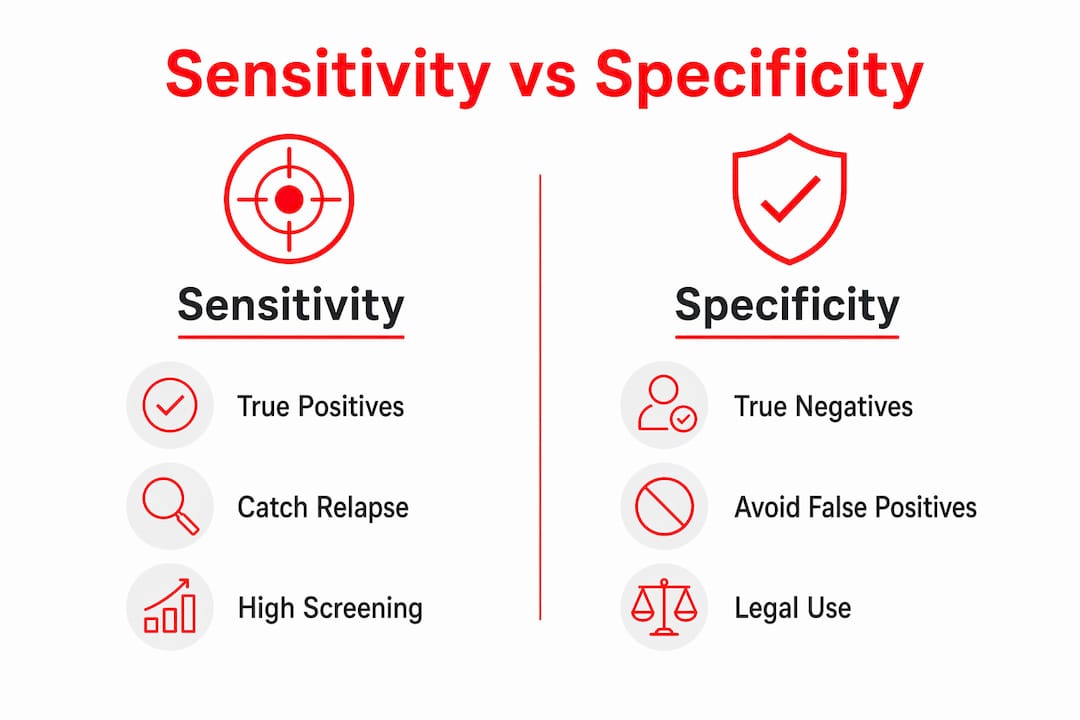
Sensitivity and specificity are intrinsic test properties — they describe how the test performs regardless of who you are testing.
- Sensitivity (true positive rate) = TP ÷ (TP + FN). It answers: “Of everyone who actually used drugs, what fraction did the test catch?”
- Specificity (true negative rate) = TN ÷ (TN + FP). It answers: “Of everyone who did not use drugs, what fraction did the test correctly clear?”
The 2×2 contingency table
| Truly Positive | Truly Negative | |
|---|---|---|
| Test Positive | True Positive (TP) | False Positive (FP) |
| Test Negative | False Negative (FN) | True Negative (TN) |
Worked example. You run 1,000 urine screens. 100 donors actually used drugs; 900 did not. The kit has moderate sensitivity and specificity.
- TP and FN numbers reflect this sensitivity.
- TN and FP numbers reflect this specificity
Ninety real users are caught. But 45 clean donors also test positive — a number your confirmatory lab will need to process. That ratio is what procurement decisions hinge on, as shown in peer-reviewed clinical examples: a test with 80% sensitivity and 95% specificity produces a nontrivial number of false positives when screening large low-prevalence groups.
Why sensitivity and specificity move in opposite directions
Every immunoassay has a detection cutoff: the concentration of a drug metabolite at which the test flips from negative to positive. Lower that cutoff and the test catches more true positives (higher sensitivity) but also flags more borderline-clean samples (lower specificity). Raise it and you get fewer false alarms but miss more real users. This is the inverse relationship at the core of every kit comparison.
For buyers, the practical consequence is straightforward: a higher-sensitivity screen increases your confirmatory testing volume and cost. If you switch from a 95% specificity cup to a 90% specificity cup across 5,000 monthly tests in a low-prevalence workforce, you add roughly 250 extra confirmatory referrals per month. That is a budget line, not a footnote.
Pro Tip: When a supplier quotes sensitivity and specificity figures, ask for the specific cutoff concentration those numbers were measured at — and request lot-specific validation data. Published headline figures are often measured under ideal lab conditions; lot-to-lot variability in manufacturing can shift real-world performance meaningfully.
How prevalence changes what a positive result actually means
Sensitivity and specificity are test-intrinsic. Positive predictive value (PPV) and negative predictive value (NPV) are not — they shift with the prevalence of drug use in the group you are testing.
- PPV = TP ÷ (TP + FP): the probability that a positive result is a real positive.
- NPV = TN ÷ (TN + FN): the probability that a negative result is a real negative.
Using the same kit with moderate sensitivity and specificity from the worked example above:
| Scenario | Prevalence | TP | FP | PPV | NPV |
|---|---|---|---|---|---|
| High-prevalence group | 300 of 1,000 | — | — | — | — |
| Low-prevalence group | 10 of 1,000 | — | — | Fewer than 4 in 10 positive screens represent actual drug use | — |
The false positive paradox in practice: In the low-prevalence scenario, fewer than 4 in 10 positive screens represent actual drug use. PPV and NPV depend heavily on prevalence; the same test gives dramatically different predictive values across populations.
This is why a random-selection workplace program (low prevalence) needs a tighter confirmatory protocol than a post-incident program (higher prevalence). Build that assumption into your program design before you order kits.
Common drug-test types and what their performance ranges look like
Understanding which test format fits which role is as important as the numbers themselves.
- Point-of-care urine immunoassay cups and dip cards. The workhorse of workplace and clinical screening. Sensitivity typically runs high (often cited in a high range for common analytes at SAMHSA cutoffs), with specificity somewhat lower due to cross-reactivity. Fast, low cost, no lab required. See screening panel composition for cutoff and analyte details.
- Lateral-flow oral fluid swabs. Useful for observed, post-incident, or roadside collection where urine is impractical. Detection windows are shorter than urine, which affects sensitivity for drugs used days earlier.
- Lab-based GC-MS and LC-MS/MS confirmation. The gold standard for specificity. These methods identify and quantify specific drug compounds rather than reacting to a class of metabolites, which is why they are required for any legally or forensically consequential result. Sensitivity and specificity at validated cutoffs routinely exceed 99%.
- Adulterant detection strips and integrated cup panels. Not a drug test per se, but a specimen integrity check. Adulteration testing catches dilution, substitution, and oxidizing agents that would otherwise produce false negatives — effectively protecting the sensitivity of the whole program.
As clinical literature shows, sensitivity and specificity ranges vary substantially by analyte and cutoff; always request analyte-specific data from your supplier, not a single composite figure.
How to match sensitivity vs specificity to your testing context
Workplace programs typically prioritize sensitivity at the screening stage. Missing a true positive creates safety and liability exposure. Use a high-sensitivity immunoassay cup as the screen, then route all positives to a CLIA-certified confirmatory lab before any employment action. Documentation requirements under DOT and SAMHSA guidelines apply to federally mandated programs.

Clinical and substance abuse treatment settings often need both high sensitivity (to catch relapse early) and reliable NPV (to reassure clinicians a negative is real). Frequency of testing can compensate for imperfect sensitivity — a point clinical examples from cervical screening programs illustrate well. Pair point-of-care screens with periodic lab confirmation to calibrate your program’s accuracy over time.
Forensic and law enforcement contexts demand the highest specificity. A false positive in a criminal case has severe consequences. The SpPIN mnemonic is a useful shorthand: a highly Specific test that is Positive rules IN the condition. Every positive immunoassay screen must be confirmed by GC-MS/LC-MS/MS with full chain-of-custody documentation before it carries any evidentiary weight. See Rapidtestcup’s forensic drug testing guidance for chain-of-custody specifics.
Personal and at-home testing sits at the opposite end of the consequence spectrum. High sensitivity matters most — the goal is usually to detect any use, not to build a legal case. Confirmatory testing is still advisable before any significant personal decision.
Pro Tip: For any program where a positive result triggers employment action, legal proceedings, or clinical intervention, require GC-MS/LC-MS/MS confirmation in your supplier contract and specify the confirmatory lab partner upfront. Verbal assurances are not procurement controls.
Your procurement checklist for drug-testing kits
Before signing any purchase order, verify each of the following:
- Claimed sensitivity and specificity at the specific cutoff concentration you intend to use (not a generic “high accuracy” claim).
- CLIA waiver status and FDA 510(k) clearance documentation for the exact product SKU.
- Lot-specific validation data (certificate of analysis) — not just manufacturer averages.
- Analyte panel and cutoff list matching your program’s requirements (SAMHSA, DOT, or custom).
- Adulterant detection capability — integrated or add-on strips for creatinine, pH, oxidants, specific gravity.
- Stability and storage requirements — temperature range, shelf life, and cold-chain needs.
- Chain-of-custody materials included or available separately (tamper-evident seals, custody forms).
- Confirmatory lab partner named and contracted, with turnaround time and reporting format specified.
- Training and support available from the supplier for collector certification and result interpretation.
- Warranty and non-conformance policy for failed or invalid results.
Sample RFP questions worth sending to any supplier: “What is the sensitivity and specificity of this product at the 50 ng/mL THC cutoff, and can you provide the validation study?” “What lot-to-lot variability have you observed across the last six production batches?” “Which confirmatory labs do you partner with, and what is the average turnaround time?”
Score supplier responses on completeness and specificity of documentation. A supplier who cannot produce a certificate of analysis for a current lot is a supplier to avoid.
What to do after a positive or negative screen
A positive immunoassay screen is not a confirmed result. The required sequence: place the donor’s result on hold, transfer the specimen to a CLIA-certified lab for GC-MS/LC-MS/MS confirmation, and maintain chain-of-custody documentation throughout. No employment action, no legal referral, and no clinical intervention should occur on a screen-only positive.
Typical confirmation turnaround runs 24–72 hours for standard panels. Build that window into your HR or clinical workflow so supervisors are not making decisions on unconfirmed data. Documentation should include the collector’s signature, specimen ID, collection timestamp, and the confirmatory lab’s signed report. Retention periods vary by program type; federally regulated programs follow DOT/SAMHSA record-keeping rules.
A negative screen generally means no further action, but re-test when collection integrity is in doubt (dilute specimen, broken seal, temperature out of range). For clinical programs, the SnNOUT principle applies: a highly Sensitive test that is Negative rules OUT use with high confidence. Before any adverse employment or forensic action, involve occupational health, a Medical Review Officer (MRO), or legal counsel.
Real-world pitfalls that reduce effective test accuracy
- Inappropriate cutoffs: Using a kit calibrated for SAMHSA federal cutoffs in a zero-tolerance program misses low-level use. Match cutoff to program policy.
- Cross-reactivity: Immunoassays react to drug classes, not specific compounds. Common OTC medications (certain antihistamines, NSAIDs, decongestants) can trigger false positives. Confirmation resolves this.
- Improper collection timing: Most drugs have narrow urine detection windows. Collect too late and sensitivity drops regardless of kit quality. Train collectors on detection window expectations per analyte.
- Specimen adulteration: Bleach, nitrites, and commercial adulterants can suppress immunoassay reactions, producing false negatives. Include adulterant detection strips in every collection kit.
- Lot-to-lot variability: Manufacturing variation shifts cutoff performance between batches. Require lot certificates and spot-check new lots against known positive/negative controls.
- Poor collector training: Misread result lines, incorrect timing, and improper specimen handling all degrade accuracy independent of kit quality. Annual recertification matters.
- Prevalence misestimation: Assuming a high-prevalence rate in a low-prevalence workforce inflates your expected PPV and leads to under-budgeting for confirmatory testing.
Budget for periodic QA sampling — running known positive and negative controls through each new lot — to catch performance drift before it affects real program results.
How these recommendations were compiled
Recommendations in this guide draw on peer-reviewed clinical overviews from NCBI Bookshelf and StatPearls, diagnostic accuracy guidance covering sensitivity, specificity, PPV/NPV, and likelihood ratios, and US regulatory references from FDA and CLIA. Selection criteria focused on US-relevant clinical and procurement guidance applicable to workplace, forensic, and clinical drug-testing programs.
Guidance note: This article is general educational information, not legal or regulatory advice. Drug-testing program requirements vary by industry, jurisdiction, and program type. Confirm current rules with your legal counsel, a certified MRO, or the relevant federal agency (DOT, SAMHSA, FDA) before finalizing program specifications.
Source links appear in the Useful Sources section below. Rapidtestcup can supply product-specific datasheets and lot certificates on request.
Key Takeaways
Sensitivity and specificity are test-intrinsic metrics that determine how a kit performs, but PPV and NPV — the numbers that actually predict whether a positive result is real — shift with the prevalence of drug use in your tested population.
| Point | Details |
|---|---|
| Screen then confirm | Use high-sensitivity immunoassays to screen; route all positives to GC-MS/LC-MS/MS before any employment or legal action. |
| Prevalence drives PPV | In a low-prevalence group (3%), a 90%/95% kit yields a PPV where fewer than 4 in 10 positive screens are actual drug use — most positives are false alarms without confirmation. |
| Budget for confirmations | Higher screening sensitivity increases confirmatory volume; factor confirmatory testing costs into per-test budgets before ordering. |
| Verify documentation | Require CLIA waiver status, FDA clearance, and lot-specific certificates of analysis from every supplier before purchase. |
| Rapidtestcup sourcing | Rapidtestcup supplies CLIA-waived, FDA-approved multi-panel cups with adulterant detection and provides COAs and lot data on request. |
A procurement perspective worth stating plainly
Most buyers focus on price per cup and panel count. Those matter, but the number that actually determines program reliability is the PPV in your specific population — and that number is invisible on any product page. I have seen programs confidently report “positive results” that were, statistically, more likely false than real, simply because no one ran the prevalence math before ordering.
The screen-then-confirm workflow is not optional overhead. It is the only way to make a positive result mean something defensible. What I would add to the standard advice: ask your supplier not just for sensitivity and specificity figures, but for the confidence intervals around those figures and the sample sizes behind them. A test claiming 99% sensitivity based on 50 validation samples is a very different product from one validated across thousands. Rapidtestcup can provide product datasheets, certificates of analysis, and batch performance data on request — the kind of documentation that turns a procurement decision into a defensible program specification.
Rapidtestcup has the kits, documentation, and bulk pricing your program needs
Procurement teams that follow the screen-then-confirm workflow need a supplier who can match that standard with documentation, not just product. Rapidtestcup’s catalog covers the full screening side: 12-panel urine cups for cost-effective multi-analyte workplace screening, and 18-panel cups with integrated adulterant detection for programs that need broader analyte coverage and specimen integrity checks in a single device. All CLIA-waived and FDA-approved options come with available certificates of analysis and lot-specific validation data.
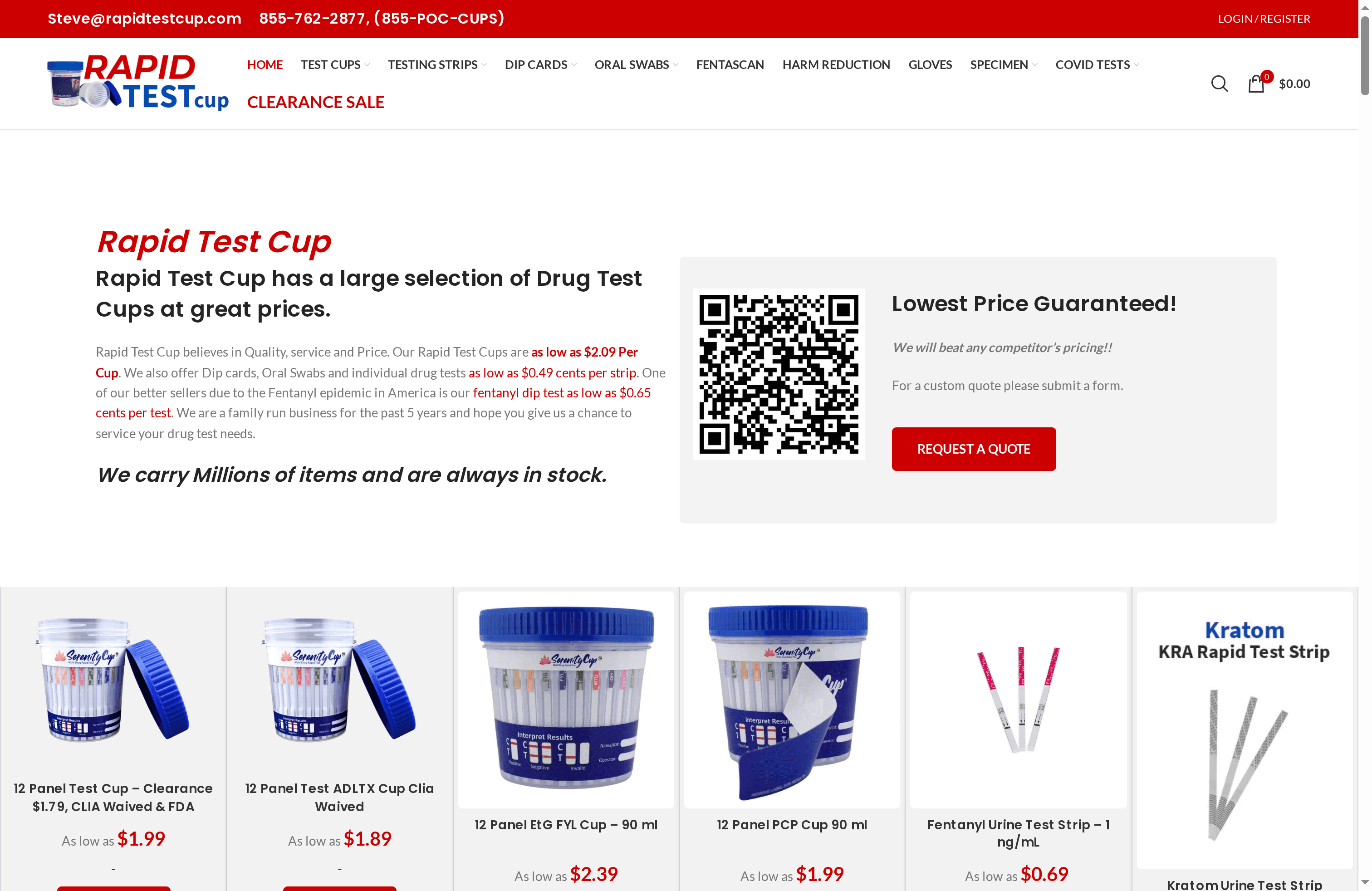
Bulk and wholesale pricing is available for laboratories, clinics, substance abuse programs, and law enforcement agencies. Request a custom quote, ask for a sample kit to evaluate before committing to volume, or download a product datasheet to verify cutoff concentrations and regulatory status against your program specs. Contact Rapidtestcup directly to get the documentation your procurement process requires.
Useful sources
- NCBI Bookshelf: Sensitivity and Specificity — Plain-language clinical overview covering definitions, formulas, PPV/NPV, and the false positive paradox. Start here for prevalence effects.
- StatPearls: Diagnostic Testing Accuracy — Technical reference for sensitivity, specificity, predictive values, and likelihood ratios; recommended for clinical program managers.
- PMC: SpPIN and SnNOUT mnemonics — Practical interpretation heuristics for ruling in and ruling out conditions based on test performance.
- Statistics By Jim: Sensitivity vs Specificity — Accessible worked examples and explanation of the inverse trade-off; useful for procurement teams building evaluation matrices.
- Evidence-Based Nursing: Sensitivity and Specificity — Clinical examples showing how sensitivity/specificity map to real screening programs and operational compensations.
- FDA — In Vitro Diagnostics — Official US regulatory guidance on device clearance and CLIA waiver status for point-of-care tests.
- SAMHSA Mandatory Guidelines — Federal workplace drug-testing standards including cutoff concentrations and confirmatory requirements.
- Rapidtestcup: Test Accuracy Metrics Guide — Internal clinical interpretation reference covering sensitivity, specificity, and predictive values for drug-testing buyers; product datasheets and lot certificates available on request.