

Blog
How to Maintain Testing Accuracy: Pro Steps for 2026


TL;DR:
- Accurate drug testing requires documented procedures, trained staff, and regulatory compliance.
- Quality control and external assessments are essential for ongoing test reliability.
- Proper verification, validation, and continuous monitoring prevent operational errors and ensure accuracy.
A single inaccurate drug test result can derail a legal case, compromise patient care, or expose your facility to serious regulatory consequences. For labs, clinics, and substance abuse treatment centers, accuracy is not a goal you achieve once and check off. It demands repeatable, documented procedures at every stage of the workflow. Following rigorous QC and QA procedures is the foundation of reliable testing, and this guide walks you through every critical step from preparation to ongoing verification so your team can perform with confidence.
Table of Contents
- Essential tools, standards, and prerequisites
- How to implement rigorous QC and QA procedures
- Verification and validation of testing methods
- Troubleshooting and benchmarking for ongoing accuracy
- Our perspective: Real accuracy comes from rigorous systems and persistent vigilance
- Enhance test accuracy with proven solutions from RapidTestCup
- Frequently asked questions
Key Takeaways
| Point | Details |
|---|---|
| Compliance starts with the right tools | Using certified labs, proper equipment, and following regulatory requirements sets the foundation for accurate testing results. |
| QC and QA aren’t optional | Routine quality control and assurance procedures are essential for monitoring and maintaining high accuracy. |
| Verification and validation ensure reliability | Verifying or validating testing methods confirms that they perform as expected and can be trusted for critical decisions. |
| Continuous benchmarking keeps results accurate | Empirical benchmarks and ongoing troubleshooting help catch errors early and maintain high reliability. |
| Practical resources enhance workflows | Choosing the right drug test kits and tools makes it easier to uphold accuracy in everyday lab operations. |
Essential tools, standards, and prerequisites
Before any specimen is collected or any test is run, your facility needs to have the right infrastructure in place. This is not just about having the correct reagents on the shelf. It means documented processes, trained staff, certified equipment, and a clear understanding of which regulatory frameworks govern your work.
At a minimum, your testing setup should include:
- Calibrators and controls matched to each analyte panel you run
- Properly labeled specimen collection cups with tamper-evident seals
- Test reagents and kits within their valid lot and expiration range
- Temperature-monitored storage for specimens and reagents
- Chain-of-custody forms for every collected sample
Three regulatory bodies define the standards most labs operate under. CLIA (Clinical Laboratory Improvement Amendments) sets federal requirements for all human specimen testing. FDA clearance status determines whether your test needs full validation or simplified verification. And for workplace drug testing, SAMHSA/HHS-certified labs must participate in proficiency testing and pass scheduled inspections to maintain certification. Falling out of compliance with any of these is not a minor issue. It can result in suspended operations or legal liability.
| Regulatory framework | Primary function | Who it applies to |
|---|---|---|
| CLIA | Clinical testing standards | All labs testing human specimens |
| FDA clearance | Approves test kits for clinical use | Labs using in vitro diagnostic devices |
| SAMHSA/HHS | Workplace drug test certification | Federal workplace testing programs |
Documentation is the backbone of compliance. Every test run, QC result, corrective action, and equipment calibration must be logged and retrievable. Staff training records should be current and tied to specific procedures, not just general orientation. Anyone running tests should be able to demonstrate competency on each method, not just familiarity with the equipment.
Proficiency testing enrollment is not optional for CLIA-regulated labs. It means periodically receiving blind samples from an external provider and reporting results, which are then benchmarked against peer performance. Pairing this with your internal accuracy best practices builds a verifiable track record. And if you operate under CLIA testing regulations, knowing exactly which category your tests fall under determines your documentation burden.
Pro Tip: Designate a dedicated QC coordinator for your lab, even in small operations. Shared responsibility often means no accountability, and that gap is where errors enter.
How to implement rigorous QC and QA procedures
Once you’ve gathered the essentials, the next step is to establish strong quality assurance systems. Internal quality control (IQC) and external quality assessment (EQA) serve different but complementary roles, and both are essential.

IQC monitors performance in real time, run by run. It catches instrument drift, reagent lot issues, or procedural errors before they affect patient results. EQA provides an external, independent check. It verifies that your lab’s outputs match those of peer laboratories using the same methods. As research confirms, implementing IQC and EQA together to monitor performance is the standard for accurate, defensible results.
| Feature | IQC | EQA |
|---|---|---|
| Frequency | Daily or per batch | Monthly or quarterly |
| Who runs it | Internal staff | External accreditation body |
| Purpose | Real-time error detection | Independent benchmarking |
| Output | Control charts, flags | Comparative performance reports |
Here is a step-by-step protocol to keep your QC workflow tight:
- Run controls at the start of each shift, using at least two concentration levels per analyte.
- Plot results on a multirule QC chart (Westgard rules are widely used) to visualize trends.
- Flag any out-of-control event immediately and halt patient testing until the root cause is identified.
- Perform root cause analysis using a structured log, noting reagent lot, instrument ID, operator, and environmental conditions.
- Document corrective action and re-run controls before resuming testing.
- Review QC logs weekly for patterns that indicate gradual drift rather than acute failures.
Chain-of-custody integrity is part of QC, not separate from it. A specimen with broken custody is inadmissible, regardless of how accurate the test itself was. Build custody verification into your intake protocol, not as a final check, but as a parallel, continuous process. Your quality assurance guide and quality control workflow can help map these steps to your specific lab environment.
Regular calibration, staff training, and proficiency testing are not administrative tasks. They are the mechanisms by which ongoing accuracy is sustained across time, personnel changes, and instrument cycles.
Pro Tip: Use a two-person sign-off on all corrective actions. Having a second qualified technician review the root cause analysis prevents confirmation bias from closing out real problems too early.
Verification and validation of testing methods
With QC/QA in place, professionals must verify and validate their testing methods for reliability. These two terms are often used interchangeably, but they mean very different things in practice, and confusing them can lead to gaps in your compliance documentation.
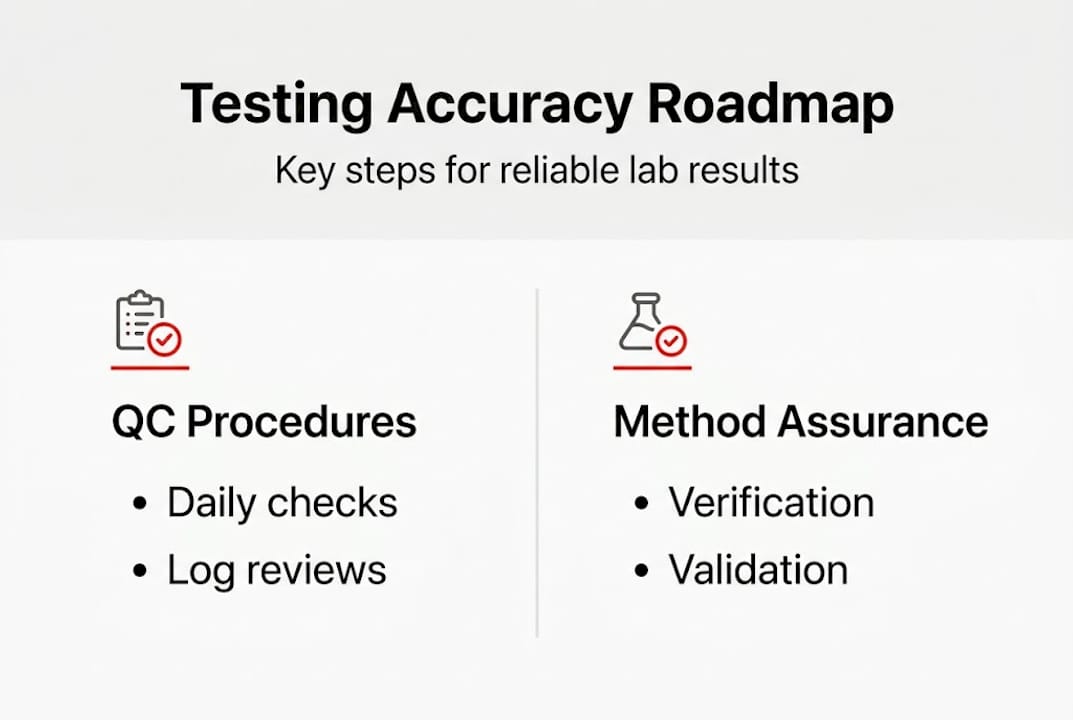
Method verification confirms that an FDA-cleared test performs in your lab according to the manufacturer’s established specifications. You are not re-proving the science. You are confirming it works as claimed in your specific environment with your specific staff. Method validation is far more resource-intensive. It is required for lab-developed tests or significantly modified methods, where no manufacturer specifications exist to verify against.
For labs using FDA-cleared kits, the process follows CLSI EP15-A3 guidelines, which define how to verify precision and bias before reporting patient results under CLIA. The key performance parameters to evaluate include:
- Precision: How reproducible are your results across runs, days, and operators?
- Accuracy (bias): How closely do your results align with the reference value?
- Specificity: Does the test correctly identify negatives without cross-reactivity?
- Sensitivity: Does the test reliably detect positives at the cutoff concentration?
- Linearity: Does performance hold across the full reportable range?
A standard EP15-A3 verification protocol runs over five days, using replicate patient-like samples at multiple concentration levels. The data generated establishes your lab’s actual precision and compares measured bias against the manufacturer’s claim. Understanding method verification vs. validation helps you allocate resources correctly without over-engineering a simple clearance or under-documenting a modified method.
For labs managing multiple panels, stagger your verification timelines by analyte category to avoid bottlenecks. Review your drug testing best practices to align verification schedules with your test menu, and consult a structured guide to selecting test kits to ensure you start with products that simplify the verification path.
Precision and accuracy are not the same metric. A test can be highly precise (consistent results) but systematically biased. Evaluating both independently is what separates a verified method from an assumed one.
Troubleshooting and benchmarking for ongoing accuracy
After method verification, maintaining accuracy requires constant vigilance and troubleshooting. Errors do not always announce themselves dramatically. They often creep in through small deviations that compound over time.
Common sources of error to monitor include:
- Specimen contamination from improper collection or handling
- Cross-reactivity from interfering substances not flagged during verification
- Custody documentation gaps that compromise result admissibility
- Reagent lot changes that introduce subtle calibration shifts
- Operator variability especially after staff turnover or training lapses
Empirical benchmarks are your measurement targets. Based on precision CV and TEa goals per CLSI EP21, each analyte in your panel should have a defined acceptable range for both imprecision (CV%) and bias. If your results trend outside those ranges, it is time to investigate, not wait for a QC failure to force action.
| Performance metric | What it measures | Benchmark source |
|---|---|---|
| Precision CV | Reproducibility across runs | Manufacturer specs / CLSI EP15 |
| Bias | Systematic offset from true value | CLSI EP21, TEa goals |
| False positive rate | Specificity failures | Internal QC logs |
| False negative rate | Sensitivity failures | Proficiency testing results |
Multirule QC charts remain the most effective tool for spotting out-of-control events before they become systemic failures. Westgard rules, for example, use a combination of warning and rejection criteria across multiple control measurements. A single point outside 3 standard deviations triggers immediate action. Two consecutive points outside 2 standard deviations signal a trend.
Staff training must be ongoing, not just onboarding-level. Schedule quarterly competency assessments for all personnel running tests. Review your false positives guide to identify common error triggers, and study the factors influencing accuracy across your testing environment.
Pro Tip: Keep a running error log categorized by source type (reagent, operator, instrument, specimen). After three months, the pattern reveals where your system is weakest, and that is exactly where to focus your next training cycle.
Our perspective: Real accuracy comes from rigorous systems and persistent vigilance
Here is an uncomfortable reality that does not get discussed enough: most accuracy failures in drug testing are not technical. They are operational. Labs with access to excellent kits, trained staff, and current equipment still generate unreliable results because they rely on habit instead of process.
Conventional shortcuts, like skipping a QC run when the workload is heavy or delaying documentation until the end of the shift, do not feel dangerous in the moment. Over time, they erode the reliability that your entire testing program is built on. One missed custody step or one undocumented corrective action can unravel months of compliant performance during an inspection or legal challenge.
We have seen labs choose full validation when verification was sufficient, consuming resources better spent on staff training. We have also seen labs run FDA-cleared tests without any formal verification documentation, assuming clearance means readiness. Both are errors of judgment, not knowledge.
The most reliable labs treat accuracy as a living system. Protocols get updated. Staff get tested. Benchmarks get reviewed. Continuous improvement, as explained in our accuracy explained resource, is not a compliance phrase. It is the only realistic model for sustaining performance across time.
Enhance test accuracy with proven solutions from RapidTestCup
Applying these steps requires the right tools from the start. At RapidTestCup, we supply labs, clinics, and substance abuse programs with CLIA-waived, FDA-approved testing kits designed to simplify your verification process and support compliant workflows.
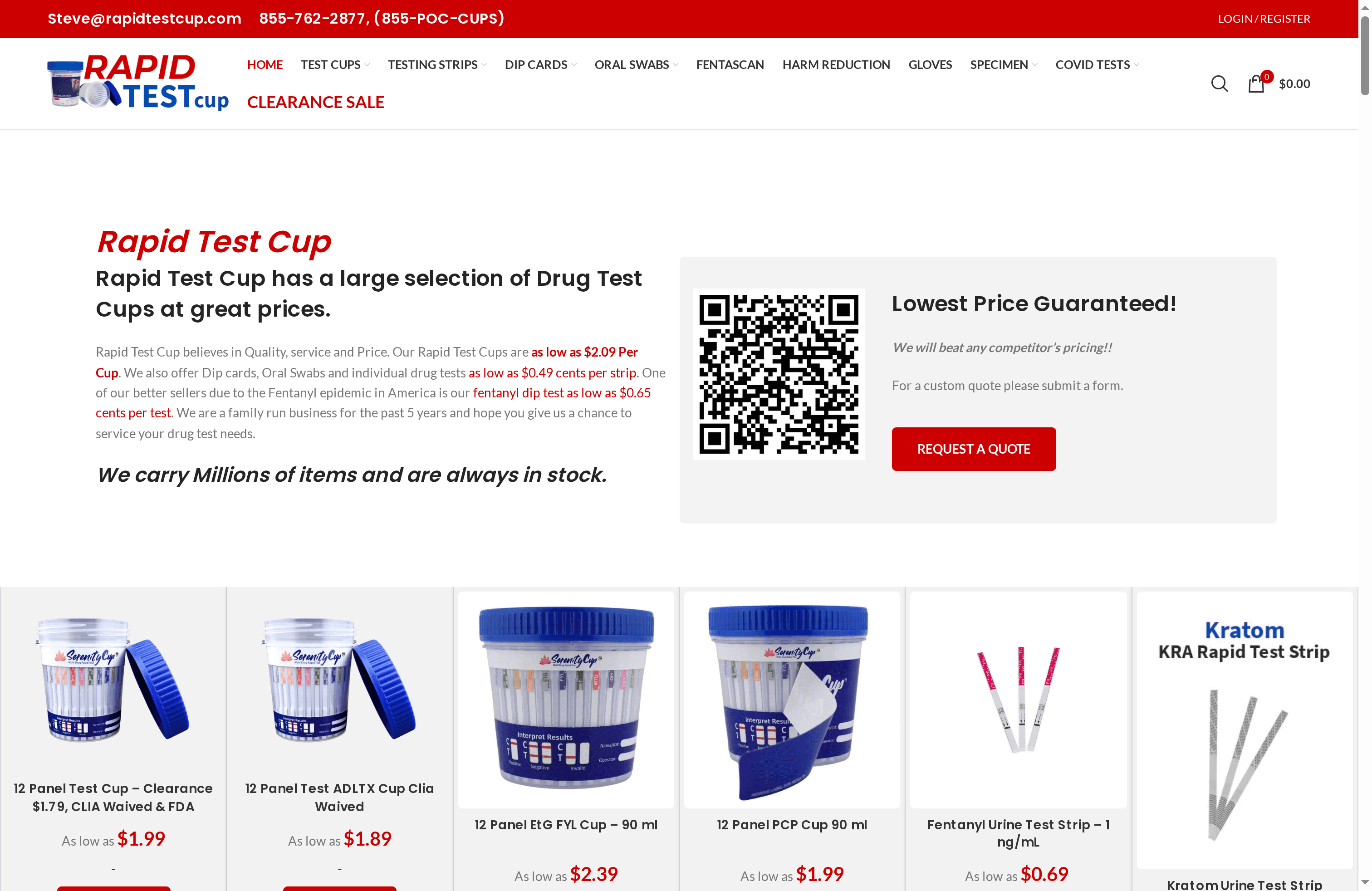
Explore our detailed urine test kit comparison to find the panel configuration that fits your testing menu. Use our drug kits guide to match product specs to your QC requirements before you buy. If you need a high-sensitivity option with adulterant detection built in, our 18-panel test cup covers the most common analytes with built-in integrity checks. Reliable accuracy starts with reliable products.
Frequently asked questions
What is the difference between method verification and method validation?
Method verification confirms FDA-cleared tests meet manufacturer specs in your lab, while method validation assesses all performance parameters for modified or lab-developed methods from the ground up.
How does proficiency testing impact drug testing accuracy?
Proficiency testing gives your lab an external check against peer performance, and SAMHSA-certified labs must participate regularly to stay compliant and maintain verified accuracy over time.
Which QC charts are effective for monitoring analytical performance?
Multirule QC charts like Westgard are the most reliable approach because they detect both acute errors and gradual trends. Using multirule charts alongside root cause analysis gives you early warning before results are compromised.
What are key benchmarks for drug test precision and bias?
Precision CV targets should match manufacturer specifications, and bias must stay within verified intervals using TEa goals defined by CLSI and CLIA standards for your analyte category.