Blog
Monitor drug compliance: benefits, best practices, impact


TL;DR:
- Medication adherence monitoring improves patient outcomes, reduces hospitalizations, and lowers healthcare costs.
- Combining objective tests, clinical observation, and prescription data creates an effective compliance program.
- Random, unannounced testing and proper sample collection techniques help prevent tampering and ensure accurate results.
Medication nonadherence affects 50 to 75% of chronic disease patients, costing the US healthcare system an estimated $100 to $300 billion every year. That number alone should reframe how you think about drug compliance monitoring. It is not a regulatory checkbox. It is a clinical and operational strategy that directly shapes patient outcomes, workplace safety, and your program’s bottom line. Whether you run a substance abuse treatment center, manage occupational health for a large employer, or oversee a pain management clinic, this guide breaks down the real-world methods, challenges, and best practices that actually move the needle.
Table of Contents
- How drug compliance impacts outcomes in healthcare and the workplace
- Common drug compliance monitoring methods: strengths and pitfalls
- Challenges: tampering, false results, and how to address them
- Best practices for maximizing drug compliance monitoring
- A smarter approach: what most guides miss about drug compliance monitoring
- Next steps: tools to streamline compliance monitoring
- Frequently asked questions
Key Takeaways
| Point | Details |
|---|---|
| Improved outcomes | Monitoring drug compliance boosts treatment results and workplace safety while reducing costs. |
| Use multimodal methods | Combining subjective with objective drug compliance checks gives the most accurate picture. |
| Counter common pitfalls | Guard against sample tampering and false results with multi-step verification and observed collections. |
| Best practices matter | Randomized, frequent testing and staff education are key to successful compliance programs. |
How drug compliance impacts outcomes in healthcare and the workplace
The ripple effects of poor drug compliance reach far beyond a single missed dose. When patients skip prescribed medications or misuse controlled substances, conditions worsen, emergency visits spike, and providers lose the data they need to make sound clinical decisions. The downstream costs are staggering, and monitoring reduces hospitalizations while lowering overall treatment costs across chronic disease populations.
For employers, the stakes are equally high. Safety-sensitive industries like transportation, construction, and manufacturing operate under strict federal oversight. The Department of Transportation’s ODAPC requires drug and alcohol testing specifically because employers who monitor for compliance see reduced accidents and lower workers’ compensation claims. This is not about distrust. It is about protecting everyone on the job site.
Here is what consistent compliance monitoring delivers across settings:
- Better patient outcomes: Providers catch diversion, underuse, and overuse before they become crises.
- Reduced liability: Documented monitoring creates a defensible record for regulators and insurers.
- Improved treatment engagement: Patients in monitored programs tend to stay in treatment longer.
- Lower costs: Fewer hospitalizations, fewer accidents, and fewer legal complications.
- Regulatory compliance: Meeting federal and state requirements protects your license and funding.
Understanding the urine drug testing impact on patient management gives providers a clearer picture of how objective data changes clinical decisions. Similarly, drug testing in rehab settings shows how monitoring supports accountability without undermining therapeutic trust.
“Compliance monitoring is not surveillance. It is a clinical tool that gives providers and program managers the data they need to intervene early, adjust treatment, and ultimately improve outcomes.”
The key insight here is that compliance monitoring works best when it is built into the care model from day one, not added as an afterthought when problems arise.
Common drug compliance monitoring methods: strengths and pitfalls
Not all monitoring methods are created equal. Understanding what each approach actually measures, and where it falls short, is essential before you build or revise your program.
Self-report is the most widely used method, accounting for 72% of adherence monitoring in clinical practice. It is easy and cheap, but patients consistently over-report adherence. Social desirability bias is real, and in high-stakes settings, self-report alone is not sufficient.
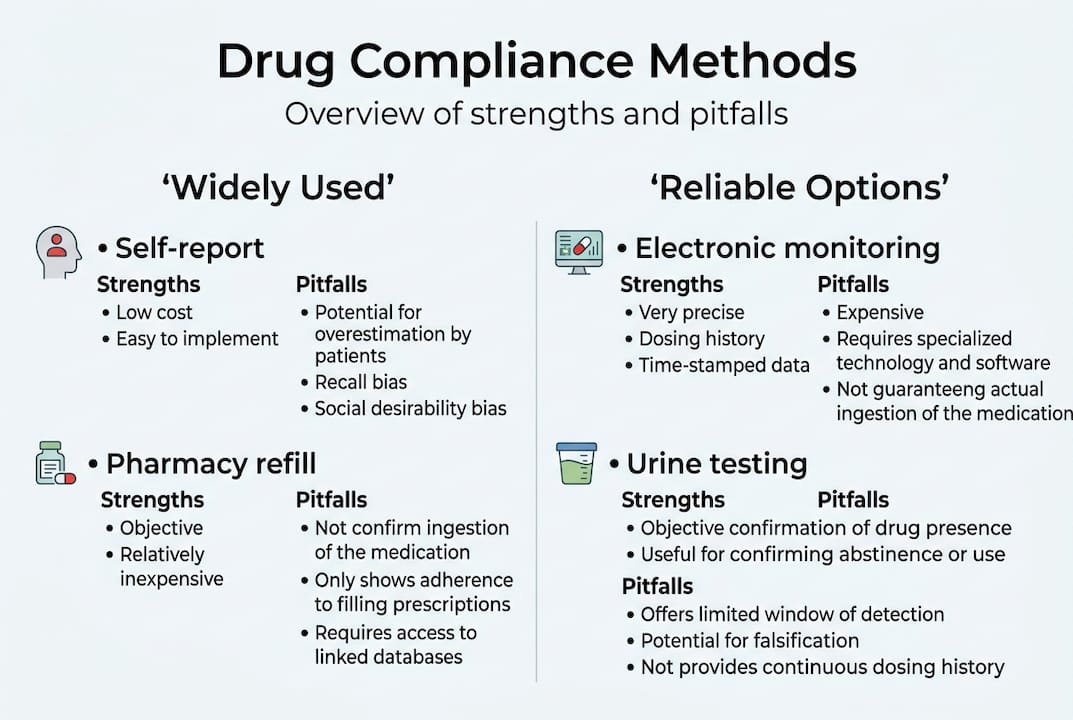
Pharmacy refill records cover about 22% of monitoring approaches. They tell you whether a prescription was picked up, but not whether the medication was actually taken or used as directed.
Electronic monitoring (EM), such as smart pill bottles that record when they are opened, is considered the gold standard but accounts for only 2.5% of real-world use. The cost and logistics explain the gap.

Urine drug testing remains the most practical objective method for most programs. It provides direct biochemical evidence of substance use or prescribed medication presence. Rapid testing matters precisely because it delivers actionable results at the point of care, not days later from a lab.
| Method | Reliability | Cost | Practical use |
|---|---|---|---|
| Self-report | Low | Very low | High |
| Pharmacy refill | Moderate | Low | Moderate |
| Electronic monitoring | High | High | Low |
| Urine drug testing | High | Low to moderate | High |
| Oral fluid testing | Moderate to high | Moderate | Growing |
The best programs do not rely on a single method. Drug monitoring boosts compliance most effectively when objective tests are layered with clinical interviews and prescription data. For a deeper breakdown of specimen types, reviewing urine vs saliva differences helps you match the test to the clinical or workplace context.
- Start with a risk assessment to determine how much objective monitoring your population requires.
- Use urine or oral fluid testing as your primary objective measure.
- Supplement with pharmacy data and clinical observation.
- Review results with a qualified clinician before taking action.
- Document everything for regulatory and legal protection.
Pro Tip: Random, unannounced testing is significantly more effective than scheduled testing. Patients and employees who know a test is coming can adjust their behavior in the short term, which defeats the purpose of monitoring.
Challenges: tampering, false results, and how to address them
Monitoring programs face real vulnerabilities. Ignoring them does not make your program more humane. It just makes it less effective.
Sample adulteration is the most common tampering method. Individuals may dilute urine with water, add bleach or other chemicals, or substitute a clean sample entirely. Urine testing is susceptible to tampering, which is why observed collection is recommended for high-risk scenarios and forensic applications.
False positives occur when a test flags a substance that is not actually present at a concerning level. Certain foods, over-the-counter medications, and supplements can trigger positive results on immunoassay screens. This is why confirmatory testing using gas chromatography-mass spectrometry (GC-MS) is the standard for any result with significant consequences.
False negatives happen when a substance is present but the test misses it, often due to dilution or a detection window mismatch.
Here is a quick reference for common tampering indicators:
| Indicator | What it suggests | Action |
|---|---|---|
| Creatinine below 2 mg/dL | Substituted sample | Reject, recollect observed |
| pH outside 4.5 to 8.5 | Chemical adulteration | Flag for MRO review |
| Temperature outside 90 to 100°F | Substitution | Immediate recollection |
| Specific gravity below 1.001 | Diluted sample | Report as dilute, retest |
A Medical Review Officer (MRO) is a licensed physician trained to interpret drug test results in context. MRO review is not optional for federally mandated programs, and it is strongly recommended for any program where results affect employment, treatment, or legal standing.
- Use adulteration test strips or built-in adulterant checks on multi-panel cups.
- Maintain chain of custody documentation for every specimen.
- Train collection staff to recognize signs of tampering before the sample leaves the collection site.
Pro Tip: Adulteration detection built into your test cup is far more cost-effective than sending every sample to a confirmatory lab. Reserve GC-MS confirmation for positive or flagged results.
For a full breakdown of program design, the drug testing compliance guide covers regulatory requirements alongside practical setup steps. Pairing that with substance abuse screening methods helps you build a layered approach that holds up under scrutiny.
Best practices for maximizing drug compliance monitoring
A well-designed monitoring program is not just about catching problems. It is about creating conditions where compliance becomes the path of least resistance.
- Match method to risk level. Low-risk outpatient patients may need quarterly urine screens. High-risk patients in pain management or early recovery may need weekly random testing. One-size-fits-all programs waste resources and miss the people who need the most attention.
- Use random testing schedules. Random or frequent testing increases deterrence and improves outcomes more than predictable schedules. Use a randomization system so neither staff nor patients can anticipate test dates.
- Integrate PDMP checks. Prescription Drug Monitoring Programs (PDMPs) are state-run databases that track controlled substance prescriptions. PDMPs help track prescriptions and prevent diversion, and checking them before prescribing or renewing controlled substances is now standard of care in most states.
- Require MRO review for consequential results. Any result that could affect employment, custody, treatment status, or legal standing needs physician review before action is taken.
- Educate everyone involved. Staff who understand why monitoring matters collect better samples and handle sensitive results more professionally. Patients and employees who understand the purpose of monitoring are more likely to cooperate honestly.
Statistic: Programs that combine random urine testing with PDMP checks and MRO review report significantly lower rates of prescription diversion and treatment dropout compared to programs using a single monitoring method.
For treatment centers specifically, drug screening in treatment centers outlines how to structure monitoring within a therapeutic framework. The substance abuse screening benefits for treatment centers go beyond detection, supporting clinical decision-making at every stage of care.
Pro Tip: Communicate your monitoring policy in plain language before someone enters your program. Transparency reduces conflict, builds trust, and actually improves adherence rates.
A smarter approach: what most guides miss about drug compliance monitoring
Most compliance guides stop at method selection. That misses the bigger picture entirely.
The real failure mode in compliance monitoring is not a bad test. It is a program that treats every result as an isolated event rather than a data point in a pattern. A single positive result might mean relapse. It might mean a lab error. It might mean a patient started a new supplement. Without context and pattern analysis, you are making high-stakes decisions on incomplete information.
We also see programs that have not updated their cannabis policies since legalization expanded. Testing detects use, not impairment, which is especially relevant for cannabis. A positive urine screen for THC tells you someone used cannabis in the past several days or weeks. It says nothing about whether they were impaired during work hours. Multimodal strategies that include oral fluid testing for recent use give you a more accurate picture.
Smart programs treat monitoring as a feedback loop. They review regular monitoring compliance boost data over time, adjust testing frequency based on individual risk, and use results to drive clinical conversations rather than just administrative actions. That is the difference between a compliance program that works and one that just exists.
Next steps: tools to streamline compliance monitoring
Ready to put compliance best practices into action? Here are solutions to make it easier.
Building a monitoring program that actually works starts with having the right tools on hand. The 12 panel drug test cup covers the most commonly monitored substances in a single, easy-to-use collection device, making it practical for both clinical and workplace settings. For programs that need adulteration detection built in, the 15 panel test with adulterants adds an extra layer of integrity to every collection. Both options are CLIA waived and FDA approved, so your results hold up under regulatory review. Browse the full range of testing kits to find the right fit for your program size, panel requirements, and budget.
Frequently asked questions
What are the main reasons to monitor drug compliance?
Drug compliance monitoring improves patient outcomes, enhances workplace safety, and reduces both medical and financial risks. Monitoring reduces nonadherence rates and the significant costs associated with untreated or undertreated conditions.
Which method is most reliable for drug compliance?
Objective methods like electronic monitoring and multi-panel urine tests offer the highest reliability, especially when combined with confirmatory analysis. Electronic monitoring is gold standard in research, but combining methods is most practical and accurate in real-world settings.
How can sample tampering be prevented?
Observed collections, multi-step confirmation, and adulteration strips minimize the risk of tampering. Sample tampering is countered most effectively through observed urine collection and built-in adulterant detection.
Does drug testing show current impairment?
Most drug tests detect prior use, not current impairment, which is especially important for cannabis policies. Urine screens indicate past use, while oral fluid testing is increasingly used for detecting more recent consumption.
What is the value of random or frequent testing?
Random or frequent testing increases deterrence and helps detect issues faster, leading to better outcomes. Random testing improves outcomes by removing the predictability that allows short-term behavioral adjustments to mask ongoing misuse.