

Blog
Why Lab Accuracy Matters for Reliable, Compliant Testing


TL;DR:
- Many labs underestimate the importance of accuracy, which is critical for regulatory compliance and trustworthy results.
- A result that appears precise may still be inaccurate, risking serious consequences in clinical, forensic, and workplace testing.
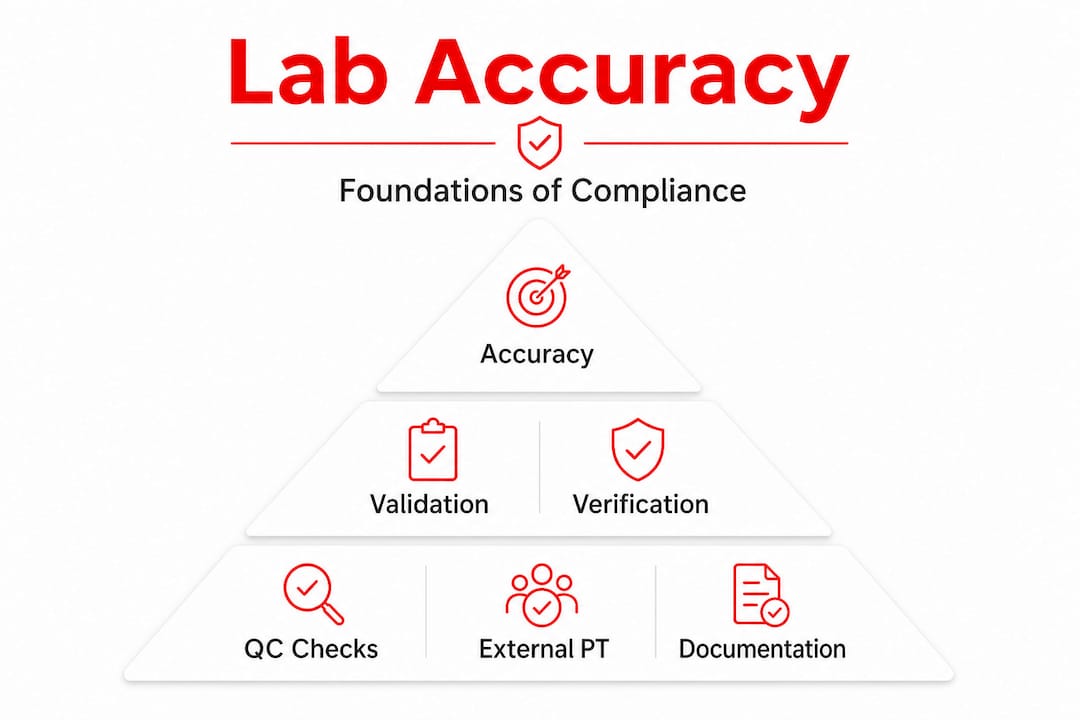
- Maintaining ongoing accuracy involves comprehensive validation, routine internal QC, external proficiency testing, and thorough documentation.
Many labs assume their routine quality checks are sufficient, but the most costly compliance failures often trace back to accuracy gaps that went unnoticed for months. A result that looks precise and consistent is not necessarily correct, and that distinction carries serious consequences in drug testing and clinical analysis. Regulatory bodies including CLIA, CMS, and HHS have all built mandatory accuracy requirements into their frameworks for good reason. This guide walks through the full system behind lab accuracy, from method validation to proficiency testing to regulatory mandates, so you can build a program that holds up under inspection and delivers trustworthy results every time.
Table of Contents
- What lab accuracy really means and why it’s non-negotiable
- End-to-end accuracy: Method validation, verification, and QC
- External benchmarking: Proficiency testing and accuracy-based programs
- Edge cases and specimen types: Practical compliance decisions
- Regulatory compliance: Accuracy requirements for federal workplace and clinical testing
- Perspective: Why the pursuit of accuracy is more than checking boxes
- How RapidTestCup supports lab accuracy and compliance
- Frequently asked questions
Key Takeaways
| Point | Details |
|---|---|
| Lab accuracy is foundational | Reliable and compliant lab results depend on maintaining true analytical accuracy, not just precision. |
| Internal and external checks are required | Successful labs use validation, QC, and proficiency testing for comprehensive accuracy assurance. |
| Accurate records protect compliance | Documenting quality controls, corrective action, and matrix studies is critical during audits and inspections. |
| External benchmarking prevents bias | Proficiency testing and gold-standard programs catch systemic errors that internal controls might miss. |
What lab accuracy really means and why it’s non-negotiable
Accuracy is one of the most frequently misused terms in laboratory quality management. Many professionals use it interchangeably with precision, but these are fundamentally different performance characteristics. Accuracy measures how close a result is to the true value of the analyte being tested. Precision measures how reproducible a result is across repeated measurements. A lab can produce highly reproducible results that are consistently wrong, and that is a dangerous situation in any clinical or forensic testing environment.
The EPA defines method accuracy as the closeness of agreement between what is measured and the actual amount present in the sample. This is the standard definition that regulators use when auditing your performance data. Meeting it requires more than running duplicate samples or comparing your results against a neighboring facility. It requires calibration against traceable reference materials and documented validation of every critical performance characteristic.
Consider what happens when accuracy fails in practice. A urine drug screen that underreports a positive result due to a matrix interference creates a false negative. In a workplace safety program or a pain management clinic, that false negative can have serious legal, ethical, and patient safety implications. In a forensic setting, it can compromise a criminal case. The clinical impact of accuracy extends far beyond the lab bench, touching every downstream decision that depends on your reported values.
Common accuracy pitfalls labs encounter include:
- Confusing peer comparison with accuracy: If your results match other labs using the same reagent lot and method, that does not confirm accuracy. It only confirms agreement.
- Relying on precision as a proxy: Tight coefficient of variation values look good on paper, but they do not reflect bias relative to the true value.
- Skipping matrix-specific validation: Assuming a method validated in plasma performs identically in whole blood or oral fluid is a documented source of false results.
- Underestimating calibration drift: Instruments that are not recalibrated on schedule can silently shift results outside acceptable limits.
“Labs must ensure analytical methods are fit for purpose via method validation and verification that explicitly includes accuracy, or bias, and other performance characteristics.” This requirement is not advisory. It is a compliance baseline that regulators expect every lab to demonstrate.
Understanding accuracy principles for labs at this foundational level is what separates labs that pass audits from labs that repeatedly scramble to explain deviation reports. The standard is not ambiguous. The challenge is implementation.
End-to-end accuracy: Method validation, verification, and QC
Accuracy is not a static achievement. It is a continuous process maintained through a system of overlapping controls. Regulators and accreditation bodies recognize this, which is why they require labs to demonstrate accuracy across the full testing cycle, not just at initial setup. Method validation and verification are the two primary tools for establishing that a method is fit for its intended purpose before routine use begins.
Validation is the comprehensive process of generating original performance data to demonstrate that a method works as claimed. Verification is a shorter, targeted process confirming that a previously validated method performs as expected in your specific lab environment. Both must include accuracy assessment, meaning you must test known reference materials and document the agreement between measured and expected values.
Here is how a robust end-to-end accuracy system is structured:
- Select reference materials: Use certified reference materials traceable to recognized standards for all accuracy assessments. Do not rely on in-house preparations unless they have been independently assigned target values.
- Run validation or verification experiments: Include multiple concentration levels, multiple days, and multiple operators to capture real-world variability.
- Define warning and control limits: Set limits before routine testing begins, based on your validation data and any regulatory thresholds.
- Implement internal quality control (IQC) routinely: Run control samples with every analytical batch. Document results systematically so trends are visible early.
- Establish corrective action protocols: Define exactly what happens when a result breaches a warning limit versus a control limit. Do not leave this to individual judgment.
- Review QC data at defined intervals: Weekly or monthly trending reviews catch cumulative drift that single-run reviews miss.
The EPA’s QC program elements directly target accuracy by requiring documented control charts, corrective action records, and periodic calibration verification. These elements map almost directly to what CLIA, HHS, and CAP expect from clinical and forensic drug testing labs.
Pro Tip: Every time a control limit is breached, write a corrective action record even if the cause seems obvious. Inspectors look for documented patterns. An undocumented corrective action is treated as if it never happened. This is the single most common documentation gap we see during audit preparation.
The goal of maintaining accuracy in your workflow is to catch problems before they affect patient or donor results, not after a proficiency testing failure reveals them. That requires treating QC as a proactive system, not a paperwork exercise. The role of QA in accuracy is to design and monitor that system so nothing falls through.

External benchmarking: Proficiency testing and accuracy-based programs
Internal QC, no matter how rigorous, cannot replace external assessment. Regulators recognize that labs can develop shared blind spots, particularly when everyone in a peer group is using the same method or reagent platform. This is exactly why proficiency testing under CLIA is a mandatory compliance mechanism, not an optional quality enhancement.
Proficiency testing (PT) involves receiving unknown samples from an approved external provider, analyzing them exactly as you would patient samples, and reporting results back for evaluation. CLIA, CMS, and in many cases CAP require labs to handle PT samples in the same manner as routine patient specimens, using the same personnel, instruments, and workflows. Running PT samples outside your normal process is itself a compliance violation.
However, not all PT programs are created equal. Standard peer-grouped PT evaluates your performance against other labs using similar methods. If a systematic error is widespread across the peer group, you might pass PT while still producing inaccurate results. CAP’s accuracy-based programs address this by using target values traceable to reference measurement procedures rather than peer-group means. This approach, sometimes called gold-standard or reference-method-based PT, catches biases that peer comparison misses entirely.
| Feature | Conventional peer-group PT | Accuracy-based PT programs |
|---|---|---|
| Target value source | Peer group mean | Reference method / certified value |
| Detects systematic bias | Only if most peers are unaffected | Yes, even if bias is widespread |
| Traceability | Limited | Full traceability to reference materials |
| Regulatory acceptance | CLIA, CMS approved | CAP, accreditation bodies |
| Best suited for | Routine compliance | Advanced quality and harmonization |
“Peer-grouped PT can create false security if many labs share the same systematic error. Accuracy-based programs using traceable target values provide a more rigorous external check.” This framing from CAP underscores why leading labs are moving toward traceability-driven quality models.
Explore best practices for accurate testing to understand how your current PT participation compares to what regulators and accreditors expect in 2026.
Edge cases and specimen types: Practical compliance decisions
One of the most frequently overlooked accuracy risks involves specimen matrix differences. A method validated in standard urine does not automatically perform with the same accuracy in dilute specimens, adulterated samples, or alternative matrices like oral fluid. Regulators and inspectors know this, and they look for evidence that labs have considered matrix effects when extending a method to new specimen types.
CLSI EP35 addresses this directly, providing decision guidance on whether a full validation or a targeted verification is required when a specimen type changes. The answer depends on how different the new matrix is from the originally validated one, and whether the analytical interferences in the new matrix could meaningfully affect result accuracy.
This is not a minor procedural question. A method that performs beautifully on standard urine samples can produce false negatives in highly alkaline specimens or false positives in samples with certain endogenous substances. Labs that skip this step because the method is “already validated” expose themselves to both patient safety failures and regulatory findings.
| Change in specimen type | Recommended action | Rationale |
|---|---|---|
| Standard urine to dilute urine | Targeted verification | Similar matrix, lower concentration effects |
| Urine to oral fluid | Full revalidation | Substantially different matrix composition |
| Standard to adulterated specimens | Targeted verification with adulteration panel | Known interference risk requires documentation |
| New lot of reference material only | QC comparison sufficient | No matrix change |
Reviewing your drug testing workflows by specimen type can help you identify where your current validation coverage may have gaps before an inspector does it for you.
Pro Tip: Document your decision logic every time you choose verification over full validation. If an inspector asks why you did not run a full validation when changing to a new specimen type, your documented rationale based on CLSI EP35 criteria is what protects you. “We did not think it was necessary” is not an acceptable answer.
Regulatory compliance: Accuracy requirements for federal workplace and clinical testing
Federal and clinical drug testing labs operate under layers of regulatory requirements that all converge on accuracy as a central performance standard. Understanding who mandates what, and what the consequences of non-compliance look like, is essential for every laboratory manager and QC specialist.
The mandatory guidelines for federal workplace drug testing require certified laboratory participation, standardized testing procedures, quarterly performance testing, and periodic on-site inspections. Labs testing federal workplace specimens must demonstrate accuracy through every one of these checkpoints. A single failed performance test cycle triggers a cascade of corrective requirements that can threaten a lab’s certification status.
Here is what a compliant regulated drug testing operation looks like on a practical level:
- Maintain current certification: Certification through HHS requires passing PT programs at defined thresholds. Falling below the acceptable score in consecutive testing events can suspend or revoke your certification.
- Conduct quarterly performance testing: HHS-regulated labs must participate in performance testing at least quarterly. Results must meet published accuracy thresholds for each analyte.
- Document method validation completely: Inspectors review original validation records. Gaps in documentation are treated as gaps in compliance, regardless of actual performance.
- Prepare for on-site inspections: Inspectors examine QC records, corrective action logs, calibration records, and personnel training documentation. Accuracy data threads through all of these.
- Manage CLIA requirements in parallel: Proficiency testing under CLIA applies additional requirements to clinical labs, including defined PT participation frequencies and consequences for unsuccessful performance.
Important statistic: Studies tracking laboratory inspection findings consistently show that documentation failures related to accuracy and QC account for a significant share of deficiency citations. In many accreditation surveys, QC and accuracy-related deficiencies rank in the top three categories of citations across all lab types.
Understanding how drug testing meets compliance requirements in 2026 means recognizing that accuracy is not one checkbox among many. It is the thread connecting certification, PT, validation, and inspection readiness into a single quality system. CLIA compliance for labs provides a useful framework for clinical facilities mapping these requirements to their specific test menus.
Perspective: Why the pursuit of accuracy is more than checking boxes
Here is something most compliance-focused articles will not tell you: labs that treat accuracy requirements as a checklist consistently underperform labs that treat accuracy as a core value. The difference shows up most clearly during change events, whether that means a new instrument, a new lot of reagents, a new specimen type, or a regulatory update.
Labs with a genuine accuracy mindset do not wait for QC failures to trigger action. They set tighter internal limits than regulations require. They invest in reference-method-based PT even when peer-group PT would satisfy the minimum requirement. They document decision logic not because an inspector might ask, but because they want to understand their own system.
The peer-grouped PT limitation that CAP highlights is a real and underappreciated risk. If most labs in your peer group are using the same platform and the same reagents, and that platform has a systematic bias, your peer-group PT score tells you nothing meaningful about accuracy. You are simply measuring how well you conform to a potentially biased consensus. Reference-method traceability is what breaks that false confidence.
The labs that stand out under inspection are not necessarily the ones with perfect QC scores. They are the ones whose staff can explain their accuracy program from first principles, whose documentation tells a coherent story, and whose corrective action records demonstrate that they catch and resolve problems internally. That kind of organizational maturity does not come from compliance training alone. It comes from treating accuracy as a daily professional standard, not an annual review event.
Benchmarking against reference methods rather than peer groups, investing in accurate practices that set labs apart, and building a culture where every technician understands the purpose of every QC step: these are the distinguishing characteristics of labs that lead rather than follow in quality performance.
How RapidTestCup supports lab accuracy and compliance
If your lab is ready to strengthen its accuracy system and compliance posture, these resources and products can help close the loop between regulatory requirements and everyday practice.
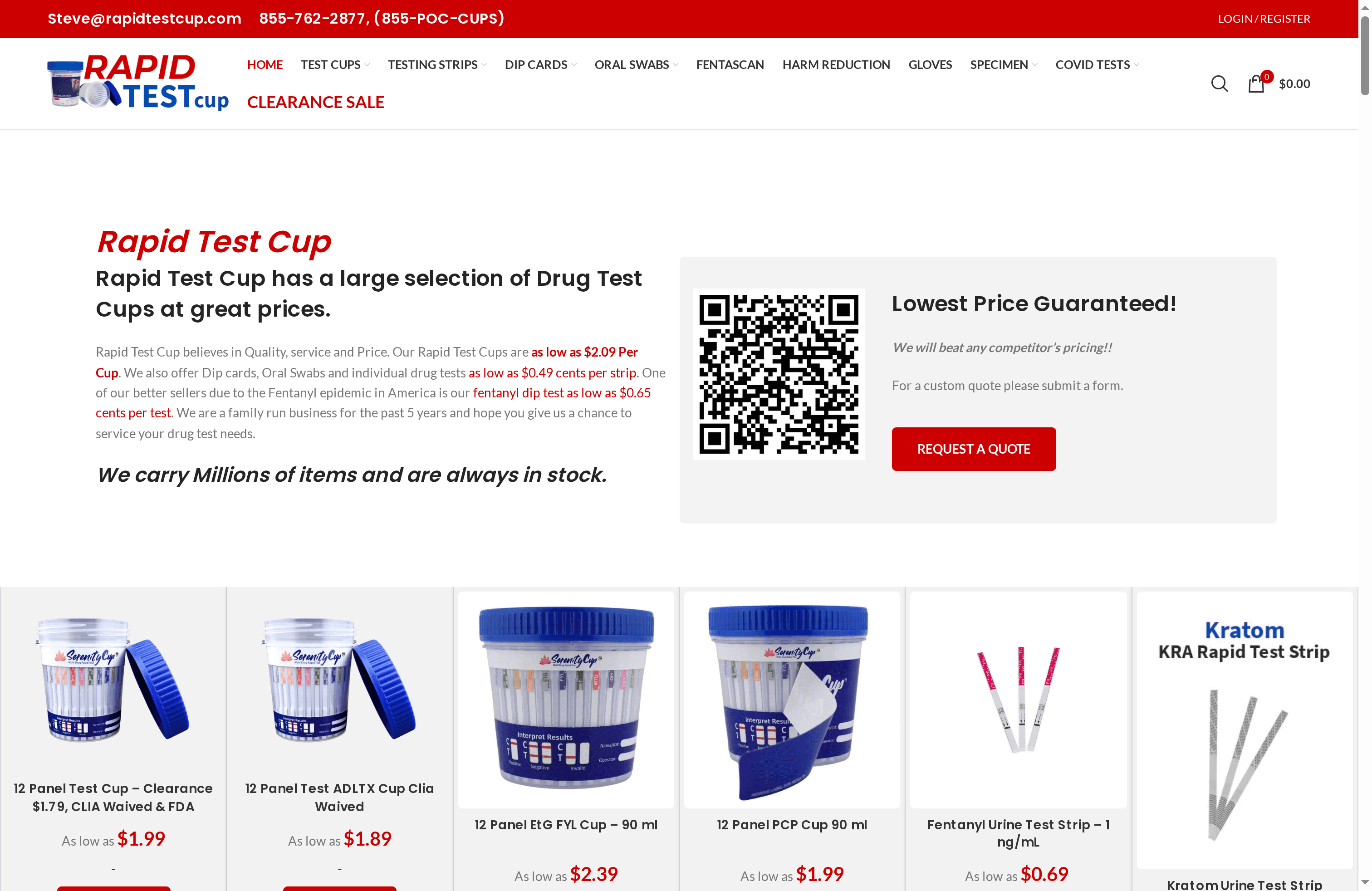
RapidTestCup offers CLIA waived, FDA-approved testing products designed to meet the accuracy and documentation standards that regulated labs require. From high-panel urine drug test cups to specimen collection supplies, every product is sourced with compliance in mind. Our 12-panel drug test solutions give labs a cost-effective, validated-format option that fits within established QC workflows. For facilities managing forensic or legally sensitive testing programs, our overview of forensic drug testing methods outlines how our product catalog supports chain-of-custody and accuracy requirements at every testing stage. Contact our team for bulk pricing, compliance checklists, or product-specific support.
Frequently asked questions
What is the difference between validation and verification in lab testing?
Validation proves a method is fit for its intended use by generating original performance data; method verification confirms that a previously validated method performs as expected within your specific lab environment, typically with a more targeted and streamlined data set.
How often should clinical labs participate in proficiency testing?
CLIA-required PT participation frequency depends on the test category, but most regulated analytes require multiple PT events per year. Labs must treat PT samples identically to patient samples and report results within defined timeframes.
Why is accuracy important in drug testing labs?
Accuracy protects patient safety, supports legally defensible workplace decisions, and satisfies the regulatory definition of fit-for-purpose testing. Inaccurate results create downstream harm regardless of how consistent or reproducible they appear internally.
What external requirements do regulated drug testing labs face?
Federal workplace drug testing labs must maintain HHS certification, participate in quarterly performance testing, undergo periodic on-site inspections, and document compliance with standardized testing procedures at every level of their quality system.