

Blog
How lab testing guides law enforcement investigations


TL;DR:
- Forensic labs support cases beyond drug identification, including DNA, toxicology, and digital evidence.
- Accuracy depends on strict quality standards, accreditation, and understanding each method’s limitations.
- Lab results should be interpreted contextually, with collaboration and questioning enhancing investigative value.
Most people assume forensic lab testing is just about confirming whether a white powder is cocaine or a pill is fentanyl. That assumption sells the science short by a wide margin. Forensic labs play a critical role in law enforcement investigations, linking physical evidence to suspects and supporting cases involving everything from homicides to financial crimes. The reality is that lab analysis shapes legal outcomes, challenges alibis, and sometimes exonerates the wrongly accused. This guide walks through the full scope of forensic lab testing, the methodologies behind it, quality standards, real limitations, and what agencies need to know to use lab results effectively.
Table of Contents
- The scope of lab testing in law enforcement
- Key methodologies: from DNA to toxicology
- Quality assurance, standards, and accreditation
- Limitations, edge cases, and interpretation challenges
- What most law enforcement guides miss about lab testing
- Connect with reliable testing solutions for your agency
- Frequently asked questions
Key Takeaways
| Point | Details |
|---|---|
| Lab testing scope | Forensic labs support law enforcement in drug, DNA, toxicology, trace, and firearms cases. |
| Reliability standards | Accreditation, proficiency tests, and SOPs underpin evidence credibility. |
| Interpretation limits | Human error, contamination, and mixture complexity can impact lab results. |
| Expert perspective | Understanding error rates and maintaining context improves investigation outcomes. |
The scope of lab testing in law enforcement
Forensic lab testing is the scientific analysis of physical evidence collected at crime scenes or from suspects, victims, and environments connected to a crime. It is not a single process. It is a collection of specialized disciplines, each requiring different instruments, expertise, and protocols. Understanding the full scope helps agencies set realistic expectations and allocate investigative resources more effectively.
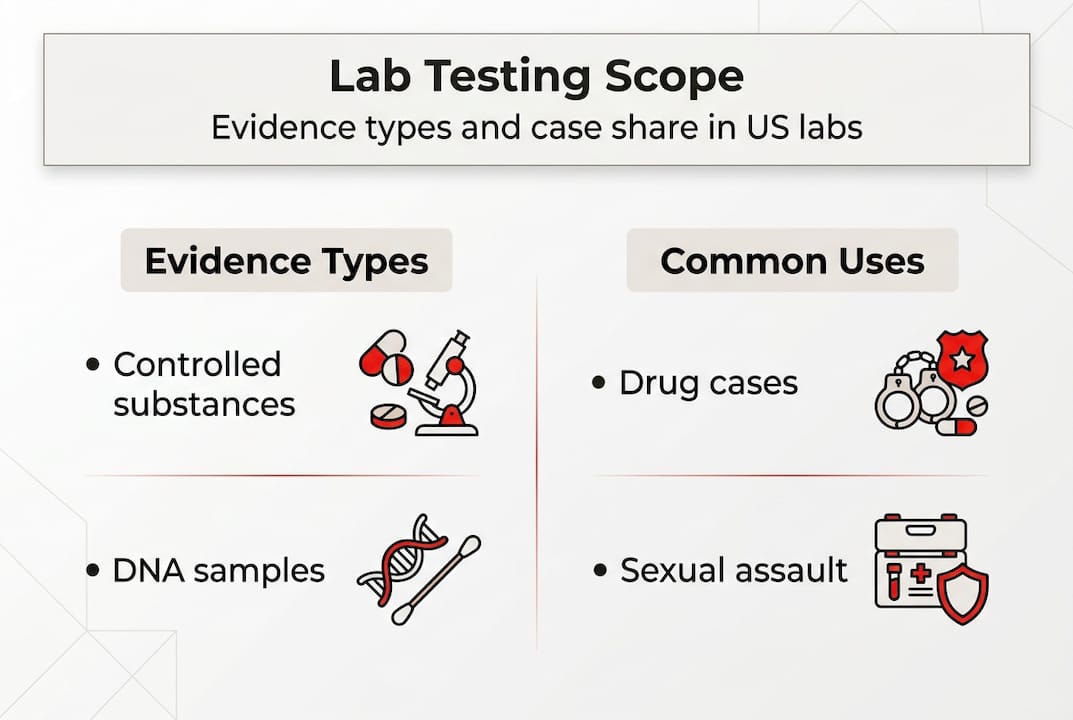
US public forensic labs received 3.3 million service requests in 2020 alone. Of those, 33% involved controlled substances, 20% involved DNA databasing, and 19% involved toxicology. Labs faced significant backlogs across nearly every category. That volume tells you something important: demand for forensic science far outpaces current lab capacity in most jurisdictions.
| Evidence type | Share of lab requests | Common case application |
|---|---|---|
| Controlled substances | 33% | Drug crimes, trafficking |
| DNA databasing | 20% | Homicides, sexual assaults |
| Toxicology | 19% | DUI, poisoning, overdose deaths |
| Trace evidence | ~10% | Arson, hit-and-run, burglary |
| Firearms/toolmarks | ~8% | Shootings, robberies |
| Other | ~10% | Mixed case types |
Forensic labs support investigations in homicides, sexual assaults, drug crimes, and arsons, making them indispensable to the criminal justice pipeline. The breadth is what surprises most people outside the field.
Here is what forensic labs actually contribute to criminal cases:
- Identifying controlled substances for charging and prosecution
- Matching DNA profiles to suspects or eliminating them from consideration
- Establishing cause and manner of death through toxicology screening
- Connecting physical materials like fibers, glass, or paint to a scene or suspect
- Analyzing firearms for ballistic comparisons and serial number restoration
- Processing digital and biological evidence together to build timelines
The role of rapid testing in forensic work has grown significantly, especially for field triage before evidence reaches the lab. Understanding where field screening ends and confirmatory lab analysis begins is a critical distinction for every officer and investigator.
The forensic drug testing importance conversation has shifted from “is this a drug?” to “what is the exact compound, concentration, and origin?” That shift reflects how much more courts and prosecutors now demand from the science.
Key methodologies: from DNA to toxicology
Forensic analysis is not one-size-fits-all. The method used depends entirely on the evidence type, the questions being asked, and the case context. Getting the wrong method applied to the wrong sample wastes time and can compromise results.
Key methodologies include serology, PCR-based DNA analysis, trace evidence techniques like GC-MS and FTIR, toxicology, firearms examination, impression analysis, and capillary electrophoresis. Each serves a distinct investigative purpose.
| Method | Best for | Turnaround | Court strength |
|---|---|---|---|
| PCR DNA analysis | Biological samples | Days to weeks | Very high |
| Toxicology (GC-MS) | Drugs, poisons in fluids | Days | High |
| Trace (FTIR) | Fibers, paint, glass | Days | Moderate to high |
| Presumptive field kits | Initial drug ID | Minutes | Low (screening only) |
| Capillary electrophoresis | DNA mixture separation | Days | High |
Here is a simplified process for how evidence moves through a forensic lab:
- Evidence is received, logged, and assigned a unique case number
- An examiner reviews the request and selects the appropriate analytical method
- The sample is prepared under controlled conditions to prevent contamination
- Instrumentation runs the analysis and generates raw data
- A qualified examiner interprets the data and writes a formal report
- A second examiner reviews the report for technical accuracy
- The final report is released to the requesting agency
Pro Tip: Matching the right forensic drug test methods to your sample type from the start prevents costly re-submissions and delays. A urine sample and a blood sample require completely different analytical approaches, even if you are testing for the same substance.
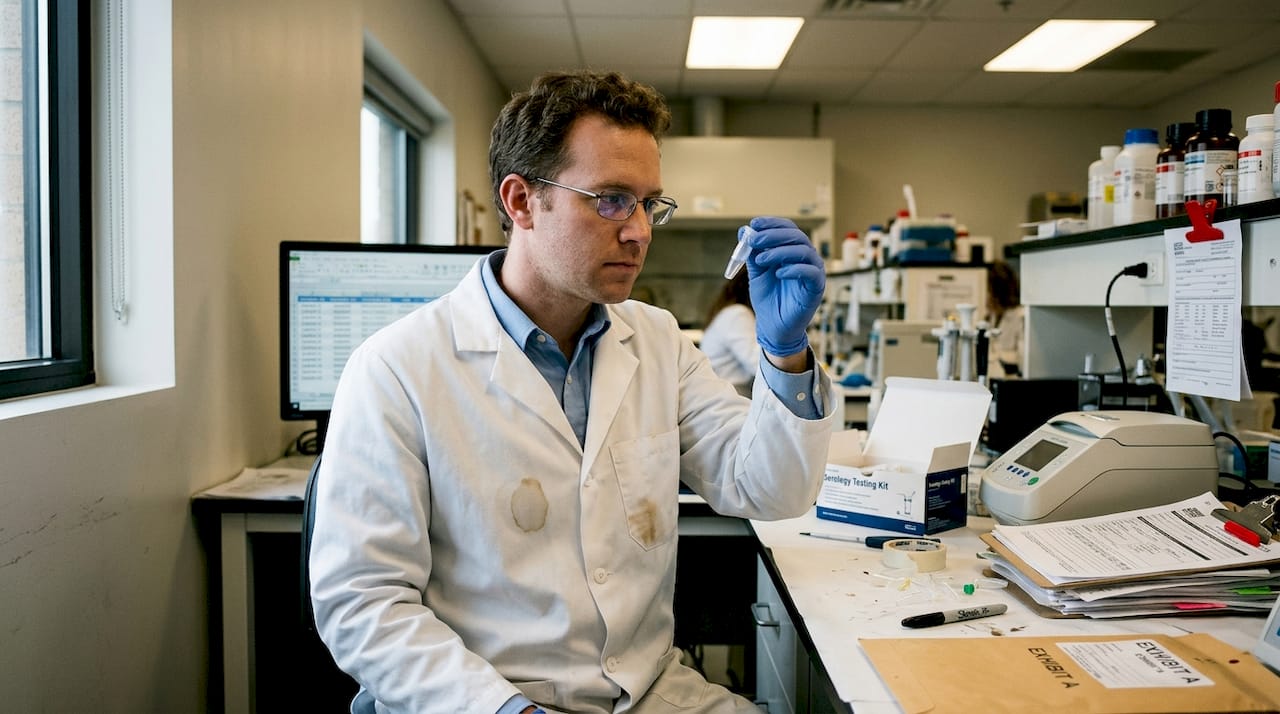
Application matters too. In a sexual assault case, serology identifies biological fluids first, then PCR DNA links those fluids to a contributor. In an arson investigation, GC-MS detects accelerant residue in debris samples. Following the forensic drug testing steps correctly from scene to lab is what makes or breaks admissibility. An NIST interlaboratory study highlights how inter-lab consistency in methodology directly affects the reliability of statistical conclusions drawn from forensic evidence.
Quality assurance, standards, and accreditation
A lab result is only as credible as the system that produced it. Accreditation is the formal process by which an independent body verifies that a lab meets established scientific and operational standards. For law enforcement, this matters enormously because defense attorneys will challenge any result produced outside a credentialed environment.
90% of public forensic labs are accredited and follow proficiency testing, standard operating procedures, and laboratory information management systems. NIST guidelines specifically address cognitive bias as a systemic risk in forensic interpretation. That is not a small detail. Bias can affect conclusions even when the chemistry is correct.
Key quality assurance components include:
- Accreditation bodies: ASCLD and A2LA are the primary accreditors for US forensic labs
- Standard operating procedures (SOPs): Written protocols for every test type that examiners must follow exactly
- Proficiency testing: Regular blind tests where examiners analyze known samples to verify competency
- LIMS software: Tracks chain of custody, test assignments, and report generation digitally
- Technical and administrative review: Every report is checked by a second qualified examiner before release
“NIST recommends that forensic labs implement measures to reduce contextual bias, including limiting examiners’ exposure to irrelevant case information before analysis is complete.” This is known as linear sequential unmasking, and it is gaining traction in high-stakes casework.
Common error types that quality assurance in forensic labs is designed to prevent include false positives from cross-reactive reagents, false negatives from degraded samples, and cognitive bias where an examiner’s expectations influence their interpretation. Blind proficiency testing and NIST forensic chemistry standards are the primary defenses against these failure modes. Agencies should ask labs directly about their proficiency pass rates and error documentation practices before relying on their results in high-profile cases.
Limitations, edge cases, and interpretation challenges
No forensic method is infallible. Understanding where the science has limits is not a weakness in your case strategy. It is a strength. Agencies that go into court without knowing the limitations of their evidence get blindsided by competent defense counsel.
The main challenges in forensic lab interpretation include:
- Contamination: Cross-contact during collection, packaging, or lab handling can introduce foreign DNA or substances
- Mixture interpretation: DNA from multiple contributors is notoriously difficult to separate and attribute accurately
- Transfer evidence: DNA or trace materials can move from person to person without direct contact, a concept called secondary or tertiary transfer
- Degraded samples: Heat, moisture, and time break down biological material, reducing the reliability of results
- Misleading statistics: Probability figures like match statistics can be presented in ways that overstate certainty
Edge cases encompass contamination risks, mixture interpretation, direct and indirect DNA transfer, degraded samples, and misleading evidence percentages, all of which require careful contextual analysis rather than face-value acceptance.
A latent print study found a 62.6% identification rate for mated pairs, a 4.2% false exclusion rate, and less than 0.2% false identification. Those numbers sound strong until you consider the volume of prints processed annually. Even a fraction of a percent translates to real cases with real consequences.
Pro Tip: Meticulous chain of custody documentation is your first line of defense against contamination challenges in court. Every transfer, every handler, and every storage condition should be recorded in writing, not just memory. Following drug screening best practices from the moment of collection protects the integrity of every subsequent lab result.
An NIJ interlaboratory study reinforces that statistical interpretation of forensic results varies significantly between labs, which is a critical consideration when comparing findings across jurisdictions. Context always matters. A positive result means something different when the sample was collected 72 hours post-incident versus immediately at the scene.
What most law enforcement guides miss about lab testing
Most guides treat lab results as the finish line. They are not. They are a starting point for interpretation. The real skill is understanding what a result means in context, and more importantly, what it does not prove.
The myth that forensic science delivers black-and-white answers is dangerous. Bayesian networks and activity-level propositions are increasingly recognized as necessary tools for nuanced lab interpretation, and there is an active debate among experts about error rate reporting gaps in current practice. That debate should inform how agencies present evidence, not just how labs produce it.
The agencies that get the most value from forensic labs are the ones that treat lab analysts as partners, not service providers. They ask questions. They push back on ambiguous language in reports. They bring in quality-driven lab results as one layer of a multi-source evidence strategy, not as a standalone verdict. Questioning a result is not adversarial. It is exactly what rigorous investigation looks like.
Connect with reliable testing solutions for your agency
Now that you understand what to look for in lab partnerships and where field testing fits into the broader forensic picture, the next step is making sure your agency has the right tools for initial evidence triage.
At rapidtestcup.com, we supply law enforcement agencies with CLIA waived, FDA-approved field testing kits designed for professional forensic use. Whether you need a top urine drug test kits comparison to find the right panel for your case types, a full selecting drug test kits guide for your procurement team, or want to understand the rapid testing benefits for your field investigators, we have the resources and products to support every stage of your evidence workflow.
Frequently asked questions
What evidence types do forensic labs analyze for law enforcement?
Labs analyze DNA, controlled substances, trace evidence, toxicology samples, firearms, toolmarks, and impressions, all of which are critical for criminal casework across a wide range of offense types.
How do labs ensure evidence testing is reliable?
Labs use accreditation, proficiency testing, standard operating procedures, and LIMS software to minimize errors; 90% of labs are accredited and follow structured quality assurance programs.
What are the main challenges in interpreting lab results?
Contamination, mixed samples, transfer risk, and human interpretation errors are the primary challenges, and each requires contextual analysis rather than a simple pass or fail reading of the data.
Why does law enforcement still need field test kits if labs do most analyses?
Field test kits deliver immediate, actionable results during initial investigations before lab confirmation is available, helping investigators make faster decisions and prioritize which evidence gets submitted for full analysis first.